



Busy Teachers: 10 Ten Frame Activities Ready in Five Minutes
Yes, ten frame activities are one of the fastest, lowest-prep ways to build early number sense, and you don’t need a curriculum overhaul to start today. Below you’ll find ten classroom-ready games, DIY frame ideas using materials you already own, and links to trusted digital tools like the NCTM interactive and NRICH games so you can mix screen time with hands-on practice.
TL;DR:
- Children develop subitizing and mental math skills through low-prep, visual ten frame activities that require only simple materials like counters and printable mats.
- Digital tools like the NCTM interactive and NRICH games supplement hands-on practice but should not replace physical movement and manipulation for effective learning.
- Teachers should focus on modeling thinking aloud and slow pacing to ensure automatic recognition of single-digit numbers before advancing to double-digit concepts.
- Using natural, tactile materials such as egg cartons, cookie sheets, or outdoor chalk grids enhances engagement and long-term understanding of number relationships.
- Consistent, brief routines that combine flash, matching, and small-group games are more effective than extended lessons for building early number sense.
Table of Contents
- Why Ten Frame Activities Work So Well
- 10 Ready-to-Run Ten Frame Activities
- Materials and DIY Ten Frame Ideas
- How to Introduce and Assess Ten Frame Work
- Digital Tools That Pair Well With Physical Frames
- Who Built This List and Why It Works
- A Five-Minute Warm-Up That Actually Sticks
- Where Best Kids Toys Fits Into Your Ten Frame Routine
- A Practitioner’s Take on What Actually Moves the Needle
- Sources
- FAQ
Why Ten Frame Activities Work So Well
A ten frame is simply a 2x5 grid, and that grid does something powerful: it gives children a visual anchor for what “ten” actually looks like. Once kids can glance at a frame and instantly know it shows seven without counting one by one, they’ve developed subitizing, which is the foundation for fast, confident math later on.
Ten frame activities for kindergarten and early first grade build several skills at once:
- Number bonds to 10 (seeing that 6 and 4 make a full frame)
- Visualizing complements and missing parts
- A concrete bridge to addition and subtraction
- Faster mental math because the “5 and 5” structure becomes automatic
These activities fit naturally into warm-ups, math centers, and small-group formative checks, which is exactly why they show up in so many strong classroom routines.
10 Ready-to-Run Ten Frame Activities
These are the same low-prep games that show up again and again across teacher resource sites, and for good reason: they require almost no setup and work whether you have five minutes or twenty.
-
Ten Frame Flash. Objective: build subitizing speed. Materials: one ten frame card and counters, or a printed flash set. Flash a filled frame for two seconds and ask, “How many, and how do you know?” Works for whole class or partners; extend by flashing two frames at once for teen numbers.
-
Ten Frame War. Objective: compare quantities. Materials: a deck of ten frame cards, split between two players. Each partner flips a card, and the higher number wins the round. Great for partner practice; extend to addition war by summing both cards.
-
Count and Match. Objective: connect numerals to quantities. Materials: number cards 0 to 10 and filled ten frame cards. Students match each numeral to its frame. This works well as an independent center or a quick small-group check.
-
Roll and Match. Objective: reinforce number recognition. Materials: a die and blank ten frames. Roll, then fill the frame with that many counters. Simple enough for independent practice, and you can swap in a second die for sums past ten.
-
Make Ten (Number Bonds). Objective: internalize combinations to 10. Materials: two-color counters and a blank frame. Fill the frame and ask what combination of two colors makes the total. This is the single best small-group activity for building the “5 and 5” mental model.
-
One More, One Less. Objective: strengthen number relationships. Materials: filled ten frame cards. Show a frame, then ask students to show one more or one less. Perfect for a quick warm-up; extend by asking for two more or two less.
-
Ten Frame Memory. Objective: build recognition fluency. Materials: matching pairs of numeral and frame cards. Play a standard memory match game in partners or small groups.
-
Sensory or Outdoor Ten Frames. Objective: add tactile engagement. Materials: chalk-drawn grids, stones, leaves, or acorns. Outdoor and sensory variations often hold attention longer than plastic counters, especially for kids who need movement built into practice.
-
Ten Frame Bingo. Objective: reinforce number sense under light pressure. Materials: bingo boards with frame images, calling cards. Call a number, students cover the matching frame. Works well as a whole-class review.
-
Number Stories. Objective: connect ten frames to real math problems. Materials: a frame and counters. Tell a simple story (“3 birds flew away”) and have students adjust the frame to match. Suitable for small groups or one-on-one support.
Pro Tip: Keep a set of blank laminated ten frames in your math bin year-round. Half these activities need nothing but that mat, a handful of counters, and a partner.
Materials and DIY Ten Frame Ideas
You don’t need to buy a kit to get started, though having durable counters on hand makes daily use easier. Some of the best frames are things you’d otherwise recycle.
- Egg cartons with two end cups removed make an instant 2x5 grid.
- Popsicle sticks glued into a frame shape create a reusable, sturdy mat.
- Cookie sheets with magnetic counters work well for whole-class demos.
- Chalk outlines on pavement turn a ten frame into an outdoor, whole-body activity.
- For counters, stones, dried beans, buttons, or painted rocks all work, and natural, hands-on materials tend to hold young children’s attention longer than store-bought chips.
Free printable ten frame mats are widely available online, or you can draw a quick 2x5 grid on a sheet of card stock and laminate it in under a minute.
How to Introduce and Assess Ten Frame Work
Start by modeling your own thinking out loud. Fill a frame, count it, and narrate: “I see five on top and three on the bottom, so I know that’s eight without counting each one.” That narration teaches the strategy, not just the answer.
Useful prompts to ask while kids work:
- “How do you know that’s the number, without counting one by one?”
- “Show me one more. Now show me one less.”
- “What two colors could you use to make that same total?”
Differentiate by pairing struggling students with a number line or physical counters alongside the frame, and stretch advanced students with a second, aligned ten frame to model teen numbers as “10 and some more.” For quick formative checks, try an exit slip with a blank frame to fill, a thumbs-up signal for a flashed number, or a fast partner report where one student builds a quantity and the other names it and explains their reasoning.
Pro Tip: If half your class hesitates before answering a flash prompt, slow down and stay on single-digit frames another week before adding a second frame for teen numbers.
Digital Tools That Pair Well With Physical Frames
Screens shouldn’t replace counters, but the right interactive can sharpen what tactile practice started. The NCTM Ten Frame interactive offers several modes for counting and modeling numbers, and it works well as a whole-class demo or an independent practice station. NRICH’s ten-frame games lean more toward problem-solving, with small-group rules and prompts that push kids to explain their reasoning, not just find an answer.
- Use a digital demo to introduce a concept, then move immediately to physical counters for practice.
- Save interactives for independent centers once a skill is already familiar.
Who Built This List and Why It Works
This guide was put together by Danica Hodge, drawing on classroom-tested activity patterns that consistently show up across teacher resources. This guide leans on physical counters and low-prep materials rather than worksheets to encourage hands-on practice. Early math sticks best when hands are involved, not just eyes.
A Five-Minute Warm-Up That Actually Sticks
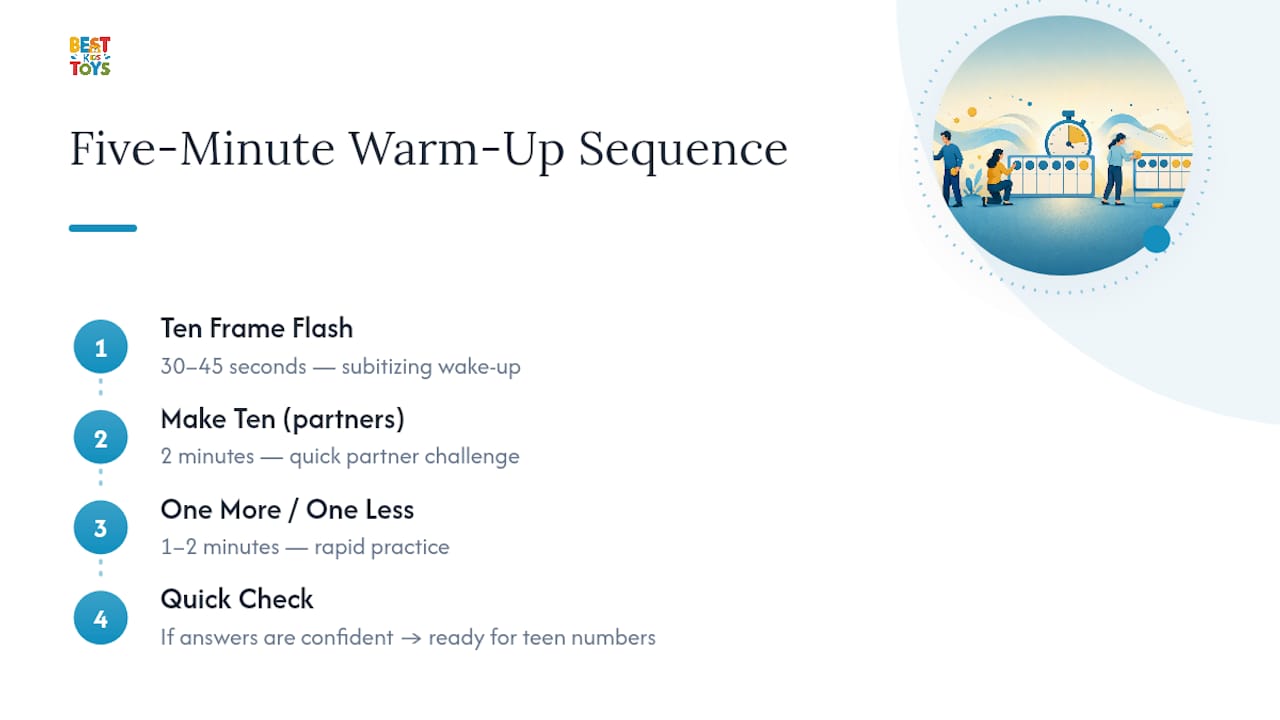
Try this sequence tomorrow: Ten Frame Flash for 30 to 45 seconds to wake up subitizing, then a two-minute Make Ten challenge in partners, then one to two minutes of One More/One Less. If most students answer without hesitation, they’re ready for teen numbers.
Where Best Kids Toys Fits Into Your Ten Frame Routine
Every activity above works better with counters that feel good in small hands and hold up to daily use, which is exactly what to look for when you’re choosing manipulatives: real weight, a safe size for little fingers, and enough sensory variety to keep attention on the math instead of the material. Best Kids Toys curates Montessori STEM Toys built for exactly this kind of tactile, screen-free practice, reviewed for developmental value rather than just novelty.
If you’d rather skip the egg cartons and popsicle sticks, our wooden counting toys give you durable, ready-to-use counters that pair with any ten frame mat, and the magnetic fish and worm counting set works especially well for small-group Make Ten practice. Every order over $60 ships free, and purchases are backed by a 30-day risk-free guarantee, so you can try a set of counters in your classroom or living room with no real risk. Browse the full toy collection and pick a set that matches how your kids actually play.
A Practitioner’s Take on What Actually Moves the Needle
Most guides to teaching tens and ones treat ten frames like a worksheet topic, something you print, fill in, and file away. That misses the point entirely. The frame is only useful while a child is physically moving counters, because the moving is what builds the mental image they’ll rely on later when the frame disappears.
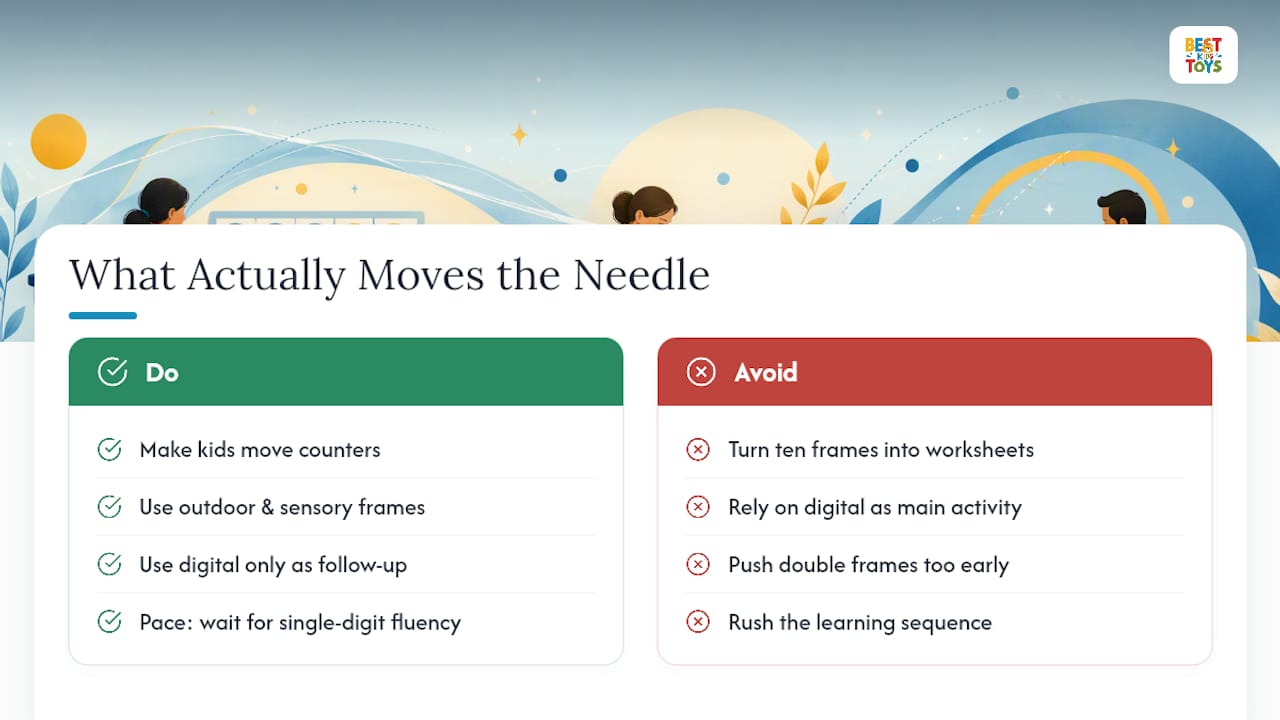
Here’s what surprises a lot of new teachers: the outdoor and sensory versions aren’t a nice add-on for restless kids. They’re often the fastest route to real subitizing, because a child arranging acorns in a chalk grid is doing more active number work than one clicking through a screen. Digital interactives like NCTM’s and NRICH’s earn their place, but only as a second layer on top of physical practice, never as the main event.
The other overlooked piece is pacing. Teachers often push toward teen numbers and double frames before single-digit recognition is automatic. If a child still counts one by one to confirm six, a second frame just adds confusion. Number sense doesn’t build in a straight line, and rushing the sequence is the most common reason ten frame practice stalls out instead of sticking.
— Danica Hodge
Sources
- Ten Frame
- Ten-Frames Games - NRICH - Millennium Mathematics Project
- 10 Frame Activities and Lesson Ideas - WeAreTeachers
- Ten Frames Activities - 20 Ways To Make Or Use Them - Early Impact Learning
FAQ
What are some activities to teach tens and ones?
Pair a filled ten frame with a second, aligned frame so students can see “10 and some more” concretely before moving to base-ten blocks. Ten Frame Flash and Make Ten also reinforce the tens-and-ones structure, since a full frame is always exactly ten.
How do you teach with ten frames?
Start by modeling your own thinking aloud as you fill a frame, then move to guided practice with prompts like “How do you know?” and “Show me one more.” Use short daily routines, such as a warm-up flash followed by a quick partner game, rather than long isolated lessons.
What does the ten frame activity help learners do?
Ten frame activities help children subitize, meaning they recognize a quantity instantly without counting one by one, and they build number bonds to ten that support later addition and subtraction. This visual structure becomes the mental model kids fall back on for mental math.
What are some activities to practice counting by 10s?
Two aligned ten frames let students count “ten, then some more” as they fill the second frame, which naturally leads into skip counting by tens once several frames are lined up. Roll and Match, extended with a second die, also reinforces counting patterns past ten.
Where can I buy ten frame counters for my classroom or home?
Best Kids Toys offers durable, Montessori-inspired counting toys, including wooden counters and manipulative sets suited to daily ten frame practice. Current prices and available bundles are listed on the site, with free shipping on orders over $60.