



One Pouring Tray to Start: Practical Life Materials List for Parents
This practical life materials list gives you a prioritized starter checklist and a set of materials organized by Montessori’s five core areas, so you can set up meaningful, independence-building activities at home this week. You will find what to buy first, what to make yourself, and how to match materials to your child’s age.
TL;DR:
- Using small, well-chosen items like trays, pitchers, and bowls helps toddlers focus and develop wrist control through simple pouring and transferring activities.
- Key materials should match the child’s size and reach, with an emphasis on safety, durability, and the ability to be stored as complete activity sets for independence.
- Presenting one or two activities at a time with slow demonstrations encourages sustained attention and mastery rather than overwhelming the child with choices.
- Storing materials on low open shelves and rotating activities every few weeks fosters independence, proper coordination, and task completion.
- Starting with a basic pouring activity on a tray is the most effective way to introduce practical life exercises before expanding to additional materials.
Table of Contents
- The Practical Life Materials List You Need First
- Materials by the Five Practical Life Areas
- How to Choose, Adapt, and Source Materials
- What to Offer at Each Age
- Setting Up a Station Your Child Can Actually Use
- What Classroom Practice Gets Right
- A Small Tray, a Big Shift
- A Curated Starter Set Without the Guesswork
- Sources
The Practical Life Materials List You Need First
You do not need a shopping cart full of gear to start. A handful of well-chosen items covers most early activities, and every one of them shows up on the starter materials lists Montessori parents and teachers rely on most.
Here is what to grab before anything else:
- A small tray to define the workspace
- A small pitcher (1 cup capacity) for pouring
- Two small bowls or cups for transferring
- A child-sized broom and dustpan
- A sponge and a small towel
- A sturdy step stool
- A small apron
- A child-safe spreading knife
Each item earns its spot. The tray creates a boundary that says “this is your work,” which helps a toddler focus instead of wandering. The pitcher and bowls teach pouring and transferring, two motions that build the wrist control needed for writing later. The broom and dustpan hand your child real responsibility for a real mess, and the step stool means she can reach the sink without you lifting her onto the counter every time.
You likely own half this list already. Check your kitchen drawers, then a dollar store, before you buy anything specialized. Thrift stores are also surprisingly good for miniature pitchers and bowls, since vintage creamers and juice glasses are often exactly toddler-sized.
Pro Tip: Buy glass or ceramic over plastic wherever safety allows. Breakable materials teach carefulness in a way indestructible plastic never will, and the natural weight helps small hands learn to grip and balance.
Materials by the Five Practical Life Areas
Montessori Practical Life breaks into five core areas: Care of Self, Care of the Environment, Food Preparation, Control of Movement, and Grace and Courtesy. Organizing your materials by area, rather than buying at random, makes it obvious what activity comes next.
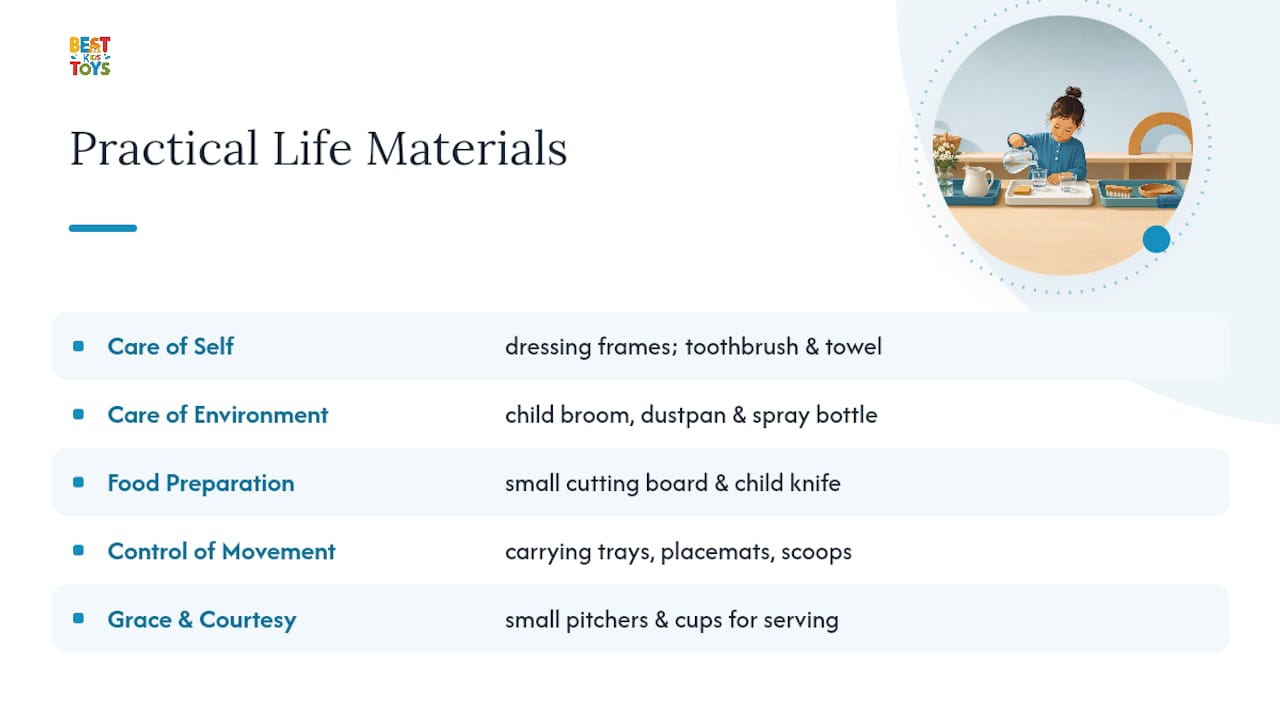
Care of Self covers dressing, grooming, and hygiene. Look for dressing frames with buttons, zippers, snaps, and laces, plus a low toothbrush and cup, a small hand towel, and hooks or a drawer set at your child’s height so clothes stay within reach.
Care of the Environment covers cleaning and tidying the shared space. A child-sized broom, dustpan, spray bottle, polishing cloths, small bucket, and dusting brush let your child participate in real household upkeep instead of watching from the sidelines.
Food Preparation covers kitchen work. A small cutting board, a child-safe knife, a hand juicer, a mixing bowl, a ladle, and a few egg cups turn snack time into a skill-building session rather than a supervised handoff.
Control of Movement is less about a single task and more about refining coordination. Trays for carrying, placemats, rolling pins, scoops, and funnels all train balance and precision, and they double as tools for the other four areas.
Grace and Courtesy rounds out the set with small pitchers and cups for serving others, placemats for setting a place, and simple play tableware for practicing table manners. These materials support the social skills Montessori classrooms treat as seriously as any academic lesson, including greetings, waiting turns, and offering help.
How to Choose, Adapt, and Source Materials
Fit matters more than brand. A pitcher that is too heavy for small hands defeats the purpose no matter how well made it is, so check weight and grip size before checking price. Look for finishes that hold up to water and drops, since these items get used daily and dropped often.
Not every item needs to be purpose-built. A small juice glass works fine for pouring practice instead of a specialty pitcher, and a cut-down kitchen sponge does the same job as a dedicated cleaning set. Save your budget for the pieces where quality genuinely matters, like sturdy trays that will not warp, pouring sets sized correctly for small hands, and dressing frames built to survive repeated buckling and unbuckling.
- Match size to your child’s hands and reach, not the package photo
- Swap in household items when the developmental goal stays the same
- Invest in trays, pouring sets, and dressing frames, since these see the heaviest use
- Label shelves or bins with a picture or word so materials return to the same spot
Pro Tip: Store each activity as a complete set on its own small tray. When the pitcher, cloth, and bowl live together, your child can carry the whole activity to a table without needing you to gather pieces.
What to Offer at Each Age
Readiness matters more than age in years, but these ranges give you a reasonable starting point.
- Toddlers (18 months to 2.5 years): Start with pouring, simple transferring, basic dressing tasks like pulling on socks, and hand washing at a low sink.
- Preschool (2.5 to 4.5 years): Add more complex food prep, dressing frames with fasteners, sweeping, and polishing.
- Early elementary (5 and up): Move into multi-step food prep, plant and animal care, and full table service for the family.
Present one or two activities at a time rather than laying out everything you own. A curated, rotating selection keeps a child’s attention on the task instead of fragmenting it across too many choices.
Setting Up a Station Your Child Can Actually Use
Define each work area with a tray or mat, and keep every material at a height your child can reach without asking for help. That single change does more for independence than any individual toy or tool.
Keep the shelf small, ideally two to four activities at once, and rotate the selection every week or two so materials stay fresh instead of ignored. When you present something new, demonstrate it slowly, invite your child to try, then step back and observe rather than correcting each move.
- Store materials on a low, open shelf, not in a closed bin
- Rotate activities on a schedule instead of leaving the same four out for months
- Model each new task in silence before inviting your child to repeat it
- Reset the tray together at the end, since tidy up is part of the activity
A curated small set with a predictable rotation helps children complete tasks fully instead of abandoning them halfway, because repetition with familiar materials is what actually builds coordination over time. If your storage setup needs a rework before any of this can happen, a practical storage guide can help you get shelves to the right height first.
What Classroom Practice Gets Right
Montessori classrooms aim for independence, concentration, and coordination, not just a finished task. That means a slow, exact demonstration matters more than any gadget on the shelf, according to guidance from the American Montessori Society. Start with plain household items and careful modeling before you buy anything specialized. If you want a head start on age-appropriate picks, this toddler toy guide is a useful companion piece.
A Small Tray, a Big Shift
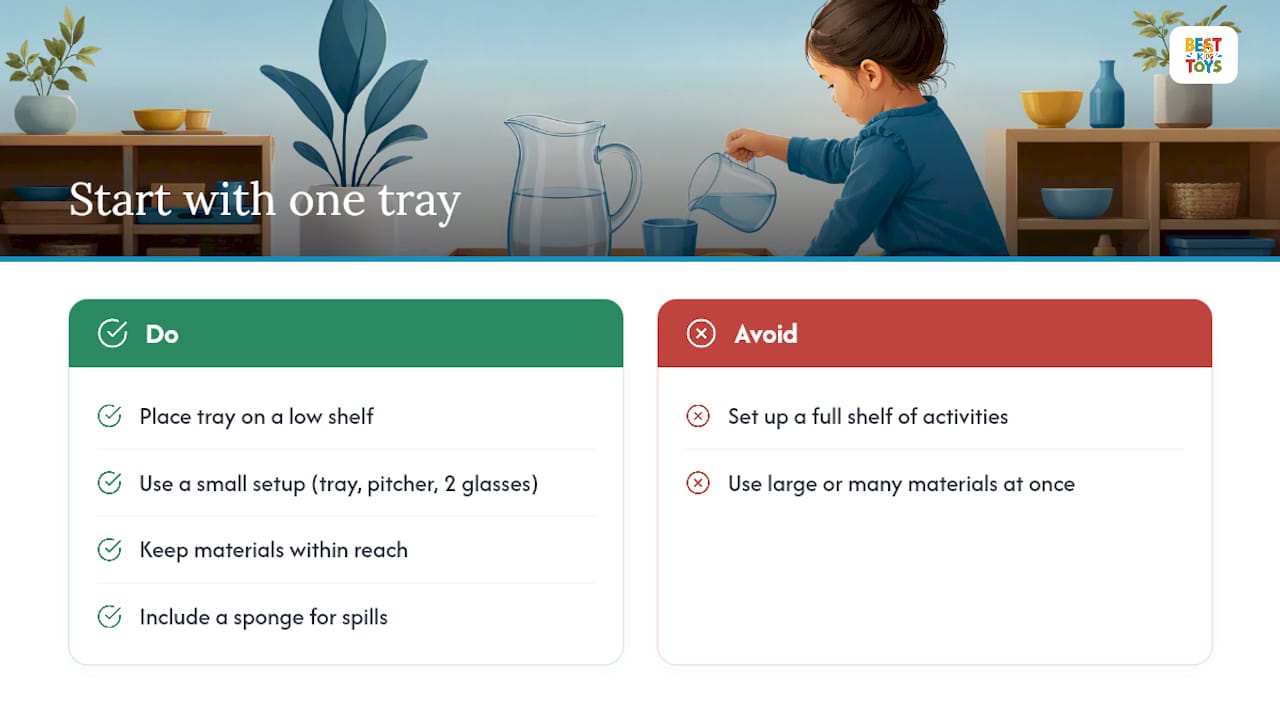
The first activity that ever worked in our house was almost embarrassingly simple: a tray, a one-cup pitcher, and two small glasses set on a low shelf. My toddler poured water back and forth for twenty straight minutes, spilled maybe a tablespoon, and wiped it up herself because the sponge was sitting right there. That is the whole trick. Put the materials where small hands can reach them, keep the setup small, and let the repetition do the work.
If you take one thing from this list, take that: start with a pouring tray this week, not a full shelf of activities.
— Danica Hodge
A Curated Starter Set Without the Guesswork
Building this list piece by piece from thrift stores and kitchen drawers works, and it is a fine place to start. But if you would rather skip the hunting, curated Montessori-inspired starter sets are available that include trays, pouring pieces, child-sized cleaning tools, and aprons reviewed for safety and sized for small hands.
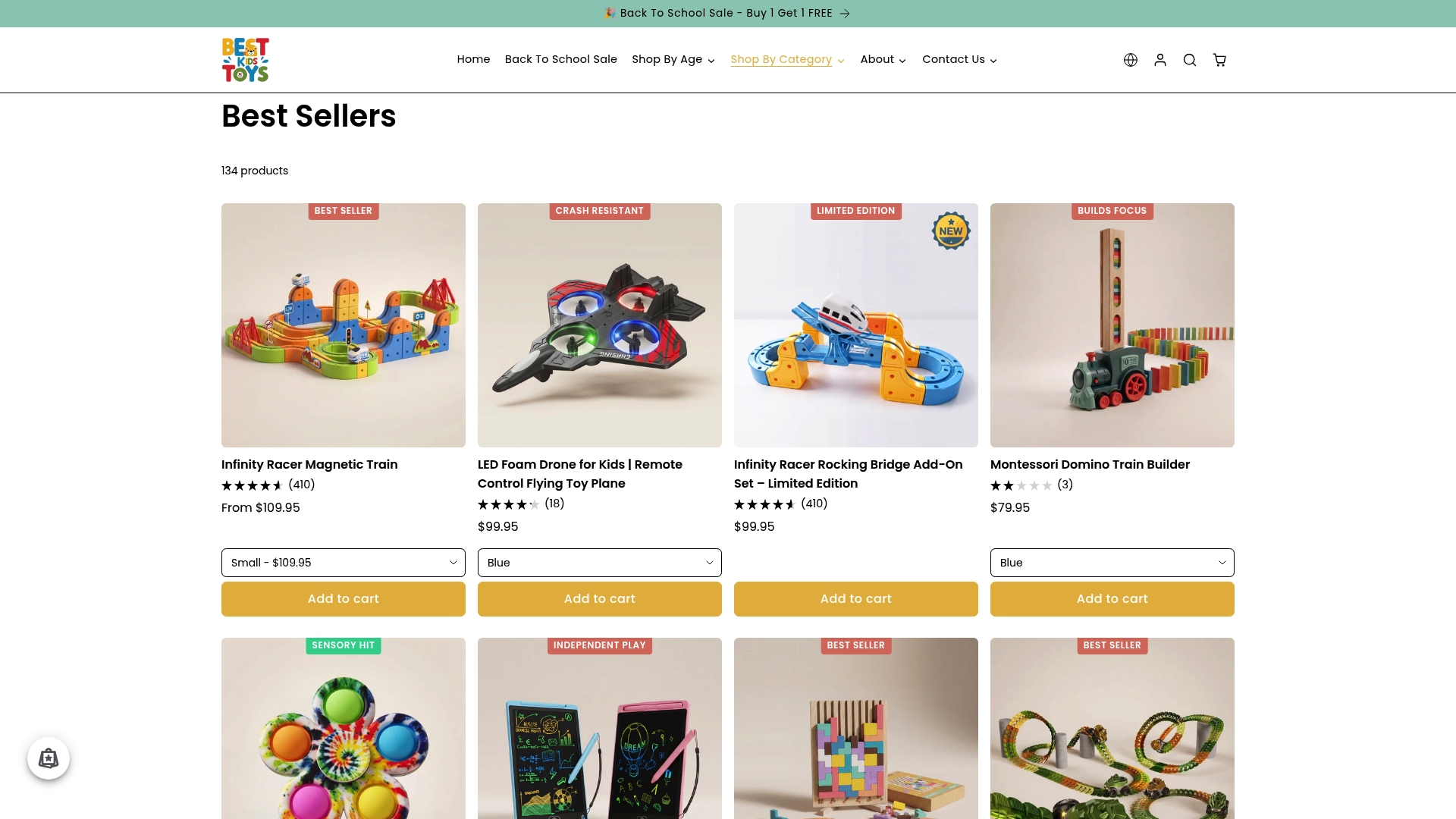
Every item is checked for safe finishes and manageable weight, following fit standards to help choose appropriate sizes without guesswork. Browse the best sellers collection to see which starter pieces other families are stocking their shelves with first.
Sources
- Practical Life Through the Ages, Part One – Early Childhood | American Montessori Society
- Montessori Practical Life Activities: The Complete Guide for Parents