



2–5 Minute Grace and Courtesy Lessons for Parents and Educators
In Montessori, grace and courtesy are short, proactive lessons that teach children how to move and speak with respect so the classroom (or living room) runs smoothly and kids build real social confidence. “Grace” means poise and economy of movement; “courtesy” means considerate politeness toward others. These lessons work like any other Montessori subject: demonstrated, practiced, and absorbed, not lectured about after the fact.
TL;DR:
- Children develop social skills through short, repetitive lessons that demonstrate polite movement and respectful speech before they are needed in real situations.
- Lessons are best taught during calm moments with simple, clear scripts, demonstration, and practical practice in small groups of two to four children.
- Age-appropriate language and visual cues ensure children with sensitivities or delays can effectively learn and practice grace and courtesy behaviors.
- Consistent modeling and small, real tools at home support the gradual internalization of social routines and reduce household friction.
- Repetition and patience are key, as natural, automatic manners result from dozens of small, mindful practice sessions over time.
Table of Contents
- What Does Grace and Courtesy Mean in Montessori?
- How Do You Teach Grace and Courtesy to Kids?
- Grace and Courtesy Activities Sorted by Category
- Adjusting Lessons for Different Ages and Needs
- Bringing Grace and Courtesy Home
- Who’s Behind This Guidance?
- What Practiced Manners Actually Build
- Simple Tools That Support Practice at Home
- Sources
- FAQ
What Does Grace and Courtesy Mean in Montessori?
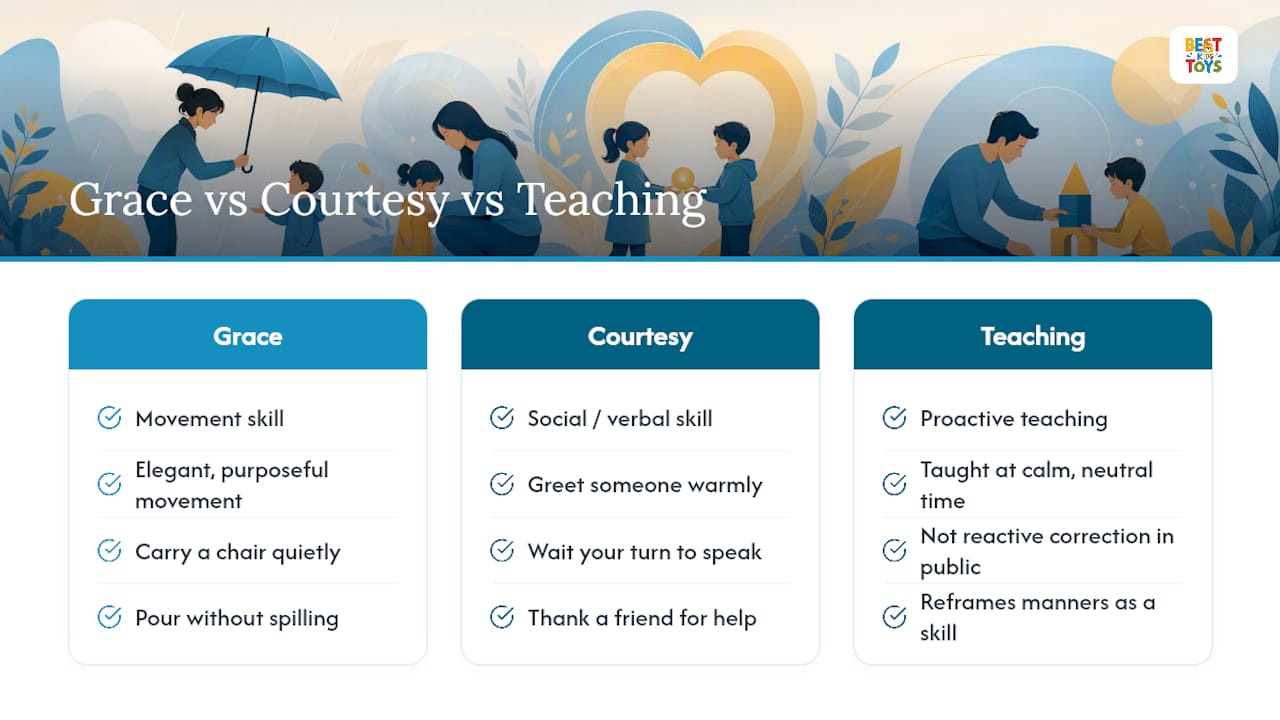
Maria Montessori treated social behavior the same way she treated math or language: as a skill built through repetition, not a trait some children happen to have. Grace refers to elegant, purposeful movement, walking around a rug without stepping on it, carrying a chair quietly, pouring water without spilling. Courtesy covers the verbal and social side: greeting someone warmly, waiting your turn to speak, thanking a friend for help. Together, they form a dedicated area of Practical Life work for children roughly ages 3 to 6, woven into the daily rhythm of the classroom rather than tucked into a single “manners” unit.
This timing is not an accident. Children in what Montessori called the first plane of development, roughly ages two and a half to six, move through a sensitive period for order and social norms. They are wired to notice how people greet each other, how conflicts get resolved, and how a room full of people manages to function without chaos. A three-year-old watching an adult step carefully around a friend’s floor mat is absorbing a rule of community life, whether or not anyone explains it in words.
The bigger shift is philosophical. Montessori argued for giving children “the means for the intelligent development of more harmonious movements,” a line from The Absorbent Mind that reframes bad manners as a skill gap rather than a discipline problem. Instead of correcting a child mid-interruption, in front of everyone, at the worst possible moment, the classroom teaches the skill in advance, at a calm and neutral time. That single change, from reactive correction to proactive teaching, is the backbone of how grace and courtesy actually get taught.
How Do You Teach Grace and Courtesy to Kids?
The format barely changes, whether you are running a classroom of 24 or coaching one child at your kitchen table. Montessori lessons in this area follow a consistent, repeatable shape:
- Pick a calm, neutral moment. Never mid-tantrum, never mid-interruption. Teach the skill before the child needs it.
- Name the lesson simply. “I’m going to show you how we ask for help” works better than a wandering explanation.
- Demonstrate slowly, without narrating every micro-movement. Let the child watch the whole sequence once.
- Invite practice. “Would you like to try?” Never force it.
- End without evaluation. No “good job,” no correction. The demo speaks for itself.
- Reconnect at the real moment. A quiet reminder later, “remember how we walk around the rug”, links the lesson to real life without embarrassing anyone.
These lessons run 2 to 5 minutes, delivered to one child or a small group of two to four. Keeping the group small matters: courtesy lessons rely on close observation and a bit of role-play, and that gets diluted fast in a crowd.
A few scripts you can borrow directly. For greetings: “Watch how I look at your eyes and say good morning.” For walking near someone working: “I walk around the edge of the rug so I don’t disturb the work.” For interrupting politely: “I put my hand gently on the person’s arm and wait until they look at me.” For offering help: “Would you like help with that, or would you like to do it yourself?”
Adult modeling carries more weight than any script. When adults narrate their own behavior calmly (“I’m going to wait until you finish talking”), children absorb the pattern without feeling lectured.
Pro Tip: Reinforce lessons with a gentle, dignity-preserving cue in the moment, not a correction. A whispered “remember our lesson” lands very differently than “we don’t do that.”
Grace and Courtesy Activities Sorted by Category
A useful lesson bank stays organized by category, so you always know which skill to pull out next. Montessori classrooms typically introduce most of these categories across the three-year primary cycle, matched to the child’s daily life rather than a rigid schedule.
| Category | Sample script | When to teach it |
|---|---|---|
| Greetings | “Good morning! I look at your eyes and smile.” | Start of the day, arrival routines |
| Physical navigation | “I walk around the rug, not across it.” | Before independent work time begins |
| Interrupting politely | “I place my hand on your shoulder and wait.” | Before group lessons or adult conversations |
| Hygiene | “I cover my mouth with my elbow when I cough.” | Cold and flu season, or anytime |
| Conflict resolution | “I can say, ‘I don’t like that, please stop.’” | After noticing repeated friction between two children |
| Care for others | “Would you like help carrying that?” | During transitions or cleanup |
| Table manners | “I chew with my mouth closed and pass the bowl.” | Before shared snack or family meals |
| Environment care | “I roll my rug and return it to the shelf.” | End of any Practical Life or sensorial activity |
Turn several of these into quick role-play games: two children practice “excuse me” while carrying a tray past each other, or a small group takes turns greeting a “guest” at the door. Simple materials help, small trays, child-size brooms, pitchers sized for little hands, because they give children something real to practice with instead of an abstract instruction.
Adjusting Lessons for Different Ages and Needs
Toddlers need the physical action stripped down to one step: “hand it gently” rather than a full script. Older primary children, ages five and six, can handle more nuanced language, including phrases for disagreement or empathy, “I can see you’re upset, do you want space?”
Mixed-age classrooms have a built-in advantage here. Older children modeling courteous behavior give younger ones repeated, varied examples to copy, and inviting a five-year-old to demonstrate for a three-year-old builds leadership without any extra planning from the adult.
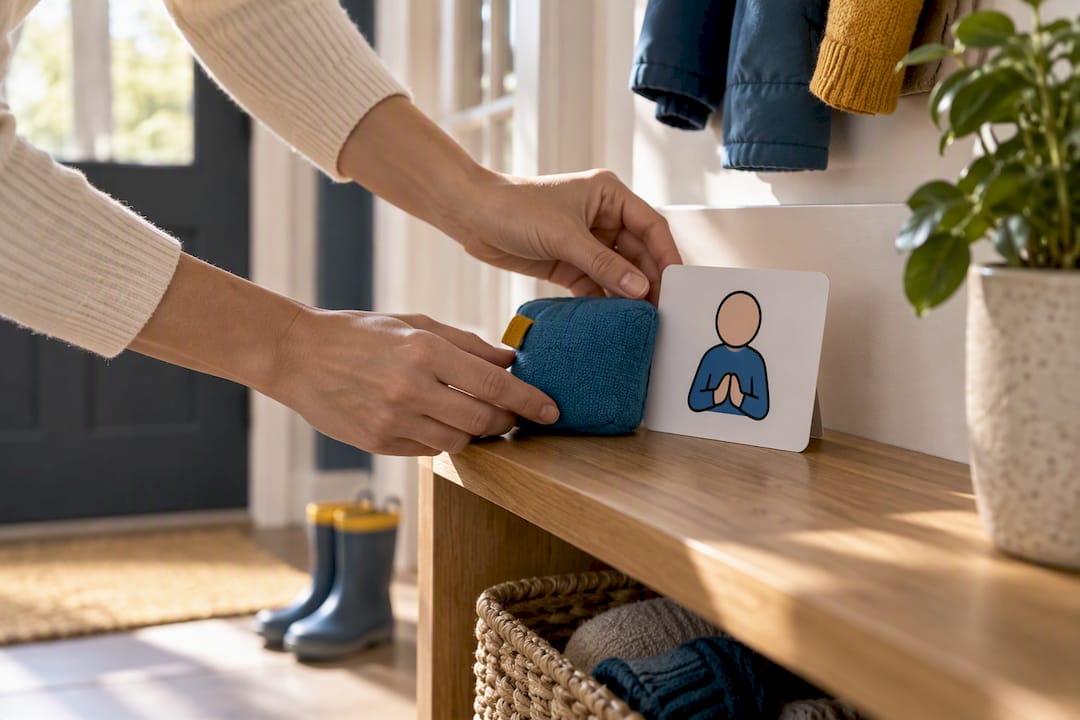
For children with sensory sensitivities or language delays, swap spoken scripts for visual cues, a picture card showing “wait your turn,” paired with a shorter, calmer demo. Tactile supports, like a textured object to hold while waiting, can replace a verbal reminder entirely. The general rule: scaffold heavily at first, then step back gradually as the behavior becomes familiar, rather than removing support all at once.
Bringing Grace and Courtesy Home
Classroom lessons fade fast if home life ignores them. The good news is that home practice takes less setup than a classroom lesson, just a few consistent minutes.
Try these before common trigger moments:
- Before guests arrive: “Watch how I open the door and say, ‘welcome, come in.’”
- Before a restaurant visit: quick role-play at home, practicing “please” and “thank you” with a stuffed animal as the waiter.
- Before walking past a sibling’s project: “Watch how I walk around your brother’s blocks.”
- At the table: model passing dishes and waiting to be served, then invite the child to try.
Keep every practice moment under five minutes and genuinely playful. A rehearsed “excuse me” delivered with a grin sticks far better than one demanded through gritted teeth, and narrating your own actions out loud works at home exactly as it does in a classroom.
Who’s Behind This Guidance?
This guide draws on established Montessori Practical Life philosophy, cross-checked against classroom practice from Montessori teacher-training resources and early-childhood specialists. Montessori-inspired toys are selected against real developmental milestones, reviewed for safety, and built for screen-free independent play, the same principles that shape grace and courtesy lessons.
Some of the simplest classroom supports double as home tools: a child-size pitcher for pouring practice, a small tray for carrying objects steadily, a soft cloth for wiping a table after snack. None of these replace the lesson itself. They just give the child something real to hold while practicing it.
What Practiced Manners Actually Build
The real payoff of grace and courtesy work isn’t a child who says “please” on command. It’s a classroom, or a household, that runs with less friction because kids have a repertoire of moves ready before they need them. That calm doesn’t arrive from a single perfect lesson. It comes from dozens of small, unglamorous repetitions that eventually feel automatic.
Pick one lesson this week, a greeting, a walking pattern, an interruption script, and model it consistently for a few days before expecting it back. Patience matters more than polish here.
— Danica Hodge
Simple Tools That Support Practice at Home
Grace and courtesy lessons succeed because of consistent modeling and calm scripts, not because of any particular product. That said, child-size tools make practice concrete: a small pitcher lets a child rehearse careful pouring during a “serve your sibling” lesson, and a lightweight broom turns “care for the environment” from an abstract idea into a real chore a three-year-old can finish.
Thebestkidstoys is the alternative to guessing which classroom-style materials actually hold up at home. Every item is curated and reviewed against real developmental milestones, with a focus on safety and independent play, so you’re not sorting through mismatched sets built for looks instead of little hands. A few categories worth browsing:
- Montessori STEM toys for hands-on problem-solving that pairs naturally with Practical Life routines
- Wooden toys sturdy enough for daily carrying, pouring, and care-for-environment practice
- Open-ended toys that create natural turn-taking and cooperative play
Remember, the toy is never the lesson, your modeling and the child’s practice are. If you want a starting point, browse the Montessori STEM toys collection and pick one item that fits a grace and courtesy lesson you’re already planning to teach this week.
Sources
For deeper study or classroom reference, the Trillium Montessori guide covers foundational definitions and timing. The Montessori Foundation explains adult modeling in depth. Montessori Guide catalogs specific lesson categories, and Toth Montessori details standard lesson format and philosophy.
- Grace and Courtesy in Montessori
- Grace & Courtesy in a Montessori Classroom - Montessori Foundation
- Montessori Guide — Grace and courtesy lessons
- The impact of grace and courtesy
FAQ
What Does Grace and Courtesy Mean?
Grace refers to poised, economical movement, like walking carefully around a workspace, while courtesy means considerate, polite treatment of others, like waiting your turn or greeting someone warmly. Together they form a core Practical Life area in Montessori classrooms for children roughly ages 3 to 6.
What Is Maria Montessori’s Quote About Grace and Courtesy?
Montessori wrote about offering children “the means for the intelligent development of more harmonious movements,” a line from The Absorbent Mind that frames social skills as something to teach proactively rather than correct reactively. This idea underpins nearly every modern grace and courtesy lesson plan.
What Does “Grace and Courtesy” Mean in Montessori Teaching?
In Montessori teaching, grace and courtesy lessons are short, deliberate demonstrations, typically 2 to 5 minutes, that show children exactly how to greet, wait, interrupt politely, or care for shared spaces. They’re delivered to individuals or small groups during calm moments, then reinforced with gentle reminders during real interactions.
What Is the Biggest Criticism of Montessori?
A common criticism is that Montessori’s structure can feel overly formal or under-stimulating for children who thrive on more spontaneous, unstructured play. Grace and courtesy lessons specifically get some pushback for seeming scripted, though in practice they’re meant as a starting scaffold that children eventually personalize rather than a rigid script for life.
Does Thebestkidstoys Sell Products Specifically for Grace and Courtesy Practice?
Thebestkidstoys doesn’t sell a single “grace and courtesy kit,” but its wooden toys and Practical Life style materials, pitchers, trays, and simple tools, work well for rehearsing pouring, carrying, and care-for-environment lessons at home.