



12 Montessori Toy Rotation Ideas for Toddlers With No New Purchases
Toy rotation works: keep a small, balanced selection of toys available, store the rest out of sight, and swap items in when your child’s interest fades rather than on a fixed calendar. The recommended range is 4 to 6 toys for infants, 8 to 10 for toddlers, and 10 to 12 for preschoolers. Start today with a one-hour reset: gather everything, purge what’s broken, and pack the rest away.
TL;DR:
- Limit toddlers to 8 to 10 toys covering different categories, and rotate them every 2 to 4 weeks based on interest rather than strict schedules.
- Store leftover toys in opaque, labeled bins out of sight to maintain the “new again” effect and make swapping quick and simple.
- Use a one-hour reset routine to gather, purge, categorize, and pack toys, helping parents start and adjust the system easily.
- Focus on diverse categories like building, pretend play, and sensory items, assembling themed sets with toys already in the house to keep play engaging.
- Adjust toy counts and rotation frequency based on age, with infants needing fewer sensory-focused toys and preschoolers able to handle longer, project-based play sessions.
Table of Contents
- How To Set Up A Toy Rotation In One Hour
- How Many Toys To Keep Out And When To Rotate
- Rotation Categories And 12 Themes To Try This Month
- Storage That Actually Keeps The System Running
- Montessori Adjustments By Age
- Why Toy Rotation Systems Fall Apart (And How To Fix Them)
- A Small Household Test, And What It Showed
- Starter Picks To Build Your First Rotation Set
- Sources
- FAQ
How To Set Up A Toy Rotation In One Hour
You don’t need a Pinterest-worthy playroom or a weekend to spare. A working rotation comes together in about an hour if you follow the same sequence Montessori-style family toy rotation programs recommend.
Step 1: Gather everything. Pull every toy out of every bin, closet, and forgotten corner of the couch. You cannot build a good rotation without seeing the full picture first. This step alone usually reveals duplicates and toys nobody remembers buying.
Step 2: Purge ruthlessly. Sort into three piles as you go:
- Keep: age-appropriate, complete, and genuinely engaging
- Donate: outgrown, broken beyond repair, or missing critical pieces
- Rotate: good toys that just don’t need to be out right now
Step 3: Group by category, then build sets. Once you know what you’re working with, sort the keep pile into categories, building, pretend play, sensory, fine motor, gross motor, books, and loose parts. Pick one or two items from each category to form your first active rotation. Aim for 6 to 10 toys total for a toddler, following the Montessori teacher approach of rotating based on what your child actually plays with, not a rigid weekly schedule.
Step 4: Pack and label the rest. Everything not in the active set goes into opaque bins or boxes, labeled by category or by “set” number, so future swaps take minutes instead of an afternoon. A one-session reset like this is designed to be finished start to finish in about an hour, which makes it realistic for a parent squeezing this in during nap time.
Pro Tip: Take a quick photo of each stored bin’s contents before you seal it. When you’re deciding what to swap in next, you can scroll your phone instead of digging through boxes.
The goal isn’t a perfect system on day one. It’s a working starting point you can adjust once you see how your child actually responds to it.
How Many Toys To Keep Out And When To Rotate
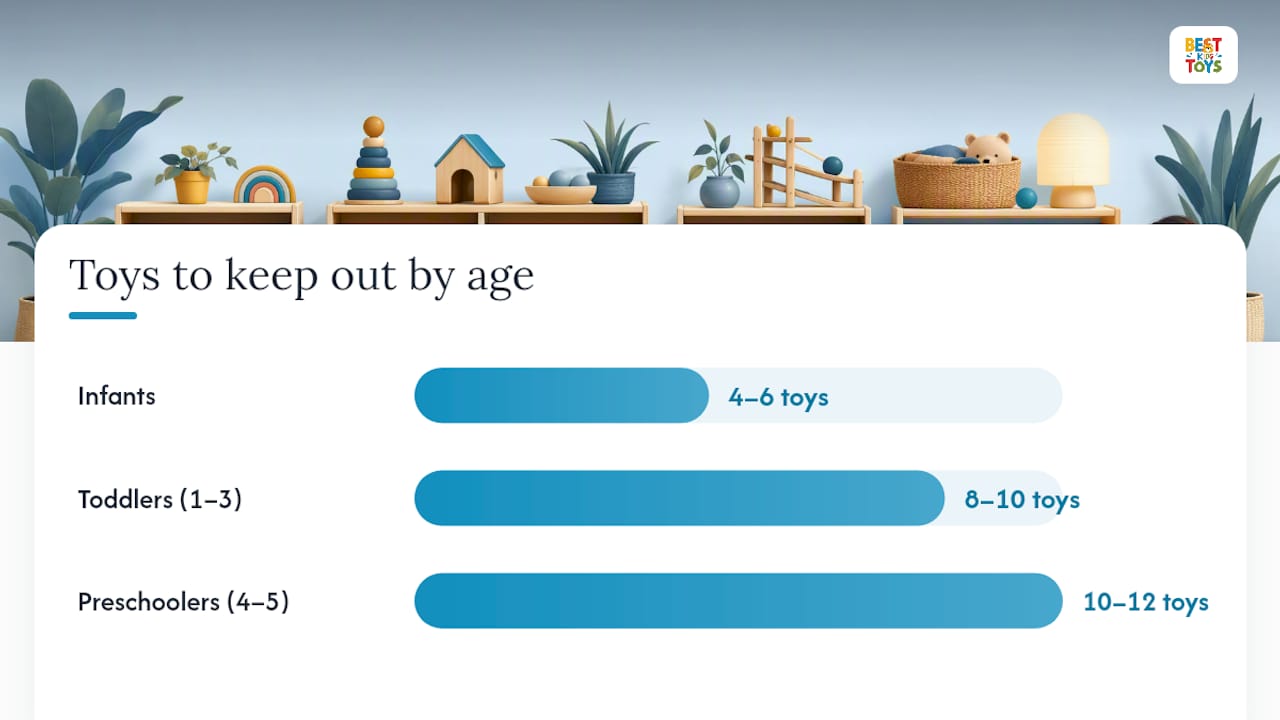
Age drives the count more than anything else. Infants do best with 4 to 6 items focused on sensory exploration, since anything more just becomes visual noise for a baby still learning to track and grasp. Toddlers between 1 and 3 years old thrive with 8 to 10 toys covering a mix of categories, matching the range multiple Montessori-informed rotation guides settle on as a practical sweet spot. Preschoolers age 4 to 5 can handle 10 to 12, since their play sessions run longer and often involve combining categories, like using blocks alongside pretend-play figures.
Frequency matters less than the signal you’re watching for. A useful cadence to start with:
- Young toddlers: weekly swaps work well while attention spans are still short
- Preschoolers: every 2 to 4 weeks, since project-based play takes longer to unfold
What the research suggests: A small, frequently cited University of Toledo study found that children given 4 toys played more creatively than children given 16. Treat this as a directional signal, not proof, since it’s a small sample. But it lines up with what most rotation-practicing families report: fewer choices, deeper play.
Watch your child instead of the calendar. Wandering between toys without settling, dumping bins and walking away, or play sessions that end in under a few minutes all suggest it’s time to swap something in. On the flip side, if your toddler is still deep in a building project or has invented three new games with the same dollhouse, leave it alone even if your mental schedule says it’s swap day.
Rotation Categories And 12 Themes To Try This Month
A rotation set works best when it pulls from multiple categories rather than five versions of the same skill. The core categories worth stocking are building, pretend play, sensory, fine motor, gross motor, books, and loose parts. Category-based rotation makes it easy to build a balanced set fast: grab one item from each bucket and you’re done.
Here are 12 themed sets you can assemble from what’s already in your house, no shopping required:
- Kitchen helper: play food, measuring cups, wooden spoons, a mixing bowl
- Nature explorer: pinecones, a magnifying glass, a small basket, smooth stones
- Builder’s corner: blocks, a ramp, small cars, a wooden mallet toy
- Sensory bin: dry rice or beans, scoops, small containers, funnels
- Dress-up drama: scarves, a few hats, a small mirror, simple costume pieces
- Fine motor station: lacing beads, tongs, clothespins, a muffin tin
- Puzzle week: two or three puzzles at different difficulty levels
- Art table: crayons, paper, stickers, a hole punch for fine motor practice
- Animal world: figurines, a felt mat, a small barn or habitat box
- Music makers: shakers, a drum, scarves for movement play
- Book nook: 5 to 6 books rotated with the rest of the toy set
- Loose parts bin: bottle caps, fabric scraps, wooden rings, cardboard tubes
Mix categories within each rotation rather than stacking similar toys. A set with two building toys, one sensory bin, one pretend-play item, and a small stack of books gives your child more reasons to stay engaged than a set full of near-identical options.
Storage That Actually Keeps The System Running
The storage method matters almost as much as the rotation plan itself, because a system your child can see through fails fast. Opaque bins outperform clear ones psychologically. Stored toys need to feel new again when they come back out, and that illusion breaks the moment your toddler can spot last month’s dump truck through a see-through lid.
Common storage options, matched to typical home layouts:
- High closet shelf: keeps toys fully out of reach and out of sight, ideal for smaller homes
- Under-bed bins: low-profile and easy to slide out for swap day
- A single suitcase: works well for families who move rotation sets between rooms
- Labeled opaque bins: the most flexible option, especially when numbered by set
Number your bins and set a short swap routine, 5 to 10 minutes, tops, so rotation day never turns into a project. In smaller homes or with multiple kids, a dedicated closet organization system can turn an awkward closet into a genuine toy library with defined shelves for each rotation set, which matters more the more kids share a play space.
One exception worth building into the plan: let your child keep one true favorite out permanently. Forcing a beloved stuffed animal or blanket into rotation usually backfires, and it’s not worth the tantrum.
Pro Tip: Stick a printed contents list on the outside of each bin. It saves you from opening three boxes just to find the wooden train set.
Montessori Adjustments By Age
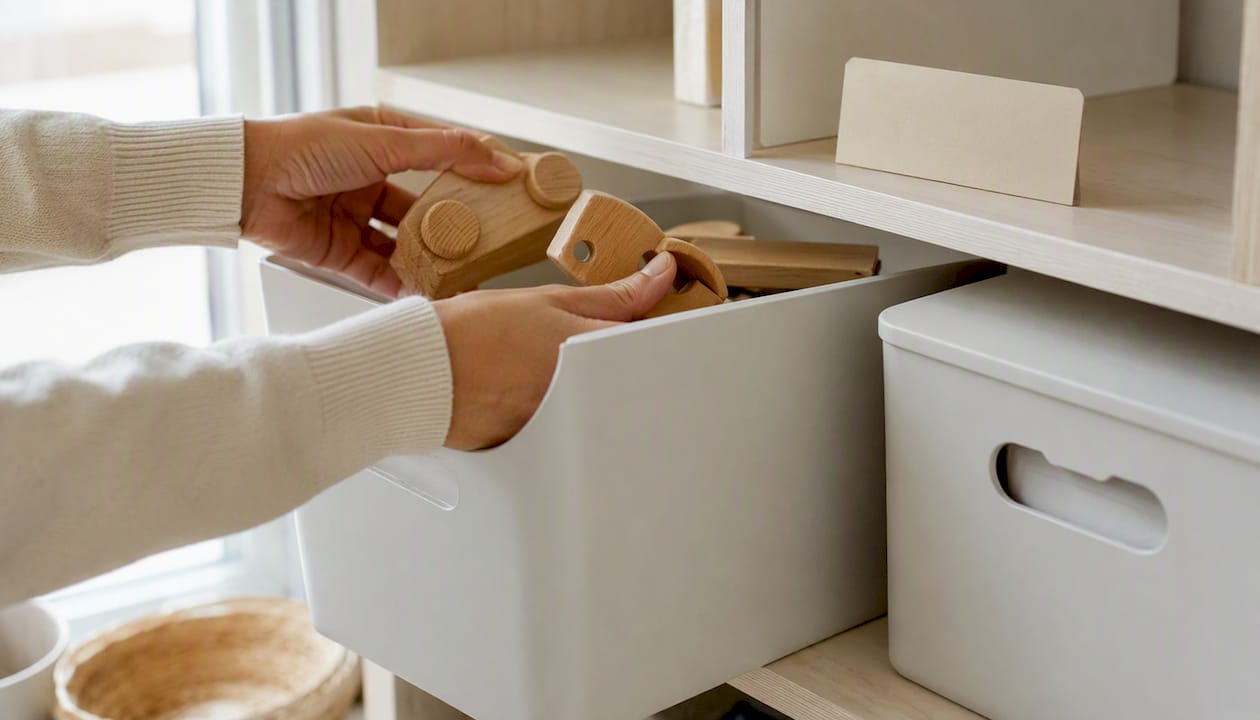
Montessori philosophy adds one key layer on top of basic rotation: how the toys are displayed matters as much as which ones are out. Low shelves and open baskets at your child’s eye level invite independent choice, while a toy bin dumped in a corner invites, well, dumping. Open-ended materials consistently outperform single-function electronic toys for sustained engagement, since a set of blocks can become a tower, a bridge, or a garage depending on the day.
Age-specific adjustments to layer in:
- Infants: a low basket with 4 to 6 sensory items, textured balls, a rattle, a soft book, within easy reach on the floor
- Toddlers: pair toy rotation with practical-life tasks, a small pitcher for pouring, a child-sized broom, a snack-prep station
- Preschoolers: rotate around a loose project theme for 2 to 4 weeks, letting one building or art set anchor deeper, longer play
A low-shelf storage setup does double duty here, since the same shelf that holds your active rotation also teaches your child where things belong when playtime ends.
Why Toy Rotation Systems Fall Apart (And How To Fix Them)
Most rotation systems don’t fail because parents pick the wrong toys. They fail because of three predictable habits. Stored toys stay visible somewhere in the house, which kills the “new again” effect the whole system depends on. Parents rotate too often, swapping toys before a child has had a real chance to get bored of them. Or the system gets overengineered with a dozen labeled bins and a spreadsheet nobody has time to maintain.
The fixes are simple:
- Move stored toys somewhere genuinely out of sight, a closet, under the bed, a different room entirely
- Simplify down to 2 or 3 bins if your current setup feels like a chore
- Let your child help pack the “away” bin, since kids who help choose what gets stored tend to greet it more enthusiastically when it resurfaces
One more rule worth adopting: when a new toy comes in, retire one from storage to make room. This keeps the total collection from creeping back up to the overwhelming pile you started with, and it gives you a natural excuse to donate what your child has genuinely outgrown.
A Small Household Test, And What It Showed
We watched a family test observation-led rotation instead of a fixed schedule, swapping toys only when a child lost interest rather than on a set day. Within two weeks, independent play stretches got noticeably longer, which tracks with what other families testing this method have reported. You don’t need a perfect setup to see a difference. A single one-hour reset, watched closely for a couple of weeks, tells you more than any amount of planning ever will.
— Danica Hodge
Starter Picks To Build Your First Rotation Set
Montessori-inspired, open-ended toys reviewed for safety and long-term play value can make building that first rotation set a lot less guesswork than starting from scratch. Every item is chosen to work across multiple play themes, not just one, so a single toy can anchor your building set this month and your pretend-play set next month.
If you’re assembling a practical-life or fine-motor rotation, the Little Learners Montessori Busy Book fits naturally into a toddler’s early rotation sets. For age-specific starter collections, browse toys for ages 3 to 4 if you’re building your first preschool rotation, or check the 4 to 5 years collection for project-based sets that hold attention over longer stretches. Older kids aren’t left out either. The 5 and up collection leans into more complex building and STEM sets worth rotating in as skills grow. Pick one category you’re missing from your current rotation and start there.
Sources
- How to Rotate Toys Like a Montessori Teacher (August 2026)
- Toy Rotation System: How to Rotate Toys & Simplify Storage
- 5-Minute Playroom Toy Rotation: Set Up a System That Works
FAQ
What Is The 10 Toy Rule?
The 10 toy rule suggests keeping around 10 toys accessible at once, close to the 8 to 10 range recommended for toddlers and the 10 to 12 range for preschoolers, so kids can focus without feeling overloaded by choice.
What Are Good Bins For Toy Rotation?
Opaque, labeled bins work best because they hide contents completely, which makes stored toys feel new again when they return. Under-bed bins, high closet shelving, and even a single suitcase all work depending on your space.
How Many Toys Should You Keep Out For Rotation?
Infants do well with 4 to 6 toys, toddlers with 8 to 10, and preschoolers with 10 to 12, adjusting based on how your child actually engages rather than sticking rigidly to a number.
Is Toy Rotation Actually Beneficial?
Yes. Rotation reduces clutter, extends focused play, and a small, frequently cited study found children with fewer toys available played more creatively than those with many more. Watching for signs like wandering or short play sessions tells you when it’s time to swap.