



Best Montessori Toys for 18 Month Olds: Top Picks
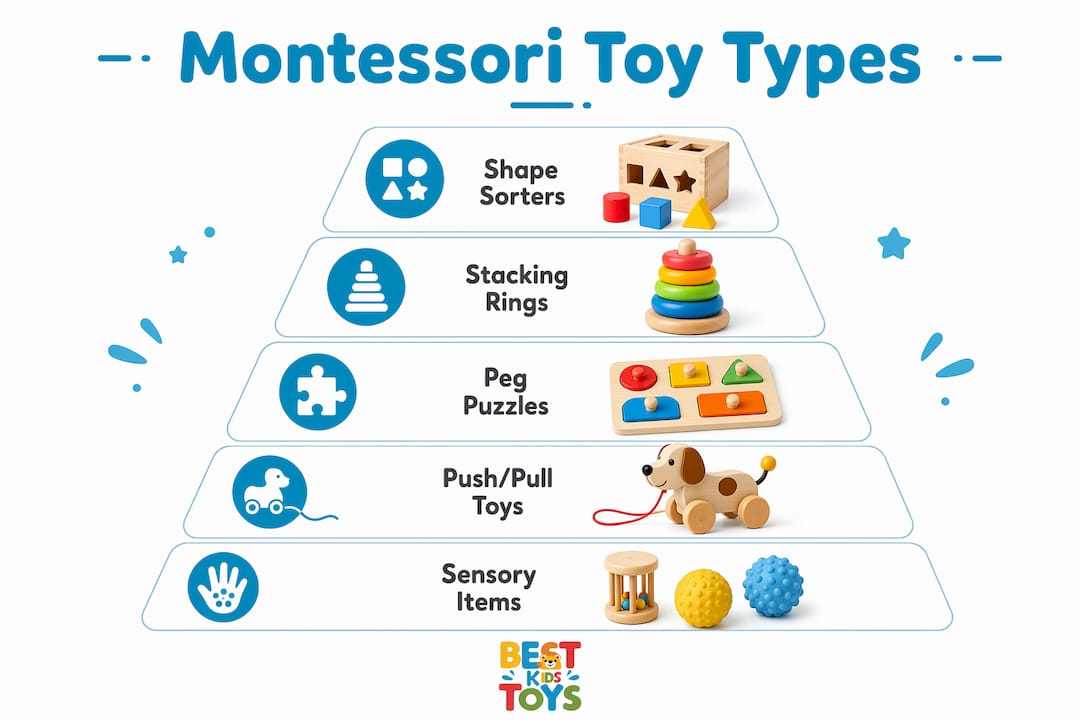
The best Montessori toys for an 18-month-old are ones that put the child in charge of the action. For most toddlers at this stage, that means a short, purposeful shortlist: a shape sorter, stacking rings, a simple peg or knob puzzle, a push/pull toy, open-ended wooden blocks, and a small climbing element. These six categories directly support the fine motor control, spatial reasoning, and gross motor independence that CDC milestone guidance identifies as hallmarks of healthy development at 18 months. From Thebestkidstoys, the picks that fit this shortlist best include the Wooden Shape Sorter, Stacking Rings, Simple Peg Puzzle, and the Color Sorting Sensory Toy.
- Wooden Shape Sorter — matches shapes to holes, builds problem-solving
- Stacking Rings — vertical stacking for wrist rotation and sequencing
- Simple Peg/Knob Puzzle — lifts and places pieces, trains fine motor grip
- Push/Pull Toy — supports walking confidence and gross motor agency
- Open-Ended Wooden Blocks — stacking, sorting, and early pretend play
- Color Sorting Sensory Toy — color matching and fine motor coordination
One safety note before you shop: the CPSC recommends avoiding any toy with parts smaller than 1.75 inches in diameter for children under three, and all finishes should be non-toxic and clearly labeled. Check the CPSC recall database before purchasing any toy, new or secondhand.
Pro Tip: Look for the ASTM F963 label on the packaging. It means the toy has been independently tested against U.S. safety standards for children’s products.
Table of Contents
- Why Montessori toys for 18 month olds work so well right now
- Montessori toy categories for 18 months: what to buy and how to use each
- How do you choose a Montessori toy for an 18-month-old?
- Best Kids Toys’ curated Montessori picks for 18 months
- How to introduce new Montessori toys and rotate them
- Safety checks, cleaning, and maintenance for toddler Montessori toys
- Key Takeaways
- What makes these picks worth trusting
- Thebestkidstoys has the picks your 18-month-old is ready for
- Authoritative sources and further reading
Why Montessori toys for 18 month olds work so well right now
These toys are not just charming wooden objects. They map directly onto what your child’s brain and body are ready to do at 18 months. CDC milestone guidance identifies this stage as a period of rapid growth in fine motor skills, walking and climbing confidence, and the beginning of purposeful imitation. A shape sorter is not just a toy — it is a problem your child can solve independently, repeat until mastered, and feel genuinely proud of.
Here is what each toy type targets at this stage:
- Shape sorters and puzzles build spatial reasoning and the pincer grip needed for writing later
- Stacking rings and vertical stackers develop wrist rotation and early sequencing logic
- Push/pull toys reinforce walking confidence and motor planning
- Practical-life items (toy brooms, pretend dishes) tap into the imitation drive that peaks around 18 months
- Climbing elements advance balance, proprioception, and physical confidence
- Open-ended blocks invite creativity and early pretend play without a script
“At 18 months, toddlers are developmentally equipped to be active adventurers. The best toys for this stage support movement, imitation, and purposeful play — not passive watching.”
— Pediatric occupational therapy guidance, as cited by The Bump
Montessori philosophy emphasizes that repetition is not boredom — it is mastery in progress. When your child drops the same ring onto the stacker fifteen times in a row, their brain gears are churning through motor sequencing, cause-and-effect, and spatial awareness all at once. The moment they stop repeating and start looking around for something new, that is your cue to rotate.
Watch for these readiness signals when choosing or rotating toys:
- Child completes the task without frustration on the first or second try
- Child repeats the same action four or five times successfully
- Child begins using the toy in unintended ways (stacking the puzzle pieces instead of placing them)
- Child loses interest within two minutes of picking the toy up
- Child seeks out more complex challenges nearby
Montessori toy categories for 18 months: what to buy and how to use each
Shape sorters and matching toys
Shape sorters build the spatial reasoning and hand-eye coordination that underpin early problem-solving. A good one has three to six distinct shapes, chunky enough for small hands to grip. Expect your child to use this toy actively for six to twelve months before needing a more complex version. Price range: typically affordable within a modest budget.
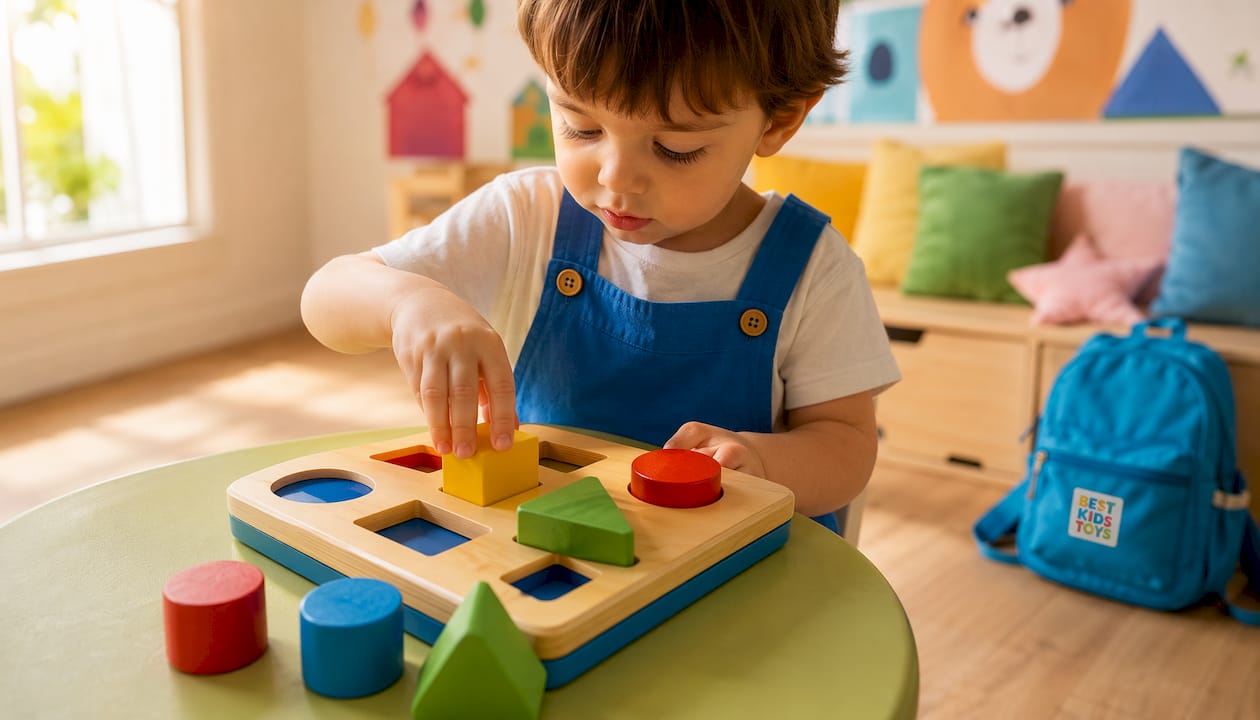
Readiness cue: Child can pick up and intentionally place objects into a container.
Play tip: Sit beside your child, pick up one shape, and slowly match it to the hole without speaking. Let them imitate. Resist the urge to guide their hand — the struggle is the learning.
Vertical stackers and stacking rings
Vertical stackers (rings on a dowel) develop wrist rotation and early sequencing. The classic rainbow ring stacker also introduces size discrimination. Most children use this toy from 12 months through age two, often cycling back to it with new play goals. Price range: generally moderate and accessible.
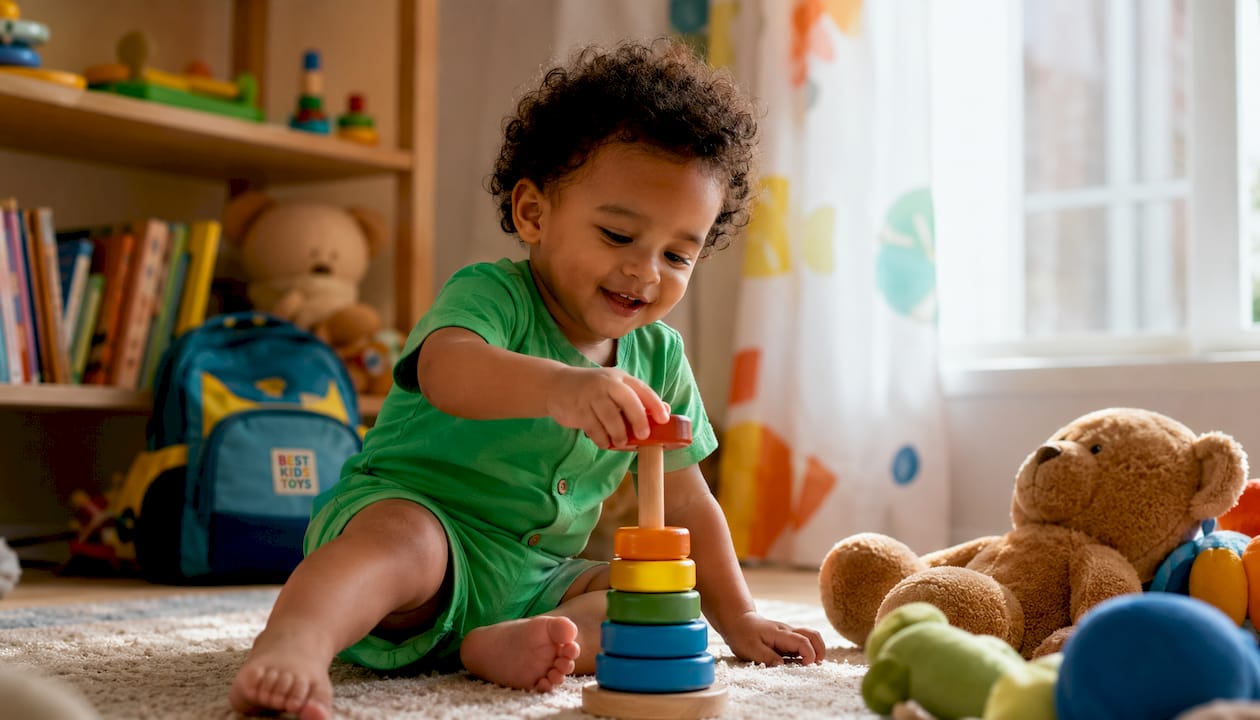
Readiness cue: Child can grasp and release objects with intention.
Simple peg and knob puzzles
A two- to four-piece knob puzzle is the sweet spot at 18 months. Larger knobs reduce frustration while still demanding precision. These puzzles support the fine motor development that feeds into drawing and writing skills years later. Price range: often available at an entry-level cost.
Readiness cue: Child can pinch and lift small objects deliberately.
Push/pull and walker toys
Research published in JAMA Pediatrics supports choosing toys that require the child to initiate and control movement over passive, battery-operated alternatives. A push-along toy that moves when the child walks gives immediate physical feedback, reinforcing both motor planning and walking confidence. Price range: usually varies within a reasonable range.
Practical-life and pretend play items
By 18 months, toddlers shift from pure sensory exploration to purposeful imitation. Toy brooms, pretend cleaning sets, and simple tool kits mirror the daily routines they watch you perform. This category supports pretend play and imitation skills that are central to language and social development. Price range: commonly sold at a mid-range price point.
Sensory and open-ended items
Wooden blocks, simple figurines, and color-sorting sets invite your child to write their own play script. Open-ended toys grow with your child because there is no single “right” way to use them. Durability matters here: parents consistently report higher long-term satisfaction from solid wooden pieces that survive rough play and retain value across multiple stages.
Gross motor: mini slides and climbing arches
A low Pikler arch or climbing triangle advances balance, proprioception, and physical confidence. Choose one sized to your child’s current mobility, and always supervise directly. For sourcing larger gross-motor items, birthday party toy alternatives can be a useful reference for physical play equipment options. Price range: typically higher-end for specialized climbing equipment.
| Toy category | Key skill | Readiness cue | Typical use period |
|---|---|---|---|
| Shape sorter | Spatial reasoning, problem-solving | Places objects in containers intentionally | 15–30 months |
| Stacking rings | Wrist rotation, sequencing | Grasps and releases with control | 12–24 months |
| Peg/knob puzzle | Fine motor, pincer grip | Pinches and lifts small objects | 15–24 months |
| Push/pull toy | Gross motor, motor planning | Walking independently | 12–24 months |
| Practical-life set | Imitation, pretend play | Imitates adult actions | 18–24 months |
| Open-ended blocks | Creativity, early pretend play | Stacks two or more objects | 15 months–3 years |
| Climbing arch | Balance, proprioception | Pulls to stand, climbs furniture | 12–24 months |
Pro Tip: Choose toys that invite one more step of challenge than your child can currently complete. A shape sorter with five shapes is more engaging than one with three once your child has mastered the simpler version. Slight difficulty keeps the brain gears turning.
How do you choose a Montessori toy for an 18-month-old?
Use this checklist the next time you are browsing or standing in a store aisle.
- Age and readiness match — Does the toy match what your child can almost do, not just what they already do easily?
- Material and finish — Is it solid wood, BPA-free plastic, or food-grade silicone? Is the finish labeled non-toxic? Look for ASTM F963 compliance.
- Open-ended play value — Can the toy be used in more than one way? A stacker can also become a pretend tower or a sorting game.
- Repeatability — Will your child want to do it again? Montessori toys should invite repetition naturally, not require novelty to stay interesting.
- Maintenance and cleaning — Can you wipe it down easily? Wooden toys with sealed finishes are straightforward; fabric items need machine-washable construction.
- Price and value — A wooden shape sorter used frequently over many months delivers far more value than a battery toy used rarely.
Red flags to avoid:
- Toys where the battery does all the work (lights, sounds, automatic movement) — these reduce the child’s role to passive observer
- Sets with many small loose parts that could become choking hazards
- Climbing toys without stable, wide bases or weight ratings appropriate for toddlers
- Toys with sharp edges, peeling paint, or unlabeled finishes
Quick decision flow: If your child is already completing a four-piece puzzle independently, move to a six-piece version or introduce a shape sorter with more complex shapes. If they are just starting to walk confidently, a push toy is the right next step before a climbing arch.
Typical price ranges to budget for:
- Wooden shape sorter: $15–$35
- Stacking rings: $12–$30
- Basic peg puzzle: $10–$25
- Pikler climbing arch: $80–$200
Best Kids Toys’ curated Montessori picks for 18 months
These picks were selected using four editorial criteria: developmental match for the 18–24 month window, material safety and durability, open-ended play value, and parent-reported longevity. Every item below meets or exceeds ASTM F963 safety standards.
| Product | Best for | Readiness cues | Materials & safety | Open-ended value | Price bracket | Portability |
|---|---|---|---|---|---|---|
| Wooden Shape Sorter | Spatial reasoning, problem-solving | Places objects in containers | Solid wood, non-toxic finish | High — shapes can be sorted, stacked, counted | Affordable price range | Compact, easy to store |
| Stacking Rings | Wrist rotation, sequencing | Grasps and releases with control | Wood or BPA-free plastic, non-toxic | High — stacking, sorting by color/size | Moderate price range | Very compact |
| Simple Peg Puzzle | Fine motor, pincer grip | Pinches small objects deliberately | Solid wood, non-toxic finish | Moderate — grows with complexity | Entry-level price range | Flat, easy to store |
| Color Sorting Sensory Toy | Color matching, fine motor | Identifies colors, grasps small pieces | Non-toxic, child-safe materials | High — sorting, matching, counting | Mid-range price | Compact tray format |
Wooden Shape Sorter The Wooden Shape Sorter from Thebestkidstoys is the natural starting point for most 18-month-olds. It builds spatial reasoning and problem-solving through hands-on repetition, and the chunky wooden pieces are sized well above CPSC choking-hazard thresholds. Parents find it holds attention longer than expected because each shape presents a slightly different challenge.
Stacking Rings Stacking rings look simple, but they pack in wrist rotation, size discrimination, and early sequencing all at once. The Thebestkidstoys version uses smooth, non-toxic finishes and rings large enough for confident toddler grips. This is one of those toys that earns its shelf space for a full year or more.
Simple Peg Puzzle A two- to four-piece knob puzzle is the right complexity for 18 months. The Montessori puzzle from Thebestkidstoys uses chunky knobs that train the pincer grip without causing frustration. It is also one of the easiest toys to wipe clean after a snack-time session.
Color Sorting Sensory Toy Color matching at 18 months is genuinely exciting for toddlers. The Color Sorting Sensory Toy from Thebestkidstoys doubles as a fine motor workout and a color recognition activity, making it one of the most versatile picks in this age range.
How to introduce new Montessori toys and rotate them
The rule is simple: introduce slowly, show two or three ways to use the toy, then leave it in an open basket at your child’s level for independent repeat use. Resist the urge to demonstrate everything at once.
Here is a step-by-step sequence that works well:
- Unbox quietly — Bring the toy out without fanfare. Novelty alone will draw your child in.
- Short silent demo — Pick up the toy and use it slowly, once or twice, without narrating every move. Let your child watch.
- Invite imitation — Set the toy down in front of your child and step back. Give them space to try.
- Reduce prompts — If they get stuck, offer one gentle physical cue (point to the hole, not their hand). Then step back again.
- Return to the shelf — After the session, place the toy on a low, open shelf where your child can reach it independently. This is the Montessori shelf principle in action.
For rotation, Montessori philosophy recommends rotating a toy out once a child demonstrates mastery — typically after repeating the same successful pattern four or five times in a row. Rotate it out for two to four weeks, then reintroduce it with a small added challenge (a new prop, a different sorting rule, or combined with another toy).
“Repetition is how toddlers build mastery. When a child repeats an action over and over, they are not being stubborn — they are wiring a new skill. The moment they stop and look for something harder, the learning has landed.”
— Montessori Northwest
Signs a toy is ready to rotate out: your child completes it in under 30 seconds without pausing, uses it as a prop for something else, or ignores it entirely for three or four days. Signs it is ready to come back: a few weeks have passed and you introduce it alongside a new prop or slightly higher challenge.
Pro Tip: Keep no more than five to seven toys visible at one time. A crowded shelf overwhelms toddlers and reduces focused play. Less choice, paradoxically, means more creativity.
You can find more ideas for weaving toys into daily routines in Thebestkidstoys’ guide on Montessori toys for spring.
Safety checks, cleaning, and maintenance for toddler Montessori toys
Safety and maintenance are straightforward when you know what to check. Run through this list before any new toy enters your home and again every few months.
Pre-purchase and in-use safety checklist:
- All pieces pass the CPSC small-parts test (nothing smaller than 1.75 inches in diameter)
- Finish is labeled non-toxic; look for ASTM F963 or CPSC compliance on the box
- No sharp edges, splinters, or peeling paint on wooden toys
- Fastenings (screws, dowels, knobs) are tight and cannot be pulled loose by a toddler
- Climbing toys have a stable base and a weight rating clearly listed
- No strings or cords longer than 12 inches (strangulation risk)
- Check the CPSC recall database before purchasing secondhand
Cleaning by material:
| Material | Recommended cleaning method | Frequency |
|---|---|---|
| Solid wood (sealed finish) | Wipe with damp cloth, mild soap; dry immediately | After each use or daily |
| Wood (unsealed/natural) | Dry wipe only; occasional light sand if rough | Weekly or as needed |
| BPA-free plastic | Wipe with mild soap and water; air dry | After each use |
| Fabric/soft elements | Machine wash on gentle cycle, air dry | Weekly or after illness |
| Silicone | Wash with warm soapy water or top-rack dishwasher | After each use |
If a recall notice appears for a toy you own, stop use immediately, follow the manufacturer’s instructions for return or disposal, and check the CPSC site for replacement options. Recalls are searchable by brand, product type, and date.
Key Takeaways
The most effective Montessori toys for 18-month-olds are open-ended, child-powered, and matched to the fine motor, gross motor, and imitation milestones that define this developmental window.
| Point | Details |
|---|---|
| Start with six core categories | Shape sorters, stacking rings, peg puzzles, push/pull toys, blocks, and a climbing element cover the key 18-month milestones. |
| Repetition signals mastery | When your child repeats a task four or five times successfully, it is time to rotate the toy out and reintroduce with added challenge. |
| Safety check every purchase | Look for ASTM F963 compliance, non-toxic finishes, and no parts smaller than 1.75 inches; verify against the CPSC recall database. |
| Rotate to sustain engagement | Keep five to seven toys visible at a time; rotate out mastered toys for two to four weeks before reintroducing at higher complexity. |
| Thebestkidstoys curated picks | The Wooden Shape Sorter, Stacking Rings, Simple Peg Puzzle, and Color Sorting Sensory Toy are the recommended starting points for most 18-month-olds. |
What makes these picks worth trusting
There is a version of this conversation that ends with a list of thirty toys and a shrug. That is not helpful to you. What actually matters at 18 months is a short, purposeful shelf — five to seven items that your child can reach, repeat, and master independently.
The picks featured here reflect a specific editorial judgment: developmental match comes first, then material safety, then open-ended play value, then durability. A toy that lights up and plays music when a button is pressed is not a bad toy in isolation, but it does not ask anything of your child. The research on child-initiated play is consistent on this point: toys that require the child to act, not just react, build motor planning and problem-solving in ways that passive toys simply do not.
Parents sometimes worry that simpler toys will bore their children. The opposite tends to be true. A wooden shape sorter holds attention longer than a battery toy because the challenge is real and the satisfaction of solving it belongs entirely to the child. That sense of “I did it” is what Montessori-inspired play is built around, and it is why Thebestkidstoys’ curated picks lean toward open-ended, child-powered designs.
If you are not sure where to start, the Color Sorting Sensory Toy is the most versatile entry point. It works for color recognition, fine motor practice, and early counting, and it grows with your child well into the second year.
Thebestkidstoys has the picks your 18-month-old is ready for
Every toy on this list is available through Thebestkidstoys’ curated Montessori collection, selected specifically for the 18–24 month developmental window. You get free shipping on orders over $60, plus current savings of up to 40% off across the collection — so building a purposeful five-toy shelf costs less than you might expect.
The Little Learners Montessori Busy Book is a strong first purchase if you want one item that covers multiple skill areas at once: fine motor, color recognition, matching, and early pretend play, all in a format your toddler can carry and return to independently. Browse the full age-appropriate Montessori toys guide on the Thebestkidstoys site to find the right fit for where your child is right now.
Authoritative sources and further reading
These are the primary sources used to build the recommendations and developmental guidance in this article.
- CDC — Developmental Milestones: 18 Months — Used for milestone alignment: fine motor, walking/climbing, and exploratory play expectations at 18 months.
- Montessori Northwest — What Is Montessori Education? — Used for Montessori philosophy on repetition, graduated difficulty, and the rotation strategy.
- JAMA Pediatrics — Play and Child Development — Used to support the recommendation for child-initiated, movement-based toys over passive battery-operated alternatives.
- The Bump — Best Toys for 18-Month-Olds — Used for pediatric OT guidance on purposeful movement and imitation play at this stage, and for editorial selection criteria.
- Montessori Method — Montessori Toys by Age — Used to validate the category shortlist against broader consensus and for climbing equipment guidance.
- American Montessori Society — Characteristics of Montessori Programs for Infants and Toddlers — Background on Montessori principles for the infant and toddler age range.
- CPSC — Product Recalls — Referenced for safety standards, small-parts guidance, and the recall database parents should check before purchasing.