



Seven Piece Tangrams for Kids: Classroom Tested Activities Ages 3–13
A tangram is a seven-piece geometric puzzle that challenges kids to rearrange two large triangles, one medium triangle, two small triangles, a square, and a parallelogram into a target shape. The main payoff is spatial reasoning, the mental skill of rotating and fitting shapes in your head, paired with real problem-solving practice. This guide covers the classic rules, age-by-age adaptations, printable and wooden options, ready-to-use activities, and a few reputable digital tools worth trying.
TL;DR:
- Children need guidance on when to use colored outlines versus blank silhouettes; younger kids benefit from more structured visuals, while older children should work independently.
- Durability of materials is crucial, with laminated cardstock and wooden sets lasting significantly longer than paper or cardboard, especially for frequent use or travel.
- Introducing complexity gradually, such as moving from guided silhouette copying to free design, encourages long-term engagement and skill development.
- Tracking progress through the child’s ability to solve shapes with less guidance over time offers better insight into their spatial reasoning growth than simply focusing on speed.
- Digital tangram games serve as helpful supplements but should not replace tactile, physical puzzles that develop fine motor skills and spatial intuition.
Table of Contents
- What Is a Tangram for Kids, and What Are the Rules?
- The Real Educational Benefits of Tangram Puzzles for Children
- Matching Tangram Difficulty to Your Child’s Age
- How to Make or Choose a Tangram Set That Lasts
- Activity Ideas and Quick Lesson Plans for Tangram Play
- Should You Try Virtual Tangram Games?
- How Best Kids Toys Thinks About Tangram Play
- Step-by-Step: Building Basic and Intermediate Tangram Shapes
- How to Introduce Tangrams Without Losing a Child’s Interest
- Common Tangram Struggles and How to Work Through Them
- Measuring Real Progress With Tangram Activities
- An Editorial Take on What Actually Makes Tangrams Work
- Bring Screen-Free Puzzle Play Home With the Right Set
- Useful Resources for Tangram Practice
- Sources
- FAQ
What Is a Tangram for Kids, and What Are the Rules?
Every tangram set breaks down from a single square into seven flat pieces, known as “tans.” You get two large triangles, one medium triangle, two small triangles, one square, and one parallelogram. That’s the whole kit. No extra pieces, no missing shapes.
The classic rules are simple enough for a five-year-old to grasp:
- Use all seven pieces in every completed puzzle. Leaving one out doesn’t count.
- Lay every piece flat on the table. No stacking.
- Pieces must touch edge-to-edge without overlapping.
- The parallelogram is the one piece that can flip over. Kids often discover this by accident, and it’s a genuine “aha” moment when they realize flipping opens up new silhouettes.
Because the seven tans can combine at so many angles, the number of possible silhouettes runs into the thousands, ranging from simple houses and boats to abstract animals and letters. Large puzzle collections built around this same set of seven pieces, like those at Tangram Channel, show just how far a handful of flat shapes can stretch.
The Real Educational Benefits of Tangram Puzzles for Children
Spatial reasoning is the headline skill, and it’s not a soft one. Kids mentally rotate, flip, and slide pieces before they physically move them. That kind of mental rotation practice is exactly what shows up in research connecting early spatial ability to later math and science performance, based on findings summarized in a PubMed entry on spatial skill research.
Beyond spatial thinking, tangram play builds a cluster of skills that tend to reinforce one another:
- Geometry readiness: kids absorb symmetry, congruence, and transformation concepts long before they hear those words in class.
- Problem-solving and persistence, since most silhouettes take several failed attempts before they click.
- Fine motor control, from picking up and precisely placing small pieces.
- Creativity, especially when kids design their own shapes instead of copying a template.
Classroom connection: Tangrams double as a hands-on way to practice transformational geometry, and sites like Math Playground tie tangram activities directly to Common Core geometry standards and ISTE computational-thinking goals, which makes them easy to justify in a lesson plan, not just free time.
The combination of geometry practice and persistent problem-solving is why so many STEM-focused classrooms keep a tangram set in the supply closet year-round.
Matching Tangram Difficulty to Your Child’s Age
A three-year-old and an eleven-year-old can both play with the same seven pieces, but they need very different levels of support. Age isn’t just a suggestion here, it determines whether the activity builds confidence or triggers frustration.
- Toddlers and early preschoolers (ages 3 to 4): Stick to simple two- or three-piece shapes with a colored outline guide. Supervise closely since pieces are small enough to be a choking hazard for kids who still mouth objects.
- Preschool and kindergarten (ages 4 to 6): Introduce full seven-piece puzzles with a labeled outline showing where each shape goes. Praise the attempt, not just the finished shape.
- Elementary (ages 6 to 10): Move to plain silhouettes with no internal lines, forcing kids to figure out piece placement on their own.
- Tweens (ages 10 to 13): Try timed challenges, blank-square free-builds, or designing original silhouettes for younger siblings to solve.
This “low floor, high ceiling” structure, a phrase educators use often, means one set of seven wooden or paper pieces can realistically serve a family for a decade.
How to Make or Choose a Tangram Set That Lasts
Making a basic tangram takes five minutes and a printer. Print a square template, then cut along the internal lines to produce your seven tans. Several printable collections, including the free patterns at Tangram Channel, give you both the cutting template and dozens of silhouette challenges to print alongside it.
Material choice matters more than most parents expect:
- Paper is fine for a one-time craft afternoon, but it tears and warps fast.
- Cardstock holds up slightly longer and is easy to color-code by piece.
- Laminated cardstock survives sticky hands, spilled juice, and repeated use.
- Wooden tangram sets offer the best tactile feedback and typically outlast every paper version in the house.
- Magnetic sets work well for travel or for a refrigerator-based challenge board that stays visible all week.
If you’re buying rather than making one, check piece size (large enough for small hands, not so large they’re unwieldy), a smooth sanded finish on wooden pieces, and a parallelogram that’s cut precisely enough to flip cleanly against its neighbors.
Pro Tip: If you print a paper set, run it through a home laminator or sandwich it in clear packing tape before cutting. That one extra step turns a one-week paper puzzle into a set that survives an entire school year.
Activity Ideas and Quick Lesson Plans for Tangram Play
Getting started doesn’t require a curriculum. A few fast, low-prep activities work for almost any group:
- Silhouette copying: Give kids a printed outline and let them race to fill it using all seven pieces.
- Partner puzzles: One child builds a shape behind a folder; the other has to recreate it from a verbal description only, which is a surprisingly strong communication exercise.
- Timed rounds: Set a two-minute timer for a familiar silhouette, then remove the timer once frustration creeps in.
For classrooms or homeschool blocks, three short snippets cover a full session:
- Warm-up (5 minutes): Free-build any shape, no template, just to get hands moving and pieces sorted.
- Core lesson (15 minutes): Assign a themed silhouette set (animals, vehicles, letters) tied to whatever unit you’re covering.
- Extended project (20+ minutes): Have kids design an original silhouette, trace it, and challenge a partner to solve it.
To assess how kids are doing, watch for speed and independence rather than a right-or-wrong outcome. Mixed-ability groups do best when you offer the same silhouette in two versions, one with an outlined guide and one blank, so every kid works at their own edge without feeling singled out.
Should You Try Virtual Tangram Games?
Digital tangrams have a real place, especially for practice between physical play sessions or when a printed set isn’t handy. PBS Kids’ Cyberchase tangram game offers leveled puzzles with rotate and flip mechanics built for independent kid use, and it’s a reliably safe option since it carries no ads aimed at children. Other free tools, including options at Math Playground, use similar snap-to-place mechanics that make self-correction easy without an adult hovering over every move.
Digital versions work best as a supplement, not a replacement. Physical pieces still teach the fine motor and tactile piece of the puzzle that a touchscreen simply can’t. Save screen time for kids who’ve already mastered the physical set and want extra levels, and keep device use supervised for anyone under seven, since app store links and ads sit just a tap away from the game itself.
How Best Kids Toys Thinks About Tangram Play
Tangrams line up closely with the Montessori-inspired, screen-free philosophy that guides every product Thebestkidstoys reviews: independent problem-solving, no batteries, and a toy that gets harder as a child gets older instead of aging out of use.
A few pairing ideas worth considering alongside a tangram set:
- Wooden shape puzzles reinforce the same rotation and fit skills at a simpler difficulty level for younger siblings.
- Open-ended building sets extend the same “design your own solution” mindset tangrams introduce.
- Puzzle and brain-game collections give kids a next step once seven-piece tangrams stop being a challenge.
Rotating between a physical tangram set, a wooden puzzle, and open-ended building toys keeps spatial practice fresh without needing a new gadget every month.
Step-by-Step: Building Basic and Intermediate Tangram Shapes
Start every new tangram player on the square itself, since it’s the one shape made from a predictable pairing: the two small triangles fit together to recreate it exactly. That single exercise teaches the core mental habit tangrams demand, noticing how two odd shapes combine into a familiar one.
From there, move to the classic “house” silhouette, a beginner-friendly shape most printable sets include:
- Place the medium triangle as the peaked roof.
- Set the square directly beneath it as the house body.
- Use the two small triangles to fill the base corners, adjusting angles until the edges line up flush.
- Add the parallelogram and one large triangle as a chimney or side extension, depending on the template.
Once a child can build the house without a guide, move to an intermediate shape like a walking figure or a bird in flight. These require the parallelogram flip, since the wing or leg silhouette only closes correctly when that piece is turned over.
A useful visual trick for intermediate builders: have them trace the outline of a completed shape onto paper first, then scramble the pieces and try to refill their own outline. This forces them to analyze angles rather than rely on memory of where a piece “usually” goes.
For kids ready to go further, try building a shape with an ambiguous outline (just the outer edge, no internal lines at all). This is the point where tangrams stop being a matching exercise and start functioning as genuine geometric problem-solving, since kids have to test multiple piece arrangements before landing on the one that fits.
How to Introduce Tangrams Without Losing a Child’s Interest
The biggest mistake with a first tangram session is handing over a blank silhouette immediately. Start instead with free exploration: let the child stack, flip, and arrange the seven pieces into anything at all for five minutes with zero instructions. This lets them handle each shape’s weight and edges before any pressure to “solve” something arrives.
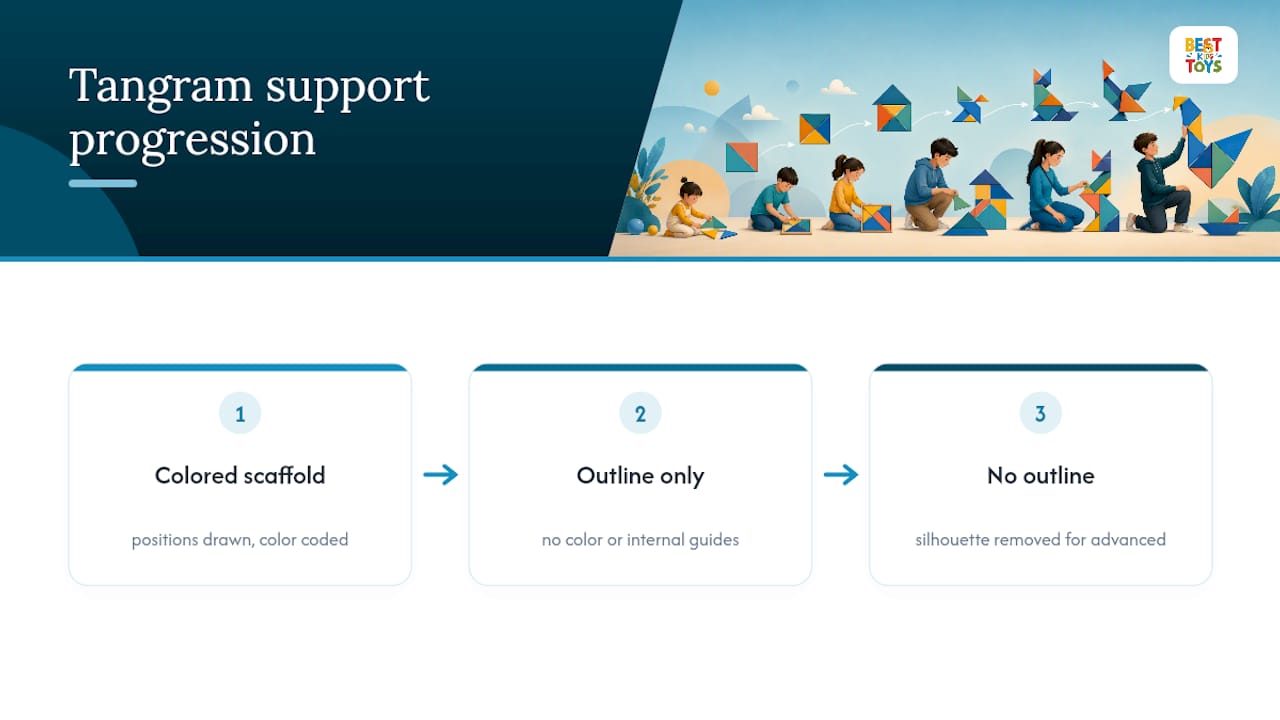
Once a child seems comfortable with the pieces, introduce a labeled outline where each tan’s position is drawn and colored to match. This scaffolded version removes the guesswork of where a piece goes and lets a young child focus purely on rotation and placement.
From there, engagement holds up best when challenges escalate gradually rather than jumping straight to a plain silhouette. Strip away one guide element at a time, first removing color coding, then removing internal lines, then finally removing the outline shape itself for advanced builders.
Keep sessions short. Ten to fifteen minutes is plenty for a young child, and stopping while a puzzle is still fun beats pushing through to the point of frustration. If a child abandons a shape halfway through, that’s not a failure. Set it aside and return to it a day or two later; tangram skills tend to click after a break, not during a forced sit-through.
Narrating your own thinking out loud, saying something like “I wonder if this triangle needs to turn,” models the exact mental process kids need without doing the puzzle for them. That single habit, modeling thought instead of giving answers, does more for long-term engagement than any reward chart ever will.
Common Tangram Struggles and How to Work Through Them
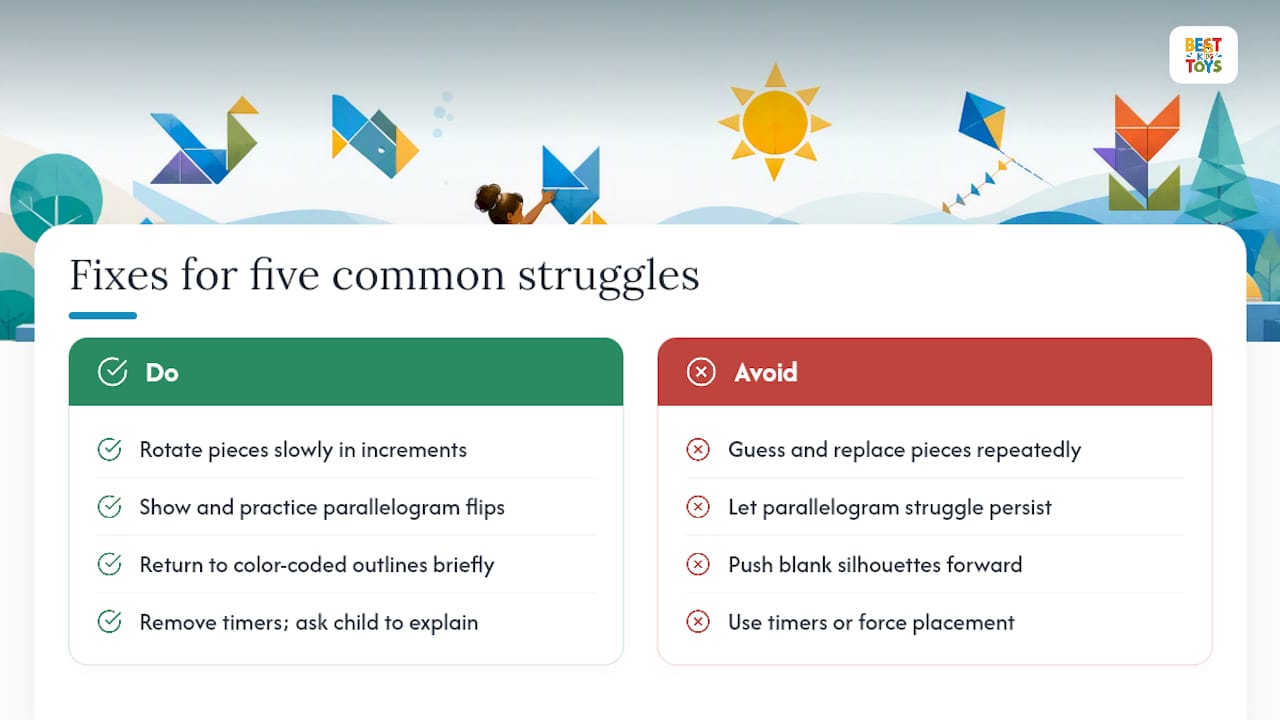
Nearly every child hits the same handful of walls with tangrams, and each one has a specific fix rather than a generic “keep trying.”
Rotation confusion is the most common issue. A child sees a piece is the right shape but can’t figure out why it won’t fit, because it needs to rotate 45 or 90 degrees first. Fix this by having the child physically spin the piece in slow increments while watching the target outline, rather than guessing and re-placing repeatedly.
Forgetting the parallelogram flips trips up almost every new player. Point this out directly the first time it comes up rather than letting a child struggle silently for ten minutes on a shape that’s unsolvable without the flip.
Giving up on ambiguous silhouettes happens once kids move past labeled outlines. The fix here is scaffolding backward, not forward: return briefly to a color-coded version of a similar shape to rebuild confidence, then try the blank silhouette again.
Rushing and forcing pieces into a close-but-wrong position is common with competitive or timer-driven kids. Removing the timer and asking the child to describe out loud why a piece fits before placing it slows this down effectively.
Losing interest in repetitive shapes is a signal to switch formats entirely, not push harder. Moving from copying silhouettes to free-designing original ones, a shift several curriculum resources recommend for renewing interest, usually restores enthusiasm within a session or two.
Measuring Real Progress With Tangram Activities
The clearest sign of progress isn’t a finished puzzle. It’s how much guidance a child needs to get there. Track whether a child moves from needing a fully labeled outline to solving the same shape with just a blank silhouette over several weeks. That shift is the actual marker of growing spatial reasoning, not speed.
A quick formative check that works well in classrooms and at home alike: give a child an unfamiliar silhouette and time how long they go before asking for help or a hint. Educators using tangrams for spatial-skill tracking often rely on short three-to-five-minute checks like this rather than long formal tests, since the puzzle format resists the kind of memorization that skews other assessments.
Rotating kids through three stations, physical tangram sets, a digital puzzle tool, and a free-build creative station, also gives a broader read on where a child’s strengths sit. A kid who breezes through digital rotation puzzles but struggles physically may need more fine motor practice rather than more geometry practice, and that distinction matters for what you assign next.
For a simple home version, keep a small log of which silhouettes a child solved independently versus with help, and revisit it monthly. Watching that list of independent solves grow is a far more reliable outcome measure than any single puzzle session, and it gives caregivers a concrete answer when they wonder whether the activity is actually working.
An Editorial Take on What Actually Makes Tangrams Work
Most tangram advice online treats the puzzle like a worksheet: hand a child a silhouette, watch them solve it, move to the next one. That misses the point. The real value sits in the moments a child sits stuck, turning a piece over and over, before something clicks. Rushing past that discomfort with too much hand-holding is the most common mistake caregivers make, and it’s usually well-intentioned.
The conventional advice to “start simple and add difficulty” is correct, but it undersells how much free, unstructured play matters at every stage, not just the beginning. A ten-year-old who’s mastered every printable silhouette still benefits from an unguided ten minutes of building something original. That’s where creativity and geometric intuition actually fuse, rather than staying as two separate skills practiced in isolation.
If there’s one priority worth taking from all this, it’s patience over pacing. A child who spends fifteen frustrated minutes on one shape and finally solves it independently has learned more than a child who breezed through five shapes with constant guidance. Resist the urge to rescue too early.
— Danica Hodge
Bring Screen-Free Puzzle Play Home With the Right Set
Tangram-adjacent sets are available that are reviewed for piece durability and developmental value, not just low price. If you want a set that survives years of use instead of one school semester, the Montessori magnetic tangram puzzle box is built with travel-friendly magnetic pieces that won’t scatter across the car floor.
For a broader spatial-skills lineup, browse the Montessori STEM toys collection, which pairs well with tangrams for kids who are ready to move from flat puzzles into three-dimensional building challenges. If durability is your main concern, the puzzle and brain games category sticks to solid wood and reinforced finishes rather than thin cardboard. Purchases may come with free shipping over a certain order amount and some form of purchase guarantee, making it easier to try a set at home. Start by browsing the Montessori STEM toys collection and pick the piece size that matches your child’s current stage.
Useful Resources for Tangram Practice
- Math Playground’s tangram puzzles offer leveled, research-backed challenges tied to classroom standards.
- PBS Kids’ Cyberchase tangram game is a safe, ad-light option for independent digital practice.
- Tangram Channel provides hundreds of free printable silhouette patterns for home cutting and lamination.
- For gift-giving guidance by age, Kadopapier’s toy age guide offers useful general benchmarks alongside tangram-specific age tips above.
Sources
- Tangram Puzzles | Math Playground
- PubMed entry related to spatial skill research
- Cyberchase - Tangram Game | PBS KIDS
FAQ
What age is appropriate for tangrams?
Most kids can start with simple, color-guided tangram puzzles around age 4, while full seven-piece silhouettes without guides usually suit kids age 6 and up.
What is tangram for kids?
A tangram is a seven-piece flat puzzle, made of triangles, a square, and a parallelogram, that kids rearrange to recreate silhouettes ranging from simple houses to complex animals.
How can I make a tangram at home?
Print a square template, cut it along the seven internal lines to separate the pieces, and laminate the set or cover it in packing tape for durability.
What skills do tangrams teach?
Tangrams build spatial reasoning and mental rotation, geometry concepts like symmetry and congruence, problem-solving persistence, and fine motor control, with research linking early spatial skill to later math and science performance.