



Best Wooden Puzzles for Toddlers and Young Learners
For most U.S. parents and educators, Thebestkidstoys’ Wooden Hexagon Puzzle is the single best wooden puzzle for toddlers building the pincer grasp and early spatial reasoning. The Car Puzzle Box earns the runner-up spot for transportation-loving kids ages 2–4 who are ready for a problem-solving challenge with a mechanical twist.
Here’s the quick buying verdict:
- Wooden Hexagon Puzzle — best for ages 18 months to 3 years; develops shape recognition and the three-finger pincer grip that prepares little hands for writing
- Car Puzzle Box — best for ages 2–4; combines fine motor practice with cause-and-effect discovery, great for curious toddlers and classroom centers
- For grandparents gifting: either pick works beautifully; the Hexagon Puzzle ships in gift-ready packaging and needs zero setup
- For educators: the Car Puzzle Box supports independent work stations; the Hexagon Puzzle pairs naturally with color and shape lessons
Table of Contents
- What are the best wooden puzzles from Thebestkidstoys?
- How do you choose the right wooden puzzle for your child?
- What does each puzzle type actually teach your child?
- Are wooden puzzles safe, and how do you keep them clean?
- How Thebestkidstoys evaluates and selects wooden puzzles
- Key Takeaways
- Why the “right age” label on a puzzle box isn’t the whole story
- Thebestkidstoys has the wooden puzzles your child is ready for right now
What are the best wooden puzzles from Thebestkidstoys?
Thebestkidstoys curates its wooden puzzle lineup around one principle: every piece should teach something. Montessori-aligned puzzles follow a clear developmental progression from single-shape knob puzzles at around 10–14 months all the way through complex jigsaws by age 5–6, and the picks below map directly to that ladder.
| Puzzle | Best For (Age/Skill) | Difficulty / Pieces | Materials & Finish | Learning Goals |
|---|---|---|---|---|
| Wooden Hexagon Puzzle | 18 mo–3 yr / shape matching | Low / hex pieces | Solid wood, non-toxic finish | Pincer grasp, color ID, spatial reasoning |
| Car Puzzle Box | 2–4 yr / cause-and-effect | Low-medium / 6–8 pieces | Solid wood, smooth sanded edges | Fine motor, problem-solving, sequencing |
| Knob Shape Sorter Board | 10–18 mo / first shapes | Beginner / 3–5 pieces | Thick solid wood, food-safe finish | Pincer grasp, shape recognition |
| Chunky Animal Lift-Out Puzzle | 18–24 mo / pretend play | Beginner / 6 pieces | ~1-inch thick wood, non-toxic paint | Grip strength, animal vocabulary |
| Inset Geography Puzzle | 3–5 yr / content learning | Medium / continent pieces | Plywood frame, non-toxic finish | Geography, spatial mapping, focus |
| Progressive Jigsaw Set (3-level) | 2–3 yr / skill building | Low→Medium / 6→12→20 pieces | Solid wood, realistic imagery | Problem-solving, persistence, sequencing |
| Wooden Memory Matching Game | 3+ yr / memory + matching | Medium / 20 tile pairs | Wood tiles, non-toxic print | Working memory, concentration |
| Montessori Wooden Tetris Toy | 4–6 yr / spatial challenge | Medium-high / open-ended | Solid wood, smooth finish | Spatial reasoning, geometry, persistence |
Why each pick earns its place:
- Wooden Hexagon Puzzle: — Knob puzzles develop the three-finger pincer grasp that directly prepares children for pencil control. The hexagon format adds a geometry layer most basic shape boards skip.
- Car Puzzle Box: — Transportation themes hold toddler attention longer, and the box mechanism rewards sequencing — open, sort, close — rather than just placing pieces.
Storage note: the Wooden Hexagon Puzzle and Car Puzzle Box both store flat or upright on a shelf, making them easy to rotate in and out of a play space without a dedicated bin.
How do you choose the right wooden puzzle for your child?
Matching a puzzle to a child’s current skills takes about five minutes of observation — and the right checklist. Here’s how to think through it.
Age and skill progression
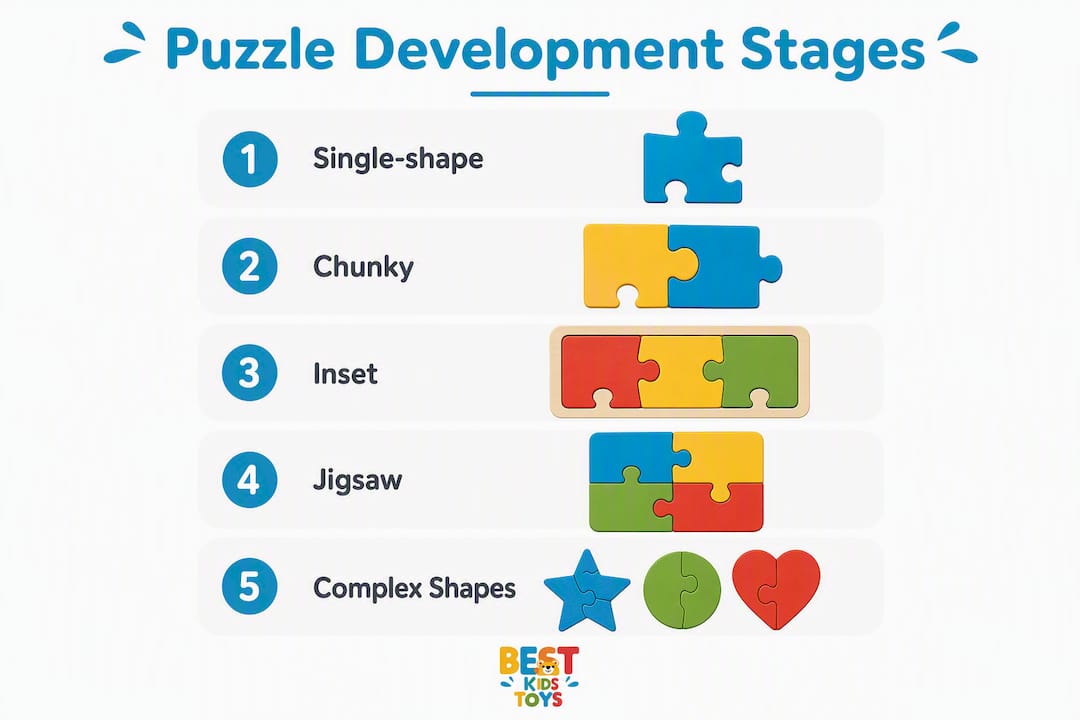
Montessori puzzle progression moves through distinct stages, each isolating a single skill:
- Single-shape knob puzzle (10–14 months) — 1–3 pieces, adult supervision recommended
- Multi-shape knob puzzle (14–18 months) — 3–6 pieces, close supervision
- Chunky lift-out puzzle (18–24 months) — 6–8 thick pieces, nearby adult
- Inset puzzle (2–3 years) — 6–12 pieces, independent with check-ins
- Simple jigsaw (3–4 years) — 12–20 pieces, mostly independent
- Detailed jigsaw (4–6 years) — 20–48 pieces, fully independent
The 5–10 minute difficulty test
Sit with the child and watch. If they complete the puzzle and immediately want to repeat it within 5–10 minutes, the difficulty is right. Signs it’s too easy: finished in under two minutes, no focus, no satisfaction. Signs it’s too hard: more than two minutes of frustration, pieces abandoned, tears. Adjust one step up or down on the progression above.
Durability and finish checklist
- Smooth, sanded edges with no splinters
- Non-toxic, low-VOC paint or finish (look for ASTM F963 compliance)
- Snug piece fit — not so tight a toddler can’t lift it, not so loose pieces fall out
- Solid wood preferred over thin plywood for pieces under 3 inches
Price and value guidance
High-quality wooden puzzles for toddlers typically cost a moderate amount typical for quality children’s toys. A $20 solid-wood knob puzzle will outlast three $8 foam alternatives and pass safely to a younger sibling.
Pro Tip: Instead of buying a harder puzzle every few months, rotate two or three puzzles of slightly different difficulty. When a child masters one, introduce the next level using the “bridge technique” — move to a piece count just a few steps higher (say, 12 to 15 pieces) rather than doubling it. Confidence stays high, frustration stays low.
Quick shopping checklist
- Match the puzzle type to the child’s current developmental stage (see progression above)
- Check for non-toxic finish and ASTM F963 compliance
- Confirm piece thickness is appropriate for the child’s grip strength
- Look for a reference image on the box or puzzle board
- Choose self-correcting designs — pieces that fit only one way support independent learning without adult correction
What does each puzzle type actually teach your child?
The developmental payoff of wooden puzzles is real and measurable by age. Here’s how the skills stack up:
| Age Range | Puzzle Type | Typical Pieces | Key Skills Developed |
|---|---|---|---|
| 10–14 months | Single-shape knob | 1–3 | Pincer grasp, object permanence, cause-effect |
| 14–18 months | Multi-shape knob | 3–6 | Shape discrimination, hand-eye coordination |
| 18–24 months | Chunky lift-out | 6–8 | Grip strength, pretend play, vocabulary |
| 2–3 years | Inset / peg puzzle | 6–12 | Spatial reasoning, color/shape matching, focus |
| 3–4 years | Simple jigsaw | 12–20 | Problem-solving, persistence, fine motor precision |
| 4–6 years | Detailed jigsaw / floor puzzle | 20–48 | Collaboration, sequencing, geography/content |
Floor puzzles with 24–48 pieces suit ages 3–6 particularly well for group settings because children move around the image and naturally divide sections, building early collaboration skills alongside gross-motor engagement.
Extending the learning beyond the puzzle:
- Language prompts: “What color is that piece?” or “Where does the car go?” while a toddler works a knob puzzle builds vocabulary without interrupting focus
- Counting: Ask a 3-year-old to count pieces before starting — it turns setup into a math moment
- Storytelling: Once chunky animal pieces are lifted out, invite the child to act out a scene — this is where the wooden Montessori approach to natural materials really shines, because open-ended pieces spark imagination that plastic characters rarely do
Are wooden puzzles safe, and how do you keep them clean?
Wooden puzzles are among the safest early toys when they meet the right standards. Here’s what to check and how to maintain them.
Safety checklist before purchase:
- Knobs sized for a three-finger pinch, not an oversized mushroom grip that bypasses fine-motor development
- No pieces small enough to pass through a 1.75-inch choke-test cylinder for children under 3
- Non-toxic, low-VOC finish compliant with ASTM F963 and CPSC guidelines
- No sharp corners or rough edges on the frame
Wooden puzzles resist bending and hold up to repeated toddler use in ways foam alternatives simply don’t — a well-made solid-wood puzzle can serve two or three children across several years.
Safety note: This article provides general guidance. Always verify current ASTM F963 and CPSC standards for your child’s specific age group before purchasing.
Cleaning and care steps:
- Wipe pieces with a damp cloth and a drop of mild dish soap
- Dry immediately with a clean towel — never soak or submerge wooden pieces
- Store flat or upright in a dry location away from direct sunlight to prevent warping
- Check knobs monthly; re-glue any that feel loose with non-toxic wood glue
- Sand any rough spots lightly with fine-grit sandpaper and wipe clean
When to retire a puzzle: Splitting wood, a knob that won’t re-seat, or paint flaking off are all signs to remove the puzzle from rotation. A puzzle that’s past its prime isn’t worth the safety risk, no matter how much a child loves it. Eco-friendly wooden toys made with sustainably sourced wood and water-based finishes tend to hold up longer and are easier to clean safely.
How Thebestkidstoys evaluates and selects wooden puzzles
Every puzzle recommended on Thebestkidstoys goes through a structured review before it earns a spot in the catalog. The process prioritizes developmental fit first, safety second, and durability third — in that order, because a puzzle that doesn’t match a child’s stage won’t get used regardless of how well it’s made.
Evaluation criteria:
- Developmental fit: Does the puzzle isolate a single skill and match a specific age-stage milestone?
- Materials inspection: Solid wood or quality plywood, smooth finish, non-toxic paint, snug piece fit
- Play testing: The 5–10 minute rule — appropriate difficulty keeps a child engaged and returning for repeats
- Durability cycles: Pieces are checked for knob stability, edge integrity, and finish adhesion after repeated handling
- Packaging and storage: Does the puzzle store cleanly? Is the reference image visible on the box or board?
- Safety checklist: ASTM F963 compliance, choking-hazard assessment, finish toxicity review
This review process is led by Danica Hodge, whose work focuses on Montessori-aligned toy selection and developmental play. Parents and educators seeking product test data or classroom case studies are welcome to reach out to Thebestkidstoys directly for additional documentation.
Key Takeaways
The single most effective wooden puzzle strategy is matching piece count and puzzle type to the child’s current developmental stage, then moving up gradually using the bridge technique rather than jumping difficulty levels.
| Point | Details |
|---|---|
| Follow the progression | Move from single-shape knob → chunky → inset → jigsaw as skills grow, not by age alone. |
| Use the 5–10 minute test | A puzzle finished and repeated in that window is the right difficulty; adjust one step if not. |
| Prioritize safety standards | Look for ASTM F963 compliance, non-toxic finish, and knobs sized for a three-finger pinch. |
| Rotate, don’t replace | Cycling 2–3 puzzles of slightly different difficulty builds confidence better than constant upgrades. |
| Thebestkidstoys’ top pick | The Wooden Hexagon Puzzle suits ages 18 months to 3 years for pincer grasp and shape recognition. |
Why the “right age” label on a puzzle box isn’t the whole story
Age ranges printed on puzzle boxes are a starting point, not a verdict. A confident 18-month-old who has been working knob puzzles since 12 months will outpace a 2-year-old encountering puzzles for the first time. The developmental stage matters far more than the birthday.
What most buying guides miss is the self-correction principle. A puzzle that only fits one way teaches a child to trust their own hands and eyes rather than waiting for an adult to say “good job.” That independence is the real gift — and it’s why Montessori educators have favored simple, realistic wooden puzzles over flashy, character-branded alternatives for decades. Bright colors and cartoon faces pull a child’s attention to the image rather than the shape, which undermines the spatial reasoning the puzzle is supposed to build.
The Car Puzzle Box is a good example of this done right: the vehicle theme holds attention, but the mechanism rewards sequencing logic, not just recognition. That’s the balance worth looking for in any high-quality wooden puzzle you bring home.
Thebestkidstoys has the wooden puzzles your child is ready for right now
Thebestkidstoys takes the guesswork out of puzzle shopping by organizing every pick around developmental stage, not just age. The Wooden Hexagon Puzzle is ready to ship today, and the full collection spans toddler first-puzzles through preschool spatial challenges.
Browse by age to find the right fit fast: ages 3–4, ages 4–5, and ages 5+ each have curated puzzle options matched to the milestones covered in this guide. Free shipping applies on orders over $60, and current promotions include up to 40% off select items. For classroom or bulk orders, contact Thebestkidstoys directly — the team can help match puzzle sets to specific learning goals and group sizes. If a specific puzzle is out of stock, the full toy collection always has age-appropriate alternatives ready to go.
Recommended
- Unlock Cognitive Development with the Wooden Hexagon Puzzle the Best Kids Toy Among Trending Toys to Buy for Your Child – Best Kids Toys
- The Best Car Puzzle Box for Kids and Gift Buyers – Best Kids Toys
- Wooden Memory Game for Toddlers For Cognitive Skills Development – Best Kids Toys
- Unlock Your Toddler’s Memory Skills with the Wooden Memory Chess Game a Top Choice Among the Best Toys for Kids and Trending Toys to Buy – Best Kids Toys