



Parents: 6 Sibling Play Ideas That Stop Fights Across Age Gaps
The best approach to sibling play ideas favors cooperative and mixed-age-friendly activities over head-to-head competition, since teamwork tasks lower conflict by giving everyone the same goal instead of a winner and a loser. Rotate through six categories, cooperative, competitive, creative, sensory, movement, and quiet play, and you’ll always have a low-prep option ready. Each category below comes with concrete, ready-to-run examples.
TL;DR:
- Cooperative activities like blanket forts and group science experiments significantly reduce sibling conflicts by focusing on shared goals rather than competition.
- Structured rivalry through scavenger hunts, relay races, and target tosses can foster teamwork while channeling competitiveness healthily.
- Role assignment based on age and ability, along with clear task rotation, keeps activities engaging and prevents power struggles.
- Sensory and parallel play setups allow mixed-age siblings to stay engaged without requiring the same skills or sharing materials directly.
- Setting ground rules, time limits, and safety precautions helps prevent meltdowns and maintains a positive environment for sibling play.
Table of Contents
- Fast Sibling Play Ideas To Try Today
- Cooperative Games And Projects That Build Teamwork
- Competitive Games That Keep Rivalry Friendly
- Creative And Pretend-Play Activities Kids Lead Together
- Sensory And Parallel-Play Setups For Mixed Ages
- Matching Roles To Age Gaps
- How To Set Up Play Without The Meltdowns
- Who’s Behind This Guide
- What Actually Moves The Needle Here
- Toys That Make These Activities Easier To Run
- Sources
- FAQ
Fast Sibling Play Ideas To Try Today
If you need something to hand your kids in the next five minutes, start here. Each category solves a different problem, so keep this list handy for whichever mood your household is in.
- Cooperative games: shift the goal from “who wins” to “did we succeed together” which cuts down on arguments fast. Try a blanket fort where one sibling gathers pillows and the other holds up the structure.
- Competitive games: channel rivalry into something structured instead of letting it turn into bickering. A simple beanbag toss with rotating judges works well.
- Creative and pretend play: let an older sibling direct while a younger one performs, building leadership and imagination together. A two-person puppet show with socks as puppets takes ten minutes to set up.
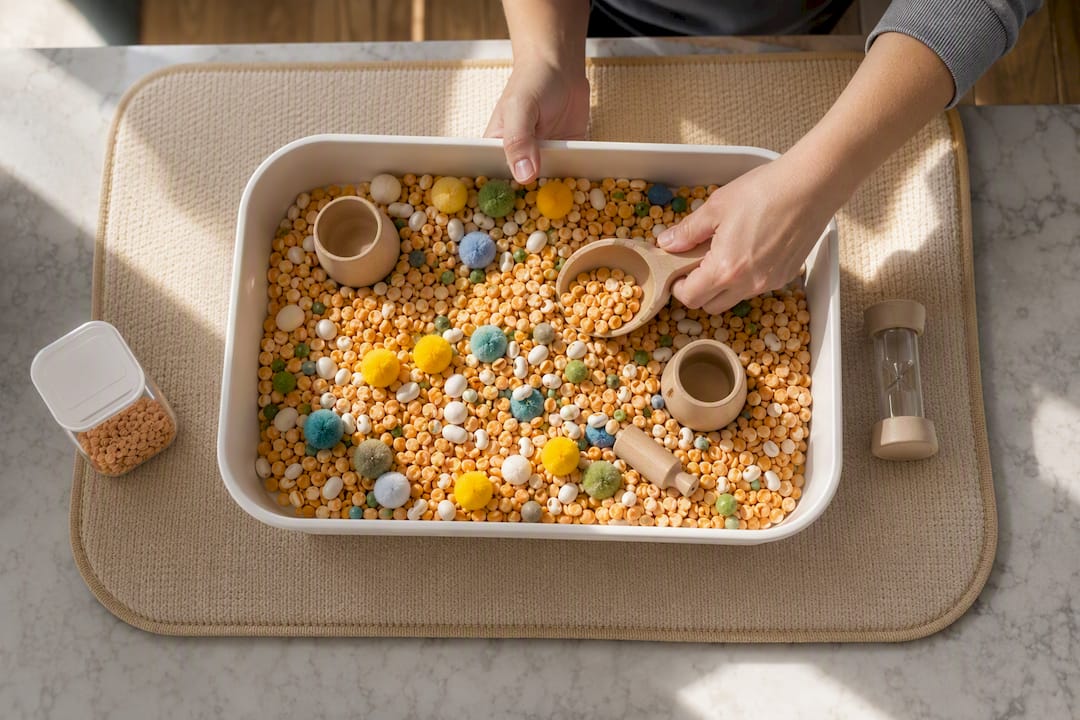
- Sensory and parallel play: put kids side by side, doing related but separate tasks, so nobody has to share materials directly. A dry rice bin with scoops and cups for each child works for a toddler and a preschooler at once.
- Movement and outdoor play: burn energy together, which tends to mean fewer meltdowns later in the day. Bubbles and a simple obstacle course made from couch cushions cover most ages.
- Quiet play: wind things down with synchronized drawing or a shared audiobook when everyone needs to reset.
Cooperative Games And Projects That Build Teamwork
Cooperative games work because they remove the win/lose structure that fuels most sibling arguments. When siblings share a single goal instead of competing for one prize, the frequency of squabbles drops noticeably, since nobody is trying to beat the other person to get something.
Here are activities worth trying this week:
- Blanket fort building. One sibling gathers cushions and blankets; the other holds structure and directs placement.
- Cooperative mural. Roll out a long strip of paper and assign each child a section, then let them blend the middle together.
- Keep the balloon up. Both kids work to keep one balloon off the floor, no scorekeeping, just shared effort.
- Team charades. Pair up against a parent or another sibling pair so the “us versus them” energy points outward, not at each other.
- Collaborative skit. One child writes a simple plot, the other performs it, then swap roles for a second scene.
- Group science experiment. A baking-soda volcano needs a pourer and a mixer, giving each child a job.
- Puzzle relay. Split a large puzzle into sections, each child owns one, and they meet in the middle.
Pro Tip: Put your kids “against the house” whenever you can. Framing an activity as siblings versus a shared challenge, like beating a timer or solving a puzzle together, turns them into teammates instead of rivals almost instantly.
One especially effective trick is forced cooperation: physically link the kids in a task, like holding a balloon between their hips while walking, so neither one can dominate the activity. It strips out the opportunity to compete and replaces it with coordination.
Competitive Games That Keep Rivalry Friendly
Not every activity has to avoid competition. Structured rivalry, with clear rules and low stakes, can be just as bonding as teamwork, as long as the format keeps things fair.
- Differentiated scavenger hunts. Give younger kids picture clues and older kids simple riddles, so both finish around the same time.
- Relay races. Break a course into stages matched to each child’s ability, toddlers crawl, older kids run.
- Target toss. Beanbags or soft balls aimed at a bucket work for a wide age range with adjustable distances.
- Rotating judge system. Let a sibling take turns being the “referee” for a round, which gives the competitive urge somewhere useful to go.
- Team variants. Pair an older and younger sibling against another pair, so skill gaps even out.
Watch for warning signs that competition is turning sour: name-calling, one child refusing to play again, or a “win” that leaves the loser in tears every time. If that pattern repeats, switch that activity to a cooperative format for a few weeks before trying competition again.
Creative And Pretend-Play Activities Kids Lead Together
Pretend play gives an older sibling a natural leadership role while letting a younger one join in without needing the same skills. That gap in ability actually works in your favor here, since make-believe scenarios flex to fit each child’s developmental stage.
- Puppet show with assigned roles. One sibling writes the story, the other performs it, using socks, paper bags, or dedicated puppet toys.
- Collaborative sculpture. Playdough, clay, or building blocks, each child adds a piece to a shared creation.
- Pretend restaurant or pet store. One sibling runs the “front of house,” the other manages the “back,” and roles swap halfway through.
- Synchronized drawing. Both kids draw the same prompt at the same time, then compare results and swap stories about them.
Keep props simple: cardboard boxes, old sheets, and a basket of dress-up clothes go further than anything elaborate. For structured scaffolding, role-play toys built around real-world scenarios give younger kids an easy entry point, while pretend-play sets that build communication skills help the older sibling practice patience and instruction giving. Outside research on pretend play’s role in toddler development backs up why this category matters so much for younger siblings specifically.
Sensory And Parallel-Play Setups For Mixed Ages
Sensory bins solve the problem competitive games can’t: they let kids of very different ages play “together” without needing the same skills or even touching the same materials. Adjusting the materials and tasks inside a shared sensory station means a toddler and an elementary-age sibling can sit at the same table and both stay engaged.
- Rice or bean bin. Add scoops, cups, and small toys, then let each child work their own section.
- Ramp races. Set up a cardboard ramp and let each sibling test a different vehicle, comparing speed and distance.
- Picture-clue scavenger hunt. Pair photo clues for pre-readers with simple written riddles for older kids, letting everyone finish close together.
- Water table with tools. Funnels, sponges, and cups keep hands busy without requiring cooperation.
For safety, choose taste-safe materials for children under three, contain loose items in a low-sided bin, and set cleanup expectations before you start. A towel underneath the bin turns a ten-minute cleanup into a two-minute one.
Setup checklist: containment tray, age-appropriate fillers, a designated “mess zone,” and a timer if you want a clear end point.
Matching Roles To Age Gaps
The fastest way to reduce conflict in any activity is to hand each child a role that fits their actual ability. Assigning tasks like gatherer, builder, tester, or storyteller gives kids something meaningful to do instead of competing for the same job.
- Toddler and preschooler: favor parallel play over shared tasks. Give the toddler a scoop-and-pour role in a sensory bin while the preschooler builds nearby.
- Preschooler and elementary-age: cooperative tasks work well here. The elementary kid can be the “builder” on a fort while the preschooler is the “gatherer” of pillows and blankets.
- Elementary and tween: the tween can take on a “storyteller” or director role in a skit, while the younger sibling performs, keeping both engaged without a skill mismatch.
When one sibling keeps grabbing the lead role, rotate responsibilities: leader one round, helper the next, timed at five minutes each, so nobody gets stuck being bossed around for the whole activity.
How To Set Up Play Without The Meltdowns
A few ground rules before you start save you from stepping in every ten minutes. Set a timebox for each activity, agree on a “safe zone” for anyone who needs a break, and use a turn token, any small object works, to signal whose turn it is to lead.
- Check the clock: tired or hungry kids escalate faster, so time activities around naps and meals.
- Clear the environment of anything genuinely fragile before handing over “leader” status to a younger sibling.
- Keep a simple script ready for conflict.
Pro Tip: Try this line when tempers flare: “I can see you both want to play this. Let’s give each of you a job for five minutes, then switch.” It creates structure fast and works better than a long explanation about why sharing matters*.*
Always double-check materials for choke hazards when a toddler is in the mix, even if the activity was designed with an older sibling in mind.
Who’s Behind This Guide
This guide comes from Danica Hodge, who writes about child development and screen-free play for families navigating mixed-age households. Her focus stays practical: what actually reduces conflict at home, not just what sounds good in theory.
The catalog is built around the principle of supporting specific kinds of sibling interaction rather than appearance alone, including categories like sensory bins, cooperative board games, and pretend-play kits. That’s the filter behind every product recommendation you’ll see here: does it actually give siblings a reason to play together.
What Actually Moves The Needle Here
Most advice on sibling play treats every activity like it should be either “educational” or “fun,” as if those are separate categories. That framing misses the real lever: structure. A cooperative mural and a competitive relay race can teach the exact same thing, patience, turn-taking, shared attention, if the roles are clear and the stakes are low.
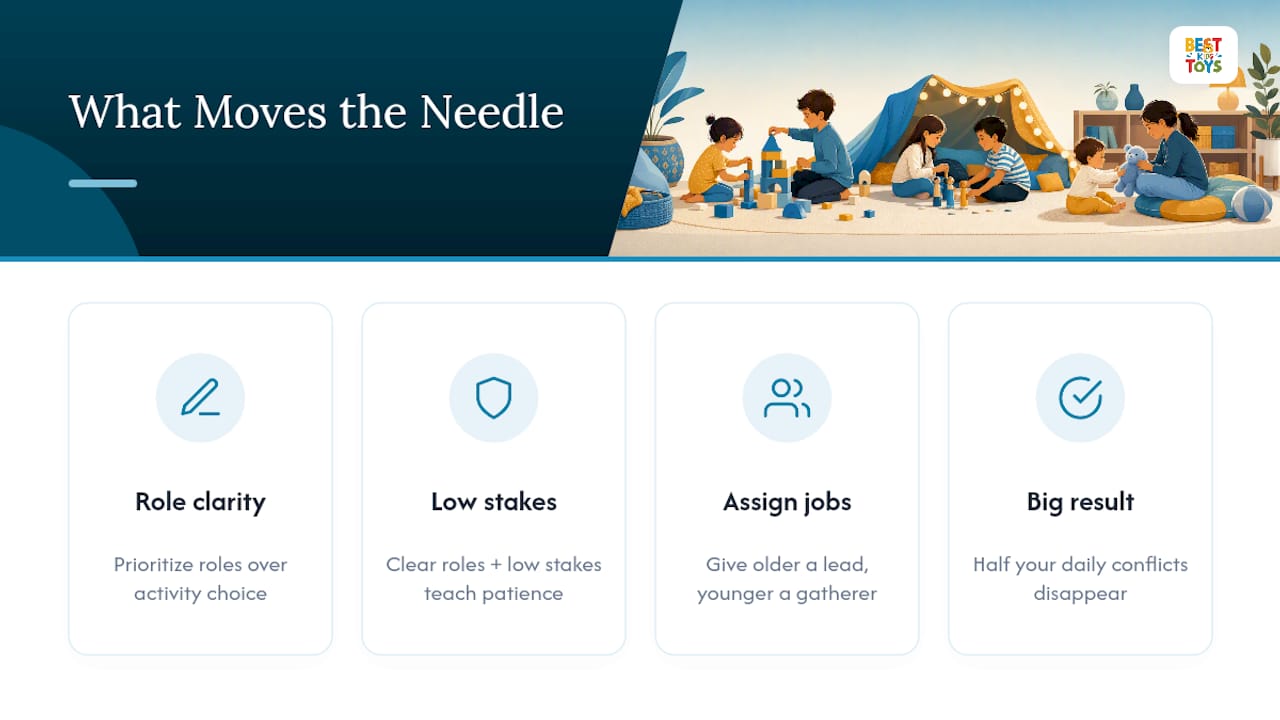
The conventional advice to just “let them work it out” undersells how much a five-minute role assignment prevents. Kids don’t need constant referee-ing. They need a job. Give a bossy older sibling something to lead and a clingy younger one something to gather, and half your daily conflicts disappear before they start.
If you take one thing from this guide, prioritize role clarity over activity choice. The blanket fort, the sensory bin, the puppet show, none of it matters as much as whether each child walked in knowing what their job was.
— Danica Hodge
Toys That Make These Activities Easier To Run
Product categories include sensory bin fillers, cooperative board games, and pretend-play sets that map onto sensory, teamwork, and imagination-based play ideas, reducing the need to find household materials.
For a preschooler paired with a toddler, the 3–4 years collection leans toward open-ended sensory and building pieces that hold up under rough handling. Once your older child moves into elementary school, the 4–5 years and 5+ collections shift toward cooperative games and creative kits that give them more leadership room. Look for durability first, since sibling play means double the wear, and check that a set includes enough pieces for two kids to each have a real job. If you’re not sure where to start, the Little Learners Montessori Busy Book works well as a shared activity for a younger sibling paired with an older helper.
Sources
- 10 Activities to Help Siblings Get Along | iMom
- Sibling activities | What Do We Do All Day
- 50 Activities for Siblings to Play Together | Inspiration Laboratories
FAQ
What are some fun activities for bored siblings?
A blanket fort build, a cooperative mural, or a picture-clue scavenger hunt all work well because they give each sibling a clear role and a shared goal, which keeps boredom from turning into bickering.
What are some fun activities I can do with my brother?
Team-based challenges like relay races, collaborative skits, or a keep-the-balloon-up game work across most age gaps and turn sibling energy into teamwork instead of rivalry.
What are some sibling bonding activities?
Cooperative games, like building a fort together or a group science experiment, tend to bond siblings faster than competitive ones because the goal is shared success rather than one winner.
What are some fun sideline activities for siblings?
Quiet parallel-play options, such as synchronized drawing or a shared sensory bin, work well as sideline activities since each child stays engaged without needing to interact constantly.