



Cooperative Board Games Kids Actually Want to Keep Playing
For kids 4 to 5, the right pick is a short, tactile cooperative game with big pieces and no reading required. For kids 6 to 8, mystery and light-strategy co-ops keep growing minds busy while the whole family works toward one goal. And if you want one box that flexes for both age groups, look for a title with adjustable rules or “helper” roles built in.
Quick picks to try first:
- Ages 4–5: 3 Little Pigs — a ten-minute, toddler-friendly first cooperative game.
- Ages 6–8: Outfoxed! — a mystery-solving co-op with an evidence scanner and adjustable difficulty.
- Mixed ages: Team Labyrinth — a maze-collecting co-op that scales from young helpers to strategic older kids.
Keep reading for the full breakdown by age, plus how to introduce cooperative play without a meltdown when the fox gets away. If you’d rather browse curated, Montessori-informed picks by age, Thebestkidstoys has collections ready to go.
Key Takeaways
Cooperative games work best when playtime, component size, and rule flexibility match a child’s actual skill level rather than the age printed on the box.
| Point | Details |
|---|---|
| Match playtime to attention span | Preschool co-ops run about 10 minutes; ages 6 to 8 handle 20 to 45 minutes comfortably. |
| Start below the printed age if unsure | A simpler first experience builds confidence faster than a frustrating one above skill level. |
| Assign roles, not just turns | Give younger kids physical tasks and older kids planning tasks so both stay engaged. |
| Model calm during shared losses | Praise teamwork and effort out loud, since team losses are natural teaching moments. |
| Shop curated, age-based picks | Thebestkidstoys’ 4 to 5 and 5 and up collections group Montessori-informed options by developmental stage. |
Table of Contents
- Why Cooperative Games Help Young Kids Bond and Grow
- How to Pick an Age-Appropriate Cooperative Game
- Best Cooperative Games for Ages 4 to 5
- Best Cooperative Games for Ages 6 to 8
- Cooperative Games That Grow With Mixed-Age Families
- Introducing Cooperative Play Without the Meltdown
- Accommodating Different Skill Levels at the Same Table
- Common Cooperative Mechanics and Why Kids Respond to Them
- What Actually Matters More Than the Box Says
- Frequently Asked Questions
- Sources
Why Cooperative Games Help Young Kids Bond and Grow
Cooperative games change the emotional math of playtime. Instead of one kid winning and everyone else losing, the whole table wins or loses together, and that shift matters more than it looks. Kids who fear “being bad” at a game will often refuse to play again after a rough loss. Take away the head-to-head competition, and that fear mostly evaporates, which is why cooperative mechanics are so often the entry point into board gaming for preschoolers and shy older kids alike.
They also do something competitive games rarely do well: force real conversation. A child scanning a card for clues has to describe what she sees. A sibling holding the map has to explain a route out loud. That back-and-forth is social-emotional learning in action, and Playworks’ guide on game-based SEL points to exactly this kind of structured, low-stakes negotiation as a way to build communication skills without a worksheet in sight.
Playtime matters more than most parents realize when picking a title. A 4-year-old’s attention span rarely survives a 45-minute game, no matter how charming the pieces are.
- Games built for preschoolers typically run a short duration per round suitable for young attention spans.
- Games aimed at 6 to 8 year olds often run 20 to 45 minutes, depending on complexity.
- If a box lists a playtime near the top of that range, plan on your child needing a break halfway through the first few sessions.
Matching playtime to attention span is the single easiest way to avoid a game gathering dust on the shelf after one frustrated afternoon.
How to Pick an Age-Appropriate Cooperative Game
Age labels on the box are a starting point, not a guarantee. A game marked “ages 6+” might genuinely challenge one 6-year-old and bore another who’s been playing games with older siblings for years. Watch how your child handles turn-taking and simple rule-following in everyday moments, and let that guide you more than the printed number.
Here’s a practical order of operations for evaluating any cooperative game before it lands in your cart:
- Compare printed age to demonstrated skill. If your child struggles to wait their turn during a card game, start a notch below the suggested age rather than above it.
- Check the real playtime, not just the box. A “20 minute” listing often means 20 minutes once everyone knows the rules. Budget closer to 30 for the first attempt.
- Scan for small parts. Games with tiny tokens, dice, or figures need a choking-hazard check if you have a child under 3 in the house too.
- Look for a simplified variant in the rulebook. Many family cooperative games include an easier mode or fewer required steps for younger players, and that flexibility is worth more than flashy components.
- Count your actual players. A game that lists “2 to 4 players” won’t flex for a family of five without someone sharing a turn or sitting out.
Pro Tip: Before buying, search the game’s name plus “rules” online and skim the first page. If the core objective takes more than two sentences to explain, it’s probably a stretch for a first-time 5-year-old player, no matter what the box says.
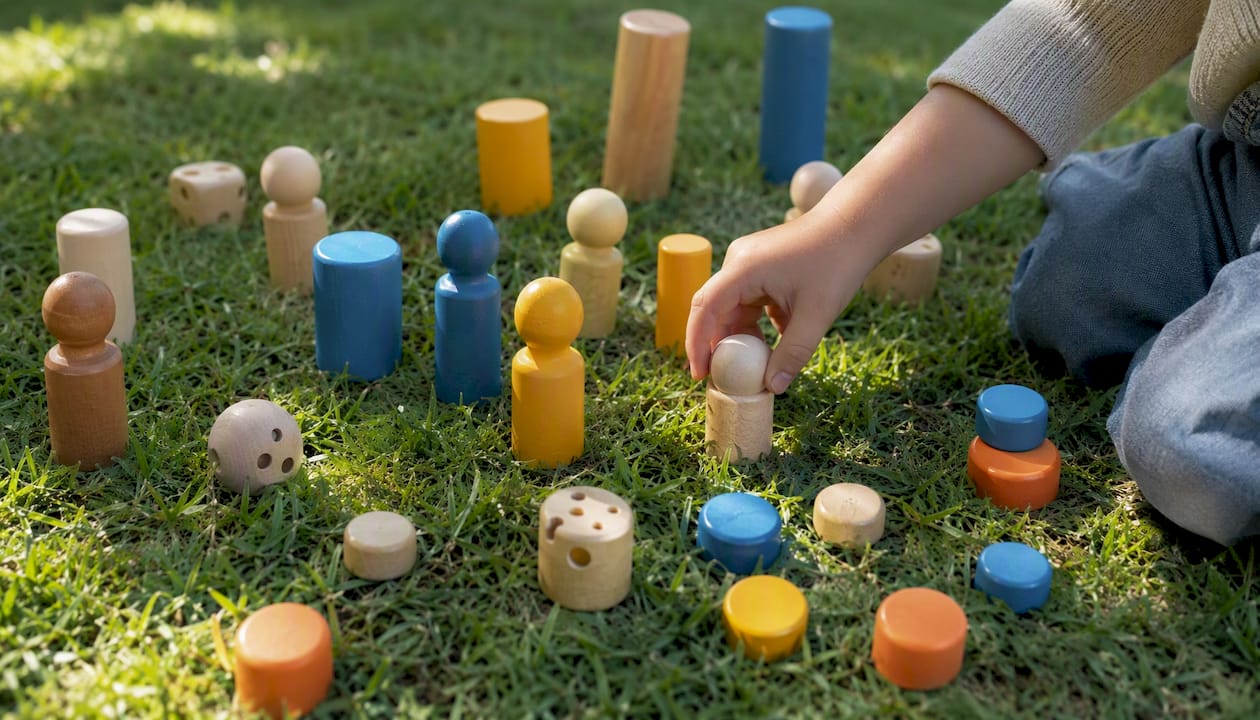
Component safety deserves its own moment here. Wooden movers, oversized dice, and chunky cardboard pieces are safer bets for the 4 to 6 crowd than games with beads, small figurines, or fold-out plastic tools. If you’re shopping for a household with a toddler underfoot too, tactile-friendly, large-format pieces do double duty as safe and satisfying to hold.
Best Cooperative Games for Ages 4 to 5
Preschoolers need games that reward participation over strategy. At this age, the win is showing up, taking a turn, and staying at the table for the whole round. These titles keep things short, tactile, and forgiving.
- 3 Little Pigs — Built specifically as a first cooperative game for preschoolers, it runs about ten minutes with oversized, toddler-friendly pieces. Kids race the wolf to finish building houses together, which teaches color recognition and turn-taking without any reading involved.
- Hoot Owl Hoot! — Players move owl pieces around a board together, racing the sunrise back to the nest. The shared movement mechanic means even a 4-year-old who can’t strategize yet still meaningfully helps the team.
- Outfoxed! (introduced early) — Though it also works beautifully for 6 to 8 year olds, its evidence-scanner mechanic is simple enough for a patient 5-year-old to enjoy with a parent guiding the early rounds, according to its own game description.
- Simple path-mover co-ops — Games built around moving a shared token toward one finish line (rather than competing tokens) are ideal warm-ups; they teach dice-reading and patience in one low-pressure package.
- Matching-based cooperative games — Titles that use matching pairs as the core mechanic double as memory and shape-recognition practice, which lines up well with Montessori-style skill building.
A few of these, including Outfoxed!, quietly grow with your child: the same box that’s a gentle first mystery at 4 becomes a genuinely engaging deduction challenge by 7 or 8, since the difficulty adjusts with how the group chooses to play. Watch for loose small parts in any preschool title, and always supervise first plays if a game includes dice, spinners, or tiny wooden pieces.
Best Cooperative Games for Ages 6 to 8
Once kids can read simple words, follow multi-step rules, and hold a plan in their head for more than a few seconds, a wider world of cooperative games opens up. This age group is where deduction, light strategy, and genuine team planning start to click, and where the games get fun enough that parents stop just supervising and start actually playing.
- Outfoxed! — A fully cooperative mystery for ages 4 and up, with 2 to 4 players and a playtime around 20 to 30 minutes. Kids scan cards with a toy “evidence detector” to narrow down which fox stole the prize pie, and the reasoning required scales naturally as kids get older.
- Team Labyrinth (Labyrinth Team Edition) — This cooperative rework of the classic tile-sliding maze game runs 30 to 45 minutes for 2 to 4 players, and the whole group has to coordinate a shifting maze before their shared card deck runs out. It’s a strong pick for kids who like spatial puzzles.
- Andor: The Family Fantasy Game — Adapted from a beloved adult cooperative classic, this family version introduces role-play and light strategy for kids around 5 to 8, with playtimes of 20 to 45 minutes depending on the scenario chosen.
- Ticket to Ride: First Journey — Technically a family route-building game rather than a pure cooperative title, it’s worth including because it teaches planning and turn management in a format that pairs naturally with true co-ops as a “next step up” for kids ready for more strategy.
- Zombie Kidz Evolution — A favorite among parent communities on hobby forums, this game rewards the team with new rules and stickers as they win, which keeps replay value high for kids who master a game quickly and want fresh challenges.
Games like Outfoxed! and Andor also happen to be ones adults genuinely enjoy playing, not just supervising, and that matters more than it sounds. When a parent is an engaged partner rather than a bored referee, families tend to play more often, according to observations from hobby gaming outlets that track which titles actually get replayed at home.
Cooperative Games That Grow With Mixed-Age Families
The real test of a family game isn’t whether your 7-year-old likes it. It’s whether your 4-year-old and your 8-year-old can both play it at the same table without one of them checking out from boredom or frustration. The games that pull this off share a few specific design tricks.
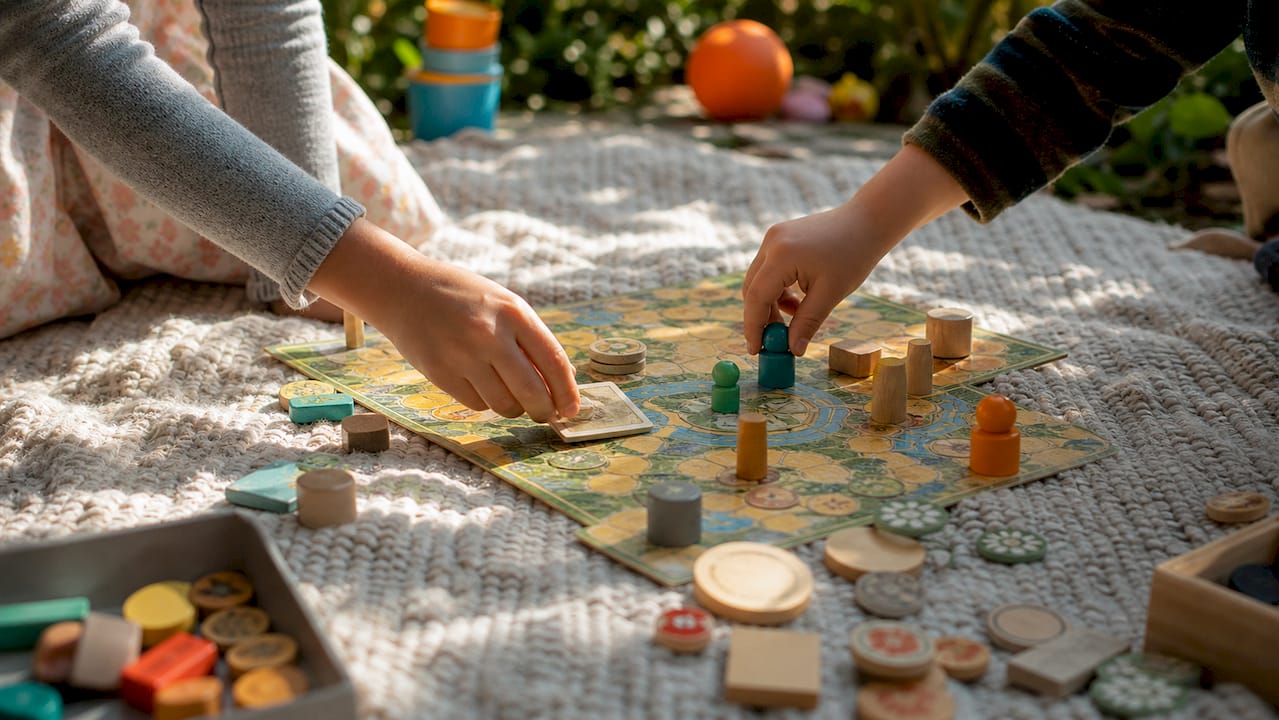
Look for modular difficulty, where the rulebook offers a shorter deck, fewer required objectives, or an easier win condition. Team Labyrinth and Andor both include options like this, letting you dial the challenge up or down mid-session. Assigned roles help too. Giving a younger sibling the job of “card holder” or “dice roller” lets them contribute meaningfully even if they can’t follow the full strategic thread yet.
Some cooperative games also lean on assist tokens, letting an older player “help” a younger one on a hard turn without simply taking over. This is a detail worth watching for on the box or in online rule summaries, since it’s one of the clearest signs a game was actually designed with siblings of different ages in mind.
- Give the youngest player the simplest physical task (moving a piece, rolling dice) rather than the decision-making role.
- Rotate who calls the “final answer” each round so no single kid dominates the thinking.
- Shorten the deck or remove a few harder cards before the first few plays, then add them back in as confidence builds.
Pro Tip: If a rulebook doesn’t offer a built-in easy mode, make one. Pull five of the hardest cards out of the deck before your child’s first play, then reintroduce them once the basic loop feels comfortable.
Introducing Cooperative Play Without the Meltdown
The first play of any new game sets the tone for every play after it. Rush the rules, and kids check out. Skip straight to a full round, and a rough loss can sour the whole title before it gets a fair shot. A little structure in the first session goes a long way.
- Read a simplified version of the rules out loud. Skip the fine print and boil the goal down to one sentence: “We’re all trying to catch the fox before it escapes.”
- Play a short demo round with the cards face up or an easier setup. Let kids see how a turn works before the real stakes kick in.
- Celebrate the team win loudly, even a small one. If the group survives round one, that’s worth a cheer.
- When the group loses, model calm before anything else. Kids take their emotional cue from the adult at the table.
Phrasing matters here more than most parents expect. Instead of “we lost,” try “we almost had it, let’s see what we’d do differently.” Praise effort and teamwork specifically: “You noticed that clue first, that’s exactly what we needed.” According to Playworks’ guide on game-based SEL, shared losses in cooperative settings are genuine teaching moments for emotional regulation, precisely because nobody’s being singled out as “the loser.”
A team loss lands differently than a personal one. It’s a chance to talk about what the group would try next time, not who let everyone down.
If frustration is building mid-game, don’t push through — for strategies on managing tricky moments like cheating or conflict, see what to do about it. Shorten the round, hand out a helper token, or pause to re-explain a step that clearly didn’t land. A five-minute reset beats a game that ends in tears and gets shoved in the closet for a year.
Why We Recommend These Picks
These recommendations come from Danica Hodge, whose writing on family game night and social skill-building and board games that build critical thinking shapes how Thebestkidstoys approaches play recommendations generally.
Every pick reflects the same standards Thebestkidstoys applies across its catalog:
- Montessori-informed curation, prioritizing open-ended, skill-building play over flashy but shallow mechanics.
- A product safety review process focused on age-appropriate components and choking-hazard checks.
- A preference for games and toys with genuine long-term play value, not one-and-done novelty.
[AUTHOR CREDENTIALS PLACEHOLDER] [PROPRIETARY DATA PLACEHOLDER]
Accommodating Different Skill Levels at the Same Table
Siblings rarely arrive at a cooperative game with matching abilities, and that’s fine, because most well-designed co-ops don’t need them to. The trick is assigning tasks that match each child’s actual skill, not their age on paper.
Give a strong reader the job of reading clue cards aloud, while a younger sibling handles the physical piece-moving. If one child gets frustrated faster, let them hold a “veto” token that lets them ask the group to reconsider a decision, so they feel involved without carrying the full planning load. Some cooperative games also include flexible modes that let a parent quietly scaffold play, removing tricky cards or shortening the deck so a younger player’s choices still meaningfully affect the outcome while an older sibling handles more of the planning.
Rotate roles every few rounds rather than locking one kid into “the easy job” permanently. A child who always holds the dice never gets a chance to practice reasoning, and a child who always makes the calls never learns patience. Swapping jobs keeps the game fair and keeps every player invested in the shared goal, which is the entire point of choosing a cooperative format over a competitive one in a mixed-age household.
Common Cooperative Mechanics and Why Kids Respond to Them
Most cooperative games for kids lean on a small set of mechanics, and understanding them helps you predict whether a new title will click with your child before you buy it.
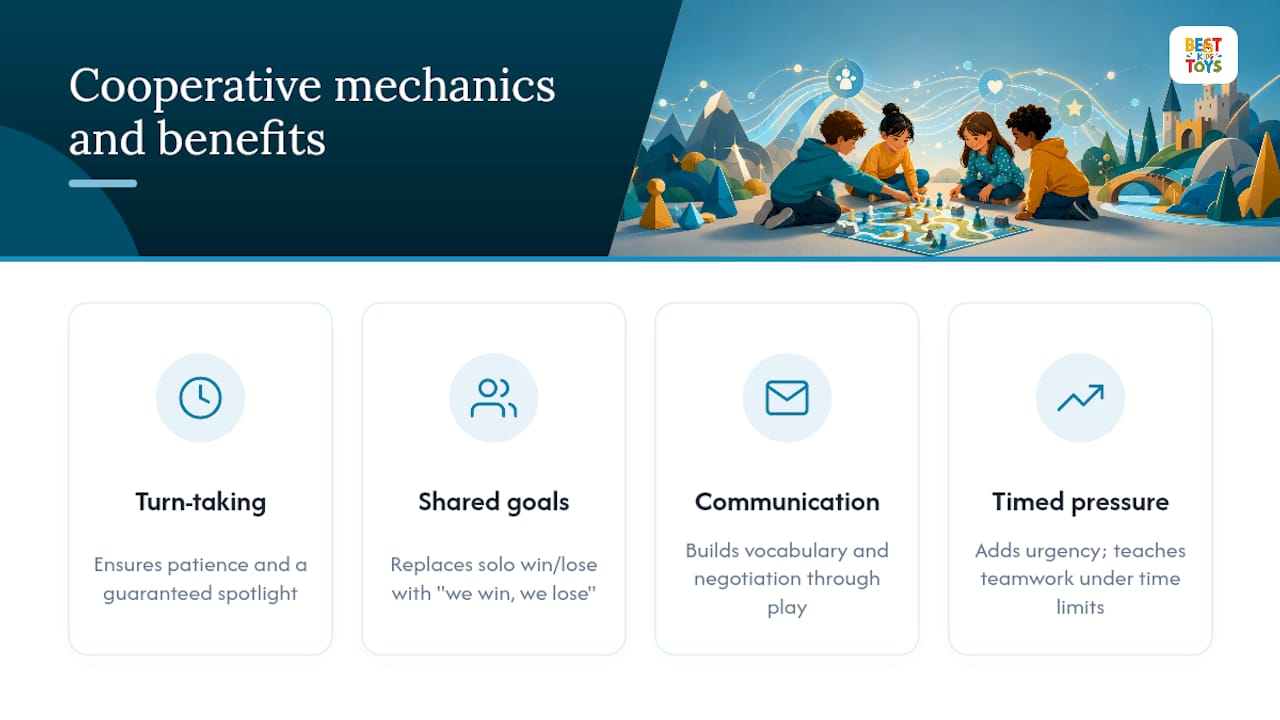
Turn-taking is the most basic building block, present in nearly every game on this list. It teaches patience and gives every child a guaranteed moment in the spotlight, which matters enormously for a 4-year-old who’s used to solo play.
Shared goals replace the “I win, you lose” structure with “we win, we lose,” and this single shift is why anxious or perfectionist kids often take to cooperative games faster than competitive ones. There’s no individual failure to absorb.
Communication mechanics, like describing a clue card or explaining a planned move before it happens, build vocabulary and negotiation skills in a way that feels like play rather than practice. Timed or deck-based pressure, such as a shrinking card deck in Team Labyrinth, adds urgency without pitting players against each other, teaching kids to work faster together rather than compete for speed. Each mechanic does real developmental work while looking, to a child, like nothing more than a genuinely fun way to spend twenty minutes.
What Actually Matters More Than the Box Says
Most “best cooperative games” lists rank titles by hobby-gamer reputation, which tells you almost nothing about whether your specific 5-year-old will sit through a full round. The research behind this list points to a different priority order: playtime realism first, component safety second, and adjustable difficulty a close third. Reputation matters least of all for this age group.
The conventional advice to “buy up” in age range so a game “lasts longer” is often backwards. A game that’s slightly too easy at 5 and grows into a real challenge by 8, like Outfoxed! or Team Labyrinth, delivers more actual play sessions than one that sits unopened for two years because it was too hard at the printed age.
If you take one thing from this, prioritize games with a built-in easier mode over games with better reviews. A flexible rulebook is worth more than a shelf of awards when you’re trying to get a 4-year-old and an 8-year-old invested in the same box on the same afternoon.
Where to Start Shopping for Cooperative Play
Sorting through dozens of cooperative titles takes time most parents don’t have between school pickup and dinner. Thebestkidstoys curates its collections around exactly the standard this article uses: age-appropriate, Montessori-informed, and built for genuine skill development rather than shelf appeal.

If your child is between 4 and 5, the toys for ages 4 to 5 collection focuses on tactile, hands-on play that pairs naturally with short cooperative games. For kids ready for more strategy, the toys for ages 5 and up collection leans into the reasoning and planning skills that mystery and light-strategy co-ops build. Families with a toddler in the mix might also check the sensory toys collection for tactile pieces that hold up to little hands during game night. Browse a collection today and find the next game your family actually keeps playing.
Frequently Asked Questions
What age can kids start playing cooperative board games? Most cooperative games designed for young children start around age 4, with titles like 3 Little Pigs built specifically for preschoolers using large, toddler-friendly pieces and no reading required.
Are cooperative games better than competitive games for young kids? Neither is universally better, but cooperative games tend to suit anxious or younger kids well since nobody personally loses, which reduces meltdowns and keeps kids willing to try again.
How long should a cooperative game session last for a 5-year-old? Aim for 10 to 20 minutes total, including setup and rule explanation. Games marketed for this age typically list playtimes in that range for exactly this reason.
Can one cooperative game work for both a 5-year-old and an 8-year-old? Yes, if it includes adjustable difficulty or flexible roles. Team Labyrinth and Andor: The Family Fantasy Game both offer this kind of scalability for mixed-age households.
What should I do if my child gets upset when the team loses? Stay calm, praise specific effort or teamwork over the outcome, and consider shortening the next round. Team losses are a natural opening to teach emotional regulation rather than something to avoid entirely.
Sources
- Outfoxed! Board Game | Cooperative Mystery Game for Kids
- Andor: The Family Fantasy Game — The Family Gamers
- SEL Game Guide — Playworks
- Team Labyrinth | Ravensburger
- 3 Little Pigs Game: Fun and Learning for Pre-K Kids | Timberdoodle
Recommended
- Board Games for Kids: Board Games for Kids That Build Critical Thinkin – Best Kids Toys
- 10 Toy Sharing Ideas That Actually Teach Kids to Share – Best Kids Toys
- Explore Cognitive Skills Development with the Wooden Memory Game - A Trending Spring Must-Have Outdoor Toy for No Screen Play Among Kids’ Toys to Buy – Best Kids Toys