



10 Toy Sharing Ideas That Actually Teach Kids to Share
The fastest way to teach a child to share is to combine short, repeatable cooperative games with a script for what to say and a predictable toy system, like rotation or a special-toy rule. Games teach the skill through practice, scripts give kids the words they don’t have yet, and systems take the pressure off ownership so sharing stops feeling like loss. Edutopia’s classroom research backs this up, and ChildcareED has documented similar wins with simple team activities. Thebestkidstoys builds toys around this exact idea: open-ended, durable pieces that hold up to group play.
Start here:
- Pick one cooperative game (a team puzzle or building challenge works for almost any age).
- Practice one script this week: “Can I have a turn when you’re done?”
- Set up a simple toy rotation so fewer toys feel “mine forever.”
Pro Tip: Run the same 10 minute game three days in a row before switching activities. Repetition, not variety, is what actually builds the sharing habit.
Key Takeaways
Teaching kids to share works best when short cooperative games, ready-made caregiver scripts, and a predictable toy system all run together instead of relying on any one alone.
| Point | Details |
|---|---|
| Start with neutral toys | Blocks and puzzles lower possessiveness better than new or favorite items. |
| Use a four-step conflict flow | Acknowledge feelings, offer a choice, set a timer, plan for next time. |
| Rotate, don’t overwhelm | Swap toy boxes every one to two weeks to reduce daily ownership friction. |
| Use a token system for swaps | Fairness fixes complaints when traded toys vary widely in value. |
| Watch for red flags | Persistent grabbing or refusal past two to three weeks warrants outside advice. |
Ready to build a rotation with toys that hold up to group play? Browse age 3 to 4 educational toys or age 4 to 5 learning sets for pieces designed for exactly this kind of hands-on cooperative practice, including the Montessori busy book many parents use as a “special pile” item during rotation weeks.
Table of Contents
- Toy Sharing Ideas by Age: What’s Realistic and What Isn’t
- What Are the Best Toy Sharing Activities to Try at Home?
- What Should You Say When Kids Won’t Share?
- How Do You Set Up a Toy Rotation or Toy Swap?
- Why Does Toy Sharing Practice Sometimes Stall?
- Which Cooperative Games Teach Real Teamwork?
- Frequently Asked Questions
- Sources
Toy Sharing Ideas by Age: What’s Realistic and What Isn’t
Sharing isn’t a switch that flips at a certain birthday. It develops in stages, and expecting a two-year-old to share the way a five-year-old does set everyone up for frustration.
Toddlers (1 to 3): Most toddlers play in parallel, side by side, not truly together. True sharing is rare and often short-lived. Focus on modeling language (“my turn, your turn”) rather than demanding compliance.
Preschoolers (3 to 5): This is when cooperative play really clicks. Kids start accepting simple roles and following basic rules, which makes structured turn-taking games worth introducing.
Early school age (5+): Kids can usually negotiate, wait longer, and handle group activities with several participants and multi-step rules.
A few dos and don’ts that apply across every stage:
- Do start with neutral toys like blocks or puzzles rather than a brand-new gift or a favorite comfort object, which tends to spike possessiveness fast, according to research on children and comfort objects.
- Do use short turn timers (2 to 5 minutes for younger kids).
- Don’t force sharing mid-tantrum. Wait for calm.
- Don’t introduce swap systems before age 3. It’s too abstract.
A quick sign a child is ready for cooperative (not just parallel) play: they’ll accept an assigned role in a game, like “you hold the funnel, I’ll pour,” without needing constant redirection.
What Are the Best Toy Sharing Activities to Try at Home?
These ten activities move from simplest to most involved. Pick two or three to start rather than trying all of them in one week.
- Pass the Parcel, Turn Edition. Teaches waiting and anticipation. Materials: one small toy, a soft timer, a rug or mat. Set a 1 minute timer, pass on the buzzer, repeat. Ages 2 to 5, five minutes.
- Cooperative Puzzle Challenge. Teaches shared problem-solving. Materials: one large floor puzzle, a flat surface, two chairs. Assign zones of the puzzle to each child, then swap zones halfway. Ages 3 to 7, ten to fifteen minutes.
- Blindfolded Guide Relay. Teaches trust and verbal instruction. Materials: a soft blindfold, floor cushions as obstacles, a finish marker. One child guides a blindfolded partner using only words. Ages 5+, ten minutes.
- Story-Building Round-Robin. Teaches turn-taking with ideas, not just objects. Materials: none, or a stuffed animal as a “talking piece.” Each child adds one sentence to a story in turn. Ages 4+, five to ten minutes.
- Building-Tower Team Challenge. Teaches shared goals and role negotiation, a core benefit Edutopia highlights in group construction tasks. Materials: building blocks, a flat base, a target height. Build together toward one tower, not competing ones. Ages 3+, ten minutes.
- Relay Ball Pass. Teaches timing and physical cooperation. Materials: one soft ball, a start and finish line, cones or markers. Pass the ball down a line without dropping it. Ages 4+, five minutes, best outdoors.
- Parachute or Group Mural Play. Teaches large-group coordination. Materials: a play parachute or a big roll of paper, markers or a lightweight ball. Everyone holds an edge or a marker and works toward one shared result.
- Timed Sharing Stations. Teaches structured rotation for multiple kids. Materials: three toy stations, a visible timer, name cards. Rotate every 3 minutes on a buzzer. Ages 3 to 6, fifteen minutes total.
- Toy-Car Group Maze. Teaches spatial cooperation and patience. Materials: ramps or blocks, several small cars, a finish line. Build one maze together, then take turns sending cars through. Ages 3+, ten minutes.
- Toy-Swapping Mini Event. Teaches short-term trading and negotiation. Materials: two similar toys per child, a small mat per participant. Each child picks a toy to lend for five minutes, then trades back. Ages 5+, ten minutes.
For sensory-sensitive kids, skip loud timers in favor of a visual sand timer, and let them opt out of blindfolded or high-touch activities like the relay.
What Should You Say When Kids Won’t Share?
Having the right words ready matters more than having the right toy. Try these scripts word for word:
- Asking for a turn: “Can I have a turn when you’re done? I’ll tell you when it’s your turn again.”
- Refusing to share: “It’s okay to say no right now. Let’s find something else while you finish.”
- Suggesting a swap: “Want to trade? You can try mine while I try yours.”
- Ending a turn fairly: “Your turn is up. Hand it to your brother, then you can pick the next toy.”
When conflict actually breaks out, follow the same four steps every time: acknowledge the feeling (“You’re mad because you wanted it”), offer a choice (“Do you want this toy or that one while you wait?”), set a visible time limit, then make a plan for next time. MyBrightwheel’s research on cooperative play notes that these small negotiations, not adult intervention, are where kids actually learn compromise.
A few house rules worth posting at kid height: “Wait your turn,” “Use kind hands,” “One toy at a time unless we’re building together.” And know when to step back. If a child is mid-meltdown, force-sharing usually escalates things rather than resolving them.
How Do You Set Up a Toy Rotation or Toy Swap?
Simple systems remove daily friction, so sharing doesn’t hinge on willpower every single time.
- Run a home rotation. Box up two-thirds of the toys, leave one-third out, and switch boxes every one to two weeks. Label bins by photo so younger kids can identify what’s “new” without reading.
- Host a small swap. Invite two or three families, set a simple rule (one toy in, one toy out), and use a token system if items vary a lot in size or value, a fix OneHundredDollarsAMonth recommends to head off complaints about fairness. Eartheasy also suggests keeping kids away from the actual swap table to avoid last-minute grabbing.
The “toy box truce” just means sorting toys into two piles up front:
| Category | Examples |
|---|---|
| Shared pile | Blocks, puzzles, group building sets |
| Special pile | Comfort toys, brand-new gifts, favorite figures |
Only the shared pile goes into rotation or swap events at first.
Why Does Toy Sharing Practice Sometimes Stall?
Stalls are normal, not a sign that nothing is working.
- Tantrum during a turn switch: Say “I see you’re upset. You can have it back in two minutes,” then hold the timer where they can see it.
- Flat refusal to join group play: Don’t push. Sit nearby and narrate what the other kids are doing until curiosity kicks in.
- Grabbing or hitting: Separate the toy immediately, name the behavior calmly (“Hands are for helping, not grabbing”), and reset with a shorter turn next time.
Watch for a few red flags that go beyond typical toddler resistance: repeated aggressive grabbing across many settings, persistent refusal to join any group play after weeks of practice, or extreme clinginess to one comfort object that blocks all other play. If these persist past two to three weeks of consistent practice, it’s worth a conversation with a pediatrician or early childhood specialist.
Over the next two weeks, reintroduce sharing with shorter turns, neutral toys only, and one game at a time rather than a full activity list.
Which Cooperative Games Teach Real Teamwork?
The group maze is one of the clearest examples. Kids build a path together using blocks or ramps, then take turns sending a ball or toy car through it, a format Edutopia and ChildcareED both point to for building real collaboration rather than side-by-side play.
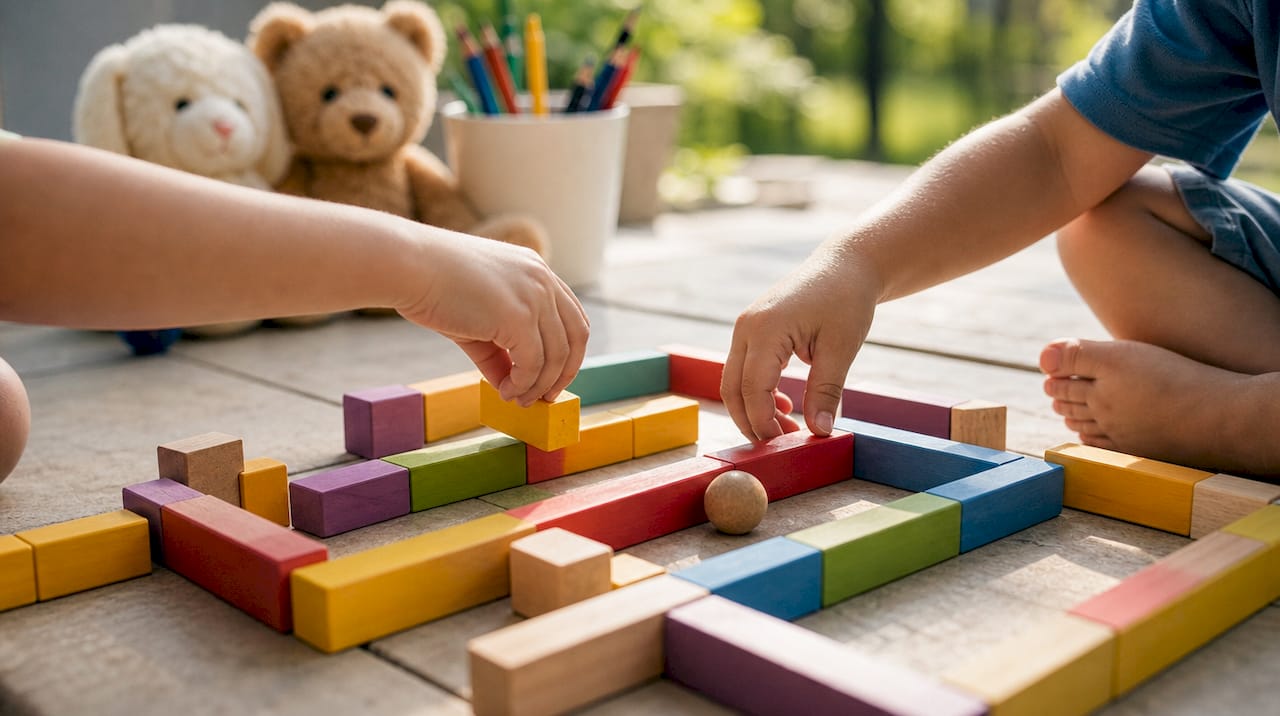
Facilitation notes: assign one builder role and one “runner” role, swap roles halfway, and stop twice to ask what’s working.
This single activity touches several skills at once:
- Verbal negotiation over design choices
- Turn-taking on the runner role
- Managing frustration when the maze collapses
- Reading a partner’s cues without adult prompting
After the game, ask two debrief questions: “Who helped you the most?” and “What was the hardest part?” These questions turn play into a lesson kids can name later.
Pro Tip: Skip the debrief with kids under 3. They rarely have the language for it yet. Save it for preschool age and up.
Why Simple Systems Matter More Than Perfect Parenting
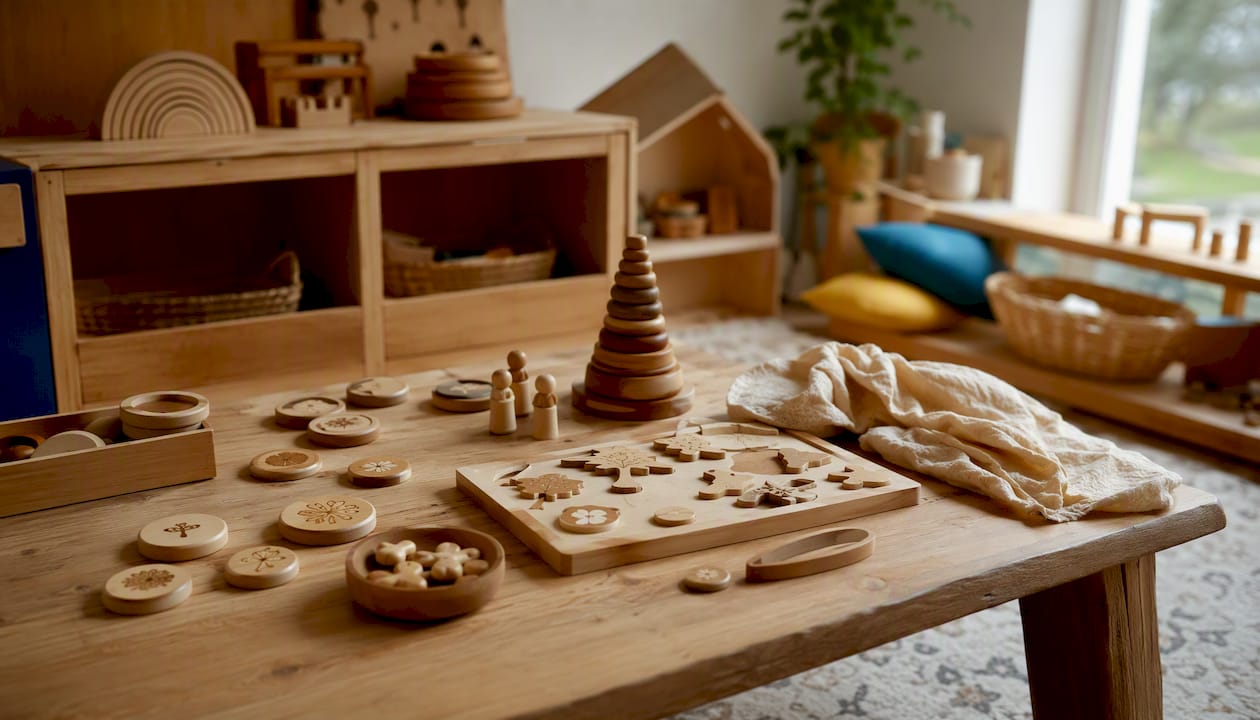
I’ve watched enough sibling standoffs over a single toy car to know the fix isn’t a perfect script delivered at the perfect moment. It’s having a system in place before the meltdown starts, so you’re not improvising while a four-year-old screams. Durable, open-ended toys, the kind Thebestkidstoys builds its whole catalog around, make these systems easier because one set of blocks or one puzzle can serve five different games without ever feeling “used up.”
Frequently Asked Questions
What age should kids start sharing toys? Real cooperative sharing usually develops between ages 3 and 5. Toddlers under 3 mostly play in parallel and need modeling more than rules.
What’s a good first activity for toy sharing? Start with a neutral, low-stakes game like the cooperative puzzle challenge or a building-tower team task before trying trading-based activities like toy swaps.
Should kids attend toy swap events? Not necessarily. Several toy-swap guides suggest handling the actual trading without kids present, since it reduces last-minute grabbing and disputes over specific items.
How do you handle a child who refuses to share at all? Don’t force it. Acknowledge the feeling, offer an alternative toy, and revisit sharing practice once the child is calm rather than mid-refusal.
Is toy rotation better than buying more toys? Rotation typically reduces clutter and renews interest in toys kids already own, making a small collection feel larger without new purchases.
Sources
- Teaching cooperative play in prekindergarten | Edutopia
- How can preschool team-building activities strengthen communication and friendship?
- How to host a toy swap
- How to Host a Toy Swap – Eartheasy
- Cooperative play: The final stage of play & why it matters