



Parents: Toy Age Ratings, CPSC Rules, and the Toilet Paper Roll Test
Toy age ratings mark a safety floor, not a ceiling on fun. When a box says “3+,” that number reflects small-parts testing and choking risk, not your child’s intelligence or readiness. If a rating and your child’s behavior seem to conflict, safety wins: run the toilet-paper-roll test, check the battery compartment, and inspect for loose strings before anyone plays.
TL;DR:
- Toy age labels primarily indicate safety thresholds related to part size and choking hazards, not a child’s intelligence or skill level.
- Manufacturers follow strict regulations like ASTM F963 and CPSC guidelines, applying the most stringent safety standards when a toy could appeal to multiple age groups.
- Physical hazards such as unsecured batteries, small parts fitting inside a toilet-paper roll, and long strings are non-negotiable risks that require careful inspection regardless of age ratings.
- Age ratings can be influenced by marketing choices, so parents should consider specific hazard details rather than relying solely on the printed age range.
- For imported or secondhand toys, checking for international safety marks like CE or EN71 standards helps ensure compliance, but verifying actual age-appropriate safety features remains essential.
Table of Contents
- What Toy Age Ratings Actually Mean
- The Safety Standards Behind Every Age Label
- Key Safety Rules by Age Group
- How to Read Labels and Warnings on the Box
- Matching Toys to Developmental Stages, Not Just Birthdays
- Quick Home Safety Checks You Can Do Right Now
- Can a Child Be “Too Old” for a Toy?
- How Toy Age Ratings Compare Around the World
- Who’s Legally on the Hook for a Wrong Age Rating
- Myths About Toy Age Ratings That Won’t Die
- Why Age Ratings Shape How Toys Get Designed and Marketed
- Balancing Safety Rules With What Your Kid Actually Wants
- How Best Kids Toys Reviews Age Ranges
- Where to Verify Recalls and Safety Guidance
- A Closer Look at What Age Labels Get Wrong
- Sources
- FAQ
What Toy Age Ratings Actually Mean
Manufacturers set age ranges by weighing a handful of concrete factors: part size, the number of small pieces, the materials used, and the motor skills a child needs to play with the toy safely. That’s the safety side of the equation. The marketing side is real too. Some toys land on a “6+” label mostly because that’s the demographic the box art is designed to attract, not because a five-year-old couldn’t handle the pieces.
This is why you should treat labels as two separate signals layered into one number. The developmental guess can flex based on your own kid. The safety guess should not. If a toy is rated 3+ because it contains parts small enough to choke a toddler, that has nothing to do with how mature your two-year-old seems. Choking risk is physiological, not behavioral. Never hand a younger child a toy labeled for older kids when the concern is a physical hazard rather than a skill gap.
The Safety Standards Behind Every Age Label
Toy age labels in the United States aren’t guesswork. They trace back to specific regulatory frameworks that manufacturers are required to follow.
The Age Determination Guidelines published by the Consumer Product Safety Commission lay out exactly how staff match product characteristics to a child’s likely skills and play behaviors. A few things worth knowing:
- CPSC staff weigh part size, shape, number of components, materials, and required motor skills when assigning an age range.
- For toys that could plausibly appeal to more than one age group under 3, CPSC applies the most stringent testing standard among the groups the toy might reach.
- ASTM F963, the industry’s core toy-safety standard, generally governs products marketed to children 12 and under, and the CPSC’s own business guidance treats anything sold to kids under 14 as a “toy” for regulatory purposes.
That last point surprises a lot of parents. A toy doesn’t need to look like a toddler product to fall under strict testing. If there’s any real chance a three-year-old could get hold of it, the strictest applicable rule wins.
Key Safety Rules by Age Group
Safety priorities shift as kids grow, and knowing what changes at each stage makes shopping (and gift-giving) a lot less stressful.
- Under 3. Avoid any toy with parts that fit inside a 1.25-inch (3.175 cm) diameter cylinder, skip anything with strings longer than the recommended safe length for young children, and confirm battery compartments need a screwdriver to open. Toys for this age should also survive chewing without shedding pieces.
- Ages 3 to 5. Small pieces are still a concern, especially in building sets and craft kits with beads or magnets. Watch closely for button batteries in electronic toys, and supervise any toy with projectile parts like foam darts.
- Ages 6 to 11. This is prime hobby-kit territory, model rockets, slime kits, basic electronics. Read warning labels for chemical exposure or fire risk before assuming the toy is purely educational.
- Ages 12 and up. Chemistry sets, woodworking tools, and advanced electronics kits often carry this rating for a reason. Fire and chemical hazards, not difficulty level, usually drive the 12+ cutoff, so adult supervision still matters even for a capable 11-year-old.
Pro Tip: Button batteries cause more emergency room visits than almost any other single toy hazard in the under-5 group. If a toy’s battery door needs a screwdriver, that’s a feature, not an inconvenience.
How to Read Labels and Warnings on the Box
Packaging language isn’t always consistent, but a few formats show up again and again: “Ages 3 to 5,” a plain “3+,” or the more explicit “Not for children under 3.” Each is doing the same job with slightly different wording. The small-parts warning icon, usually a triangle with an exclamation point, flags choking risk specifically and deserves a second look even if the age range seems fine.
Before you trust a label, check that it comes with something behind it:
- Look for a manufacturer name, contact information, and any reference to ASTM or CPSC standards printed on the packaging.
- Confirm the age range appears more than once (box, insert, and product listing) and that the numbers match.
- If labeling is missing, damaged, or contradicts itself between the box and an online listing, treat the toy as if it’s rated for the youngest reasonable age group until you can verify otherwise.
When in doubt, the stricter assumption costs you nothing. Guessing wrong costs a lot more.
Matching Toys to Developmental Stages, Not Just Birthdays
Age numbers are shorthand for skills, and skills are what actually determine whether a toy gets played with or ignored in a bin. Children engage far more fully with toys matched to their developmental stage than with toys aimed at older kids, which is a good argument against buying “up” just to get more mileage out of a purchase.
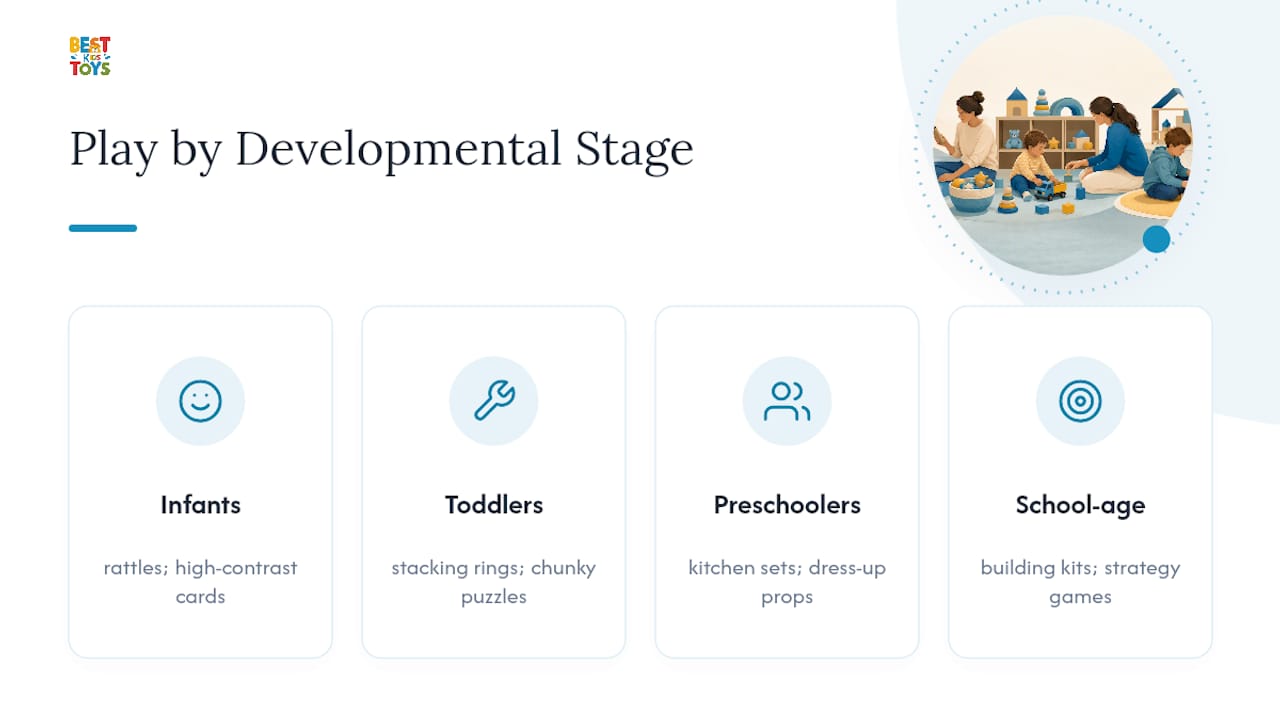
Infants respond to sensory contrast and simple cause-and-effect, think rattles, high-contrast cards, or a soft ball that makes a sound when nudged; for more on how sensory play supports development, see this sensory play and child development guide. Toddlers are building fine motor control, so stacking rings, chunky puzzles, and simple wooden puzzles tend to land well. Preschoolers thrive on pretend play, kitchen sets, dress-up props, or dollhouses that invite storytelling. School-age kids want logic and persistence, so building kits, strategy games, and open-ended construction sets fit naturally. At every stage, developmental fit still has to clear the safety bar first. A perfect match on paper doesn’t matter if the toy has an unsecured battery door.
Quick Home Safety Checks You Can Do Right Now
You don’t need special tools to catch most hazards before a toy ever reaches your child’s hands.
- Run the toilet-paper-roll test. If a part or the whole toy fits inside a standard toilet-paper roll, it’s a choking hazard for a child under 3 and should be kept out of reach.
- Check the battery compartment. It should require a screwdriver, not just fingers, to open. Unsecured compartments are a common source of button-battery injuries.
- Inspect strings, cords, and edges. Anything longer than 7 inches (18 cm) is a strangulation risk for infants and toddlers. Retire any toy with cracked plastic or exposed sharp edges immediately.
Pro Tip: Keep an empty toilet-paper roll in your diaper bag or car. It takes ten seconds to test a toy at a birthday party or a friend’s house before your toddler gets to it.
Can a Child Be “Too Old” for a Toy?
Play doesn’t have an expiration date. A 12-year-old building with magnetic tiles or a teenager doing a jigsaw puzzle is still getting real cognitive benefit, so there’s no reason to feel embarrassed about “younger” toys sticking around. What actually changes with age isn’t the value of play, it’s the content and supervision level of what’s considered next. Chemistry kits, tools, and sharp-edged hobby gear introduce fire and chemical risks that simpler toys don’t. Choose based on your child’s interest and the toy’s actual hazard profile, not an arbitrary number stamped on a shelf tag.
How Toy Age Ratings Compare Around the World
The United States isn’t the only country with a formal system, and the differences matter if you’re buying imported toys or shopping secondhand from overseas sellers.
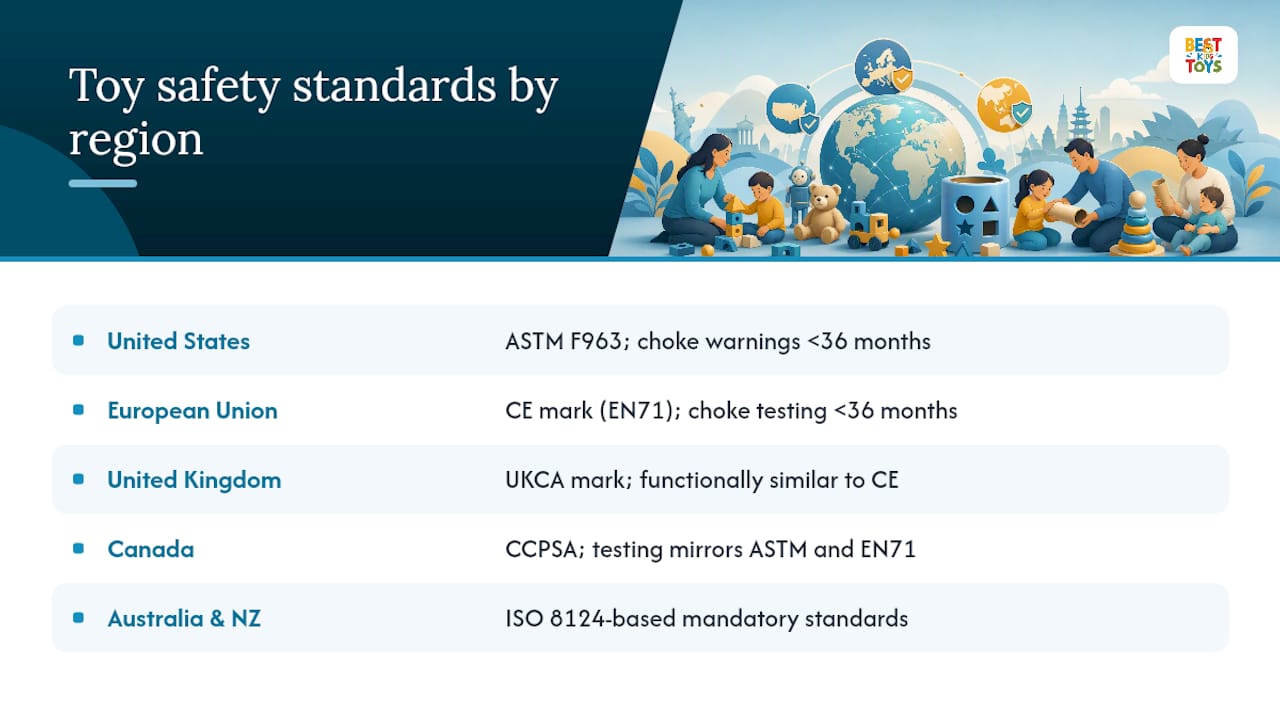
In the European Union, toys must carry a CE mark, confirming compliance with the EN71 family of safety standards, which cover mechanical and physical properties, flammability, and chemical migration limits. EN71 age labeling works similarly to the U.S. approach: warnings about small parts for children under 36 months are mandatory when the toy fails choke-hazard testing. The UK maintains a parallel UKCA mark post-Brexit, functionally similar to CE but assessed under separate UK regulations.
Canada regulates toys through the Canada Consumer Product Safety Act, with testing requirements that closely mirror both ASTM F963 and EN71 in substance, if not in exact wording. Australia and New Zealand largely rely on mandatory standards adapted from ISO 8124, the international toy-safety standard that both EN71 and ASTM F963 draw from.
The practical takeaway: these systems aren’t identical, but they share the same DNA. Small-parts thresholds, flammability limits, and chemical restrictions show up in every major framework because the underlying physiological hazards—choking, poisoning, burns—don’t change by country. If you’re buying a toy manufactured for a different market, a CE mark or EN71 reference is a reasonable trust signal, but it doesn’t guarantee the age range translates cleanly to U.S. guidance. When packaging only shows a foreign standard, apply the stricter of the two systems’ age suggestions.
Who’s Legally on the Hook for a Wrong Age Rating
Manufacturers carry the primary legal responsibility for accurate age labeling in the United States. Under the CPSC’s toy safety framework, a “toy” is any product marketed to children under 14, and manufacturers of items intended primarily for kids 12 and under must certify compliance with ASTM F963 testing before the product ever reaches a shelf. That certification isn’t optional paperwork. It requires actual lab testing for choking hazards, sharp points, flammability, and toxic substances, and the manufacturer has to keep records proving it happened.
Retailers share responsibility too, though in a narrower way. A store or online marketplace that knowingly sells a recalled or non-compliant toy can face liability, which is part of why major retailers pull recalled items from shelves and search histories the moment a recall is announced. Import sellers face extra scrutiny, since toys entering the U.S. market from overseas manufacturers still must meet the same CPSC and ASTM standards as domestically produced toys, regardless of what labeling the country of origin required.
For parents, this legal structure has one practical benefit: if a toy’s age rating turns out to be dangerously wrong, there’s a paper trail and a regulatory body to complain to. Reporting a mislabeled or hazardous toy to the CPSC isn’t just venting, it can trigger an investigation and, eventually, a recall that protects other families from the same mistake.
Myths About Toy Age Ratings That Won’t Die
A surprising number of parents make toy-buying decisions based on assumptions that don’t hold up.
Myth: A higher age rating always means a “better” or smarter toy. Age numbers reflect safety and skill match, not educational superiority. A well-designed toy rated 2+ can build more real cognitive skill than a flashy 8+ toy with limited open-ended use.
Myth: If my child is advanced for their age, the rating doesn’t apply. Developmental guesses can flex; physical hazard guesses cannot. A gifted three-year-old is just as vulnerable to a choking hazard as an average three-year-old, because the risk is about anatomy, not intellect.
Myth: Age ratings are the same as difficulty levels. Some toys are rated higher purely for safety reasons (chemical kits, magnets, certain battery types) even when the actual skill required is minimal. Others are rated lower because they’re simple to use, even if a ten-year-old still enjoys them.
Myth: Once a toy passes safety testing, it’s safe forever. Wear and tear changes everything. A toy that passed CPSC testing new can develop cracks, exposed batteries, or fraying strings that make it hazardous well before it’s technically “outgrown.”
Clearing up these misconceptions doesn’t just prevent injuries. It also stops parents from wasting money buying “up” for a child who’d actually get more play value out of something rated closer to their real stage.
Why Age Ratings Shape How Toys Get Designed and Marketed
Age ratings aren’t just a compliance checkbox tacked on after a toy is finished. They influence decisions from the earliest design sketches. A company aiming for a 3+ rating has to design around small-parts limits from day one, which shapes everything from piece count to material choice. Aim for an 8+ audience instead, and suddenly finer detail, smaller components, and more intricate mechanisms become fair game.
Marketing teams lean on age ratings just as heavily as engineers do. Age labeling is sometimes influenced by which demographic a company wants to target, not purely by what a child could safely handle if the parts and hazards were controlled differently. That’s why you’ll occasionally see two nearly identical construction sets rated three years apart. One is boxed with bright primary colors and simple photography aimed at parents of toddlers; the other gets sleeker packaging and slightly smaller pieces aimed at grade-schoolers, even though the underlying play pattern barely changed.
This isn’t necessarily deceptive. It’s a reflection of how retail shelf space works: buyers expect an age number, so brands assign one that fits both the safety testing results and the shopper they’re trying to reach. Understanding this helps you shop smarter. If two similar toys carry different age ratings, check whether the gap comes from an actual hazard difference (a real dealbreaker) or a marketing choice (a detail you can weigh against your own child’s interest and skill).
Balancing Safety Rules With What Your Kid Actually Wants
Every parent eventually hits the moment where the safety guidance says one thing and a determined seven-year-old wants something else entirely. The good news: you rarely have to choose between the two.
Start by separating hard safety limits from soft skill guesses. Choking hazards, unsecured batteries, and chemical risks are non-negotiable regardless of how much your child begs. Skill-based age suggestions have more room to flex, especially if you’re present to help with trickier steps. A six-year-old who’s dying to try a kit rated for 8+ can often manage it fine with a parent nearby handling the parts that require more hand strength or patience.
It also helps to separate interest from ability. A younger sibling wanting to play with an older kid’s construction set isn’t a sign the rating is wrong, it’s a sign you might need to supervise more closely or swap in a similar but simpler product. Open-ended toys are particularly forgiving here, since a well-designed set can flex across several skill levels without introducing new hazards. If you want ideas tailored to a specific age and interest combination, a step-by-step guide to picking toys across ages can help narrow the search without guesswork.
When you’re unsure whether an exception is reasonable, ask what specifically the rating protects against. If it’s a skill gap, some flexibility with supervision is fine. If it’s a physical hazard, the answer stays no until your child ages into it.
How Best Kids Toys Reviews Age Ranges
Every toy in the catalog gets curated by developmental stage first, safety second, and both matter equally before anything gets listed. That review checks the practical details parents actually care about: are battery compartments genuinely secure, are small parts sized appropriately for the stated age, and will the toy hold up to real use rather than gentle handling.
Reviewers cross-reference CPSC and ASTM guidance alongside pediatric development benchmarks when assigning or confirming an age range, rather than relying on manufacturer copy alone.
Where to Verify Recalls and Safety Guidance
Before buying a used toy or double-checking a current one, run it against the CPSC’s Age Determination Guidelines and the CPSC recall database. HealthyChildren.org’s toy-safety guidance and Nemours KidsHealth’s safety checklist both cover choking, batteries, and strings in more depth. Always check for open recalls before buying secondhand.
If you’re building out a collection with safety and developmental fit already factored in, the Montessori STEM Toys collection groups options by the skills they build rather than just a birthday number, and every listing gets the same safety review described above.
A Closer Look at What Age Labels Get Wrong
The biggest failure in how most parents read age ratings isn’t ignorance, it’s over-trust. There’s a common assumption that a number on a box has been calibrated specifically for a reader’s individual child, when in reality it’s a blended estimate covering two very different concerns: legal safety minimums and a rough guess at general skill level. Treating those as one number is where confusion creeps in.
What gets underestimated most is how much marketing pressure shapes ratings that look purely technical. A toy doesn’t get bumped from 4+ to 7+ because engineers discovered a new hazard, it often happens because a brand wants shelf placement next to older-kid products. That’s not dishonest, but it does mean parents need to read past the number and ask what specific risk, if any, actually justifies it. If the answer is “none, it’s a demographic choice,” you have real room to use judgment. If the answer involves a battery, a magnet, or a part smaller than a toilet-paper roll, there’s no judgment call to make. The rule holds.
The most useful shift a parent can make is treating age ratings as a starting question rather than a final answer: what specifically is this number protecting against, and does that concern actually apply to my child right now?
— Danica Hodge
Sources
- Age Determination Guidelines: Relating Consumer Product Characteristics to the Skills, Play Behaviors, and Interests of Children (CPSC, 2020)
- Choosing safe toys for toddlers and preschoolers | Nemours KidsHealth
- Healthychildren
- Children’s utilization of toys is moderated by age-appropriateness, toy category, and child age (PMC/NIH)
FAQ
What Is a Toy Age Rating, Exactly?
A toy age rating is a manufacturer’s estimate of both the safety limits and the developmental fit of a product, based largely on part size, materials, and required motor skills. It’s a combination of a legal safety threshold and a general skill guess, not a precise measurement of any individual child’s readiness.
Is 12 Too Old for Toys?
No. Play benefits continue well into adolescence, and building sets, puzzles, and strategy games still build real cognitive skill for tweens and teens. What changes at 12 is the type of hazard some products introduce, like chemistry kits or tools, which is often why those specific categories carry a 12+ rating in the first place.
Can a 5-Year-Old Watch Toy Story?
Toy Story carries a G rating from the Motion Picture Association, meaning it’s considered appropriate for all ages, including a five-year-old. Content ratings for movies and safety ratings for physical toys work on completely different systems, so a G-rated film doesn’t tell you anything about whether a Toy Story action figure is safe for a toddler’s toy box.
What Does “Toy Age” Mean on Packaging?
“Toy age” typically refers to the recommended age range printed on a box, like “3+” or “Ages 6 to 8.” That number reflects a mix of choking-hazard testing results and an estimate of the motor or cognitive skills a child needs to enjoy the toy safely, based on characteristics like part size and required dexterity.
How Strict Should I Be About Age Ratings?
Be strict about anything tied to a physical hazard, like small parts, unsecured batteries, or long strings, regardless of how mature your child seems. Be more flexible about skill-based suggestions, since a child who’s close to the recommended age with adult supervision nearby can often handle a slightly more advanced toy safely.