



Parent Ready Three Period Pink Tower Activity and 10 Extensions
The Pink Tower is a set of ten graduated wooden cubes, ranging from 1 cm to 10 cm, all painted the same shade of pink. Its core value lies in what it quietly teaches: precise visual discrimination, sustained concentration, fine motor control, and an early feel for math that most kids won’t formally meet for years. Below, you’ll find the exact three-period lesson to introduce it, plus ten extensions that keep the challenge fresh.
TL;DR:
- Using random placement of cubes enhances size discrimination, while pre-ordering them undermines the activity’s teaching value.
- Silence during the build emphasizes visual comparison, and adult narration can hinder the child’s sensory development.
- Variations like blindfolded ordering and combining materials deepen understanding after mastery of the basic tower.
- Proper set criteria include uniform color, solid wood construction, accurate size increments, and rounded, safe edges.
- Scaling the activity with smaller sets or portable mats supports learning in limited spaces and prolongs engagement.
Table of Contents
- What the Pink Tower Activity Really Trains
- How to Introduce the Pink Tower Activity Step by Step
- Ten Ways to Extend the Pink Tower Activity
- Common Pink Tower Mistakes and How to Fix Them
- Bringing the Pink Tower Activity Home
- Why the Pink Tower Gets Oversimplified
- Choosing a Pink Tower Set That Actually Works
- Sources
What the Pink Tower Activity Really Trains
Ten cubes. One color. A jump in size so exact that the math behind it is almost startling: the largest cube holds 1,000 times the volume of the smallest. That’s not a rounding trick. A 10 cm cube is 10 times taller, wider, and deeper than a 1 cm cube, and volume multiplies all three dimensions together.
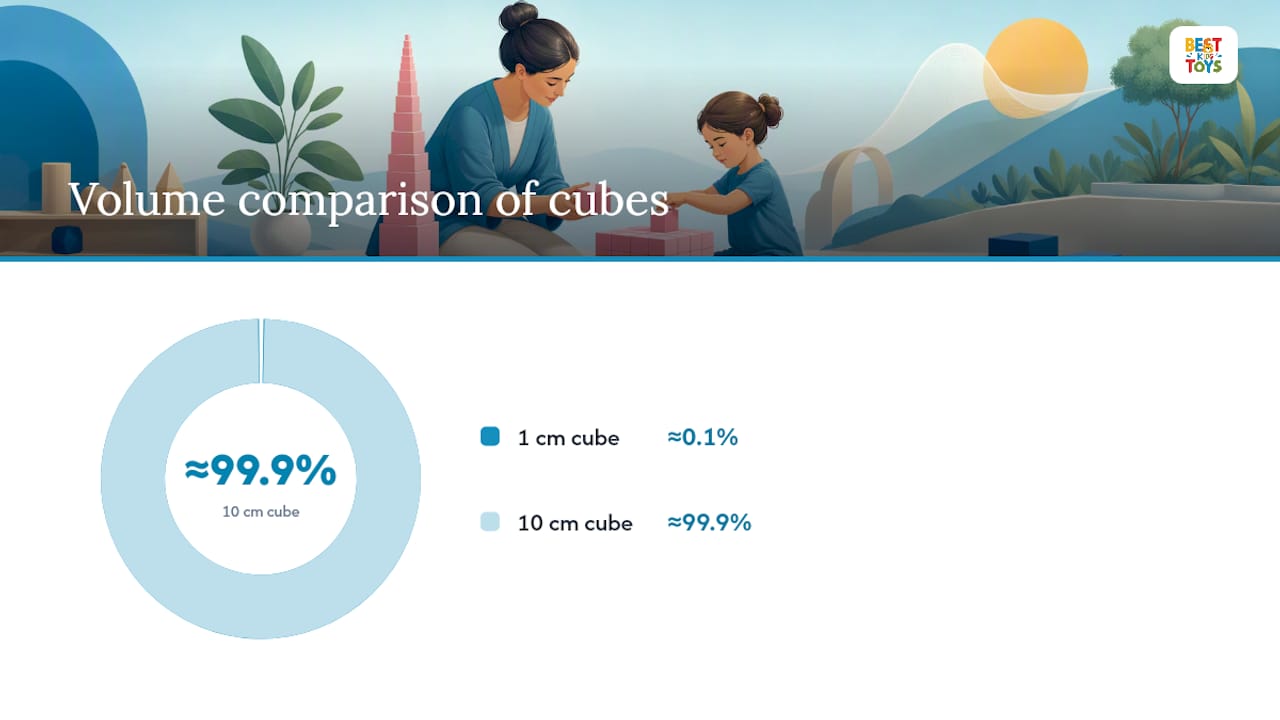
Montessori calls this a sensorial material for a reason. By keeping every cube the same color and material, the only variable left for a child to notice is size. That single constraint is the whole point. Nothing else competes for attention, so the child’s eye and hand get sharper at judging scale, weight, and proportion without any adult explanation getting in the way.
The direct goals are visible immediately:
- Order and sequencing, from largest to smallest and back
- Hand-eye coordination during careful lifting and stacking
- Concentration built through repetition the child chooses, not one imposed on them
The indirect goals show up later, often in ways parents don’t connect back to this activity: seriation skills that prep a child for math sequences, a gut sense of the decimal system, and an early feel for geometric proportion. Most children are ready for a first presentation around 2.5 to 3 years old, and the classic version of the work tends to lose its pull by 4 to 4.5 years, once a child has fully absorbed what it has to teach.
How to Introduce the Pink Tower Activity Step by Step
Setup matters as much as the demonstration itself. Here’s how a clean presentation actually runs.
Before you begin: Roll out a mat with enough floor space for a full tower plus room to move around it. Scatter the ten cubes randomly across the mat, not in size order. Check that the space is clear of foot traffic, since a child will be crossing back and forth to fetch each cube.
The presentation:
- Invite the child to the mat and sit beside them, not across.
- Scan the scattered cubes and select the largest one first, carrying it with both hands to the corner of the mat.
- Return for the next largest, again scanning rather than grabbing the nearest cube.
- Stack each cube centered on the one below it, working in near silence.
- Continue until all ten cubes form the tower, smallest on top.
Talk as little as possible during this phase. Silence keeps the child’s eyes doing the work of comparing sizes, which is the actual lesson. Once the tower is built, invite the child to try it themselves, then step back and watch without correcting. If a cube goes out of order, let the wobble or the visual mismatch teach the lesson. That’s the control of error built into the material.
Vocabulary comes later, once the physical work is solid. This is where the three-period lesson kicks in: name the extremes first (“big, small”), then ask the child to identify (“show me the big one”), and only at the end ask them to name it back to you.
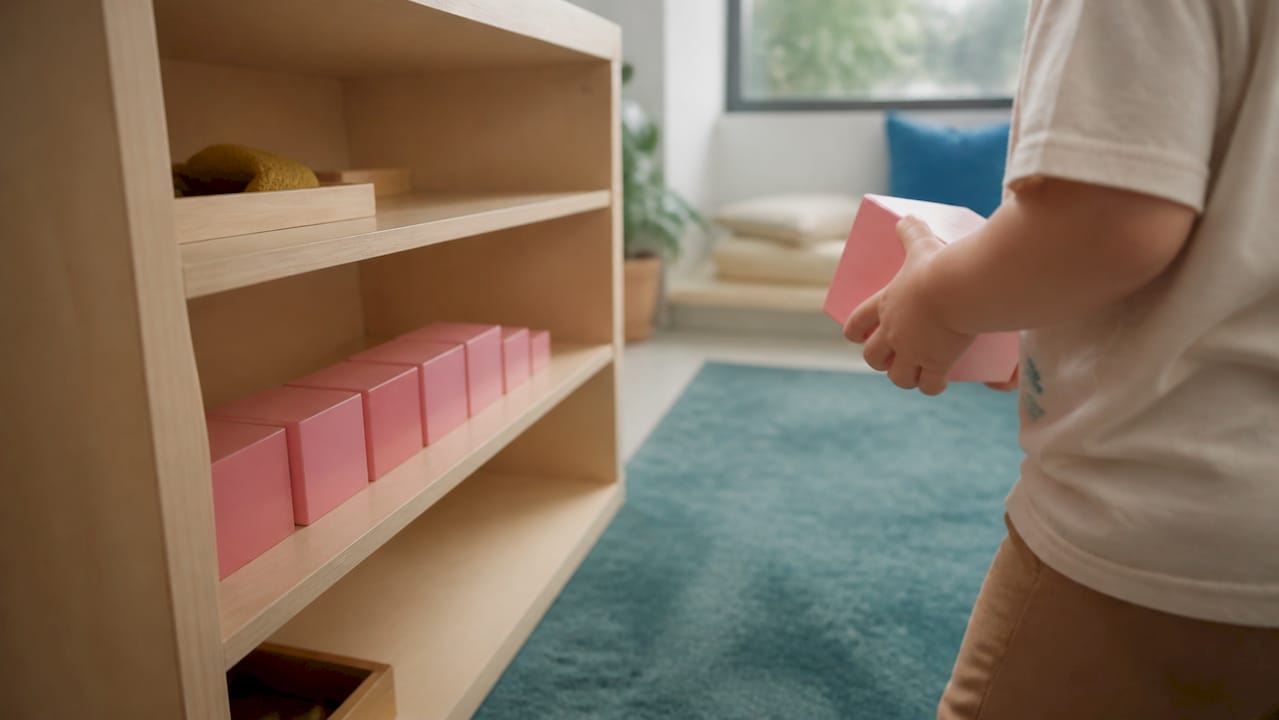
Pro Tip: Have the child dismantle the tower in reverse order, smallest to largest, and carry each cube back to the shelf one at a time. This return trip reinforces the same discrimination skill the building did, just in reverse.
Ten Ways to Extend the Pink Tower Activity
Once a child has mastered the basic build, repeating it over and over stops teaching much of anything new. That’s the signal to layer in variety.
- Horizontal stair arrangement: lay the cubes in a row instead of a tower, largest to smallest, then introduce pattern cards for the child to copy.
- Blindfolded stereognostic ordering: have the child order cubes by touch alone, building pure haptic discrimination without the visual shortcut.
- Pink Tower and Brown Stair combination: pair the cubes with the Brown Stair to work on two dimensions of size at once, since combining sensorial materials sharpens comparative reasoning.
- Cylinder Block crossover: bring in the Cylinder Blocks for a side-by-side size comparison across totally different shapes.
- Nonstandard measuring: use individual cubes as measuring units, asking “how many small cubes tall is the table leg?”
- Volume intuition games: stack smaller cubes inside the empty space where a bigger cube “should” go, building early volume sense.
- Tracing and labeling: trace each cube’s face onto paper and label the sizes for an art and language crossover.
- Counting integration: count cube edges, faces, or the total number of cubes used in a partial tower.
- Printable extension cards: rotate in printable pattern sets so the activity doesn’t go stale after the tenth repetition.
- Group challenge: with two or more children, take turns adding one cube at a time to a shared tower, building patience alongside the size work.
Common Pink Tower Mistakes and How to Fix Them
Most presentation problems trace back to a handful of habits that undercut the lesson.
- Pre-ordering the cubes. Scattering them randomly on the mat forces the child to actually discriminate size instead of just copying a visible sequence.
- Turning it into a quiz. Peppering the child with “which one’s bigger?” during their independent work breaks concentration and shifts the goal from mastery to performance.
- Missing the readiness signals. A child who repeats the plain build endlessly past age 4 to 4.5 without trying variations may be ready for an extension or for entirely new material.
- Ignoring lifting form. Bigger cubes need two hands, both for safety and because that muscular effort is part of the sensory lesson.
Pro Tip: If a child seems bored rather than challenged, that’s usually not a sign to add more cubes. It’s a sign to introduce a variation, like the blindfolded version, that asks a different question of the same material.
Bringing the Pink Tower Activity Home
Classrooms have the luxury of open floor space and a full shelf of sensorial materials. Living rooms don’t always have either, and that’s fine. A smaller mat works just as well as a full-size classroom rug, and a scaled-down practice set can preserve every pedagogical feature that matters, as long as the proportions and color stay accurate.
What actually matters when you’re shopping for a substitute:
- Uniform color across every cube, with no painted numbers or size markers
- Solid wood construction with real heft, not lightweight foam that erodes the muscular sense of size
- Rounded, safe edges that still preserve true cubic proportions
- A finish smooth enough for repeated handling without splintering
At Thebestkidstoys, every wooden toy in the collection gets reviewed against exactly this kind of criteria before it earns a spot on the shelf. If a full tower feels like too much for your space, a scaled stacking set or a colorful spatial toy can carry similar sequencing and coordination work without needing a dedicated shelf. Natural materials also tend to hold a child’s attention longer, which is worth knowing when you’re comparing wood versus plastic options.
Why the Pink Tower Gets Oversimplified
Most advice on this material treats it like a stacking toy with a fancy name attached, and that’s where the conventional take falls short. The real value isn’t in the tower shape at all. It’s in the restraint of the presentation: the silence, the random scatter, the two-handed carry for big cubes. Strip those details out and you’re left with a pretty set of blocks that teaches a fraction of what it could.
The research is consistent on one point that parents often skip past: adult narration undermines the lesson more than it helps. A child’s eyes and hands need the room to compare sizes without a running commentary. If you take one thing from this guide, prioritize the silence over the vocabulary. Words come easily later. The visual and muscular discrimination this material builds only comes from letting the child work it out alone.
What’s overrated is buying a full ten-cube set the moment your child turns two. What’s underrated is sticking with a smaller practice progression and watching for the actual readiness signals before scaling up.
— Danica Hodge
Choosing a Pink Tower Set That Actually Works
If you’re ready to bring this activity home, the products worth considering fall into three groups: full ten-cube towers for families with the floor space, smaller scaled practice sets for tighter rooms, and dedicated mats that keep the work contained and portable.
Thebestkidstoys curates its Montessori-inspired toys specifically to protect the design details that make sensorial work effective, not just to look nice on a shelf. Before you buy any Pink Tower set anywhere, run it through a short checklist: confirm the cubes hold true 1 cm increments with no shortcuts, check that the color is uniform across every piece, and press a fingernail into the wood to feel for real solid construction instead of a hollow shell. Rounded edges are fine and often safer for younger hands, as long as the underlying proportions stay accurate.
For families with a child in the classic Pink Tower window, the toys for ages 3 to 4 collection is the most direct starting point, and current sales include 40% off with free shipping over $60. If your child is aging into extension work, the toys for ages 4 to 5 collection carries the next tier of spatial and sequencing materials. Browse the current selection and pick the set that matches where your child actually is right now, not where a generic age chart says they should be.
Sources
For deeper background on presentation technique and pedagogy, see the American Montessori Society’s analysis and this Montessori nursery guide for parents building a home routine.
- Montessori Guide — Pink Tower
- Trillium Montessori — Pink Tower
- American Montessori Society — Revisiting the Pink Tower
- Montessori Mom — Lesson: The Pink Tower