



50+ Magnet Tiles Activities for Hands-On Learning
The best magnet-tile play falls into five simple buckets: quick games, engineering challenges, light and sensory play, imaginative storytelling, and toddler-safe adaptations. Pick one that matches your window of time and your child’s age, and you’re set up in minutes. Below, each activity comes with an age range, a time estimate, and the specific skill it builds, so you can grab exactly what your afternoon calls for.
- 5 minutes, any age: Sort tiles by color into muffin tins.
- 10 minutes, ages 3+: Build a domino line and knock it down.
- 15 minutes, ages 2+: Stick tiles to a window and watch light pass through.
- 20 minutes, ages 4+: Build a car ramp with a start and finish line using a moderate number of tiles.
- Anytime, ages 8 months+: Post single tiles into a shoebox slot.
Supervise closely under age 3, and always check tiles for cracks before handing them over.
Key Takeaways
Limiting tile selection to one prompt at a time builds more focus and creativity than unlimited access to a full bin.
| Point | Details |
|---|---|
| Start with an invitation, not a bin | Offer one shape or color family plus a single loose part to spark deeper play. |
| Scaffold construction gradually | Move from a simple tower to a bridge, then a 26-tile ramp, before attempting a catapult. |
| Match activities to age and skill | Toddlers need posting and stacking; preschoolers need sorting; older kids need engineering challenges. |
| Rotate, don’t replace | Vary color, tile count, or one loose part weekly to keep the same set feeling new. |
| Build with the right tools | Thebestkidstoys’ Magnetic Magna Tiles STEM Building Blocks support quick games through advanced construction challenges in one set. |
Table of Contents
- Quick Magnet Tile Games for Short Attention Spans
- Construction Challenges That Teach Real Engineering
- Setting Up Color-Mixing and Sensory Light Play
- Storytelling Builds That Spark Language and Pretend Play
- Safe Magnet Tile Activities for Babies and Toddlers
- How to Set Up and Rotate Magnet Tile Play
- The One Tip That Boosts Learning From Magnet Tile Play
- Printable Challenge Cards and Build Prompts
- Teaching STEM Concepts Through Everyday Tile Play
- Cooperative Builds for Siblings, Playdates, and Classrooms
- Adjusting Activities for Every Age and Every Learner
- Combining Magnet Tiles With Other Toys for Bigger Builds
- Sources
Quick Magnet Tile Games for Short Attention Spans
Some days you get twenty minutes, not two hours. These games work in those gaps.
- Color sort race (ages 2+, 5 minutes, easy): Divide tiles by color into bins or baskets. Builds color recognition and sorting logic.
- Shape match hunt (ages 3+, 10 minutes, easy): Hide shapes around the room and match them to a tray outline. Builds shape recognition and memory.
- Domino tumble (ages 3+, 10 minutes, easy): Stand tiles on their edges in a line and tip the first one. Builds spatial planning and cause-and-effect thinking.
- Window stick-up (ages 2+, 15 minutes, easy): Press tiles onto a glass window or sliding door to see how they cling and slide. Builds fine motor control.
- Match-and-find (ages 3+, 10 minutes, easy): Flip tiles face down and pair matching colors, memory-style. Builds concentration and early memory skills.
- Ball run starter (ages 4+, 15 minutes, medium): Prop two tiles into a simple V-shaped chute and roll a small ball through. Builds an early sense of gravity and slope.
- Quick marble maze (ages 4+, 20 minutes, medium): Arrange flat tiles into walls on a table to guide a marble to a target. Builds problem-solving and patterning.
Rotate two or three of these into your weekly routine and each one stays fresh instead of getting shoved to the bottom of the bin.
Construction Challenges That Teach Real Engineering
This is where magnet tiles earn their reputation as a STEM toy rather than just a stacking toy. Each challenge below builds on the last, so difficulty climbs gradually instead of overwhelming a first-time builder.
- The simple tower (ages 2+, 10 minutes, easy). Stack squares straight up until it topples. The lesson is balance, and the wobble teaches more than a lecture ever could.
- The stable bridge (ages 4+, 15 minutes, medium). Build two towers of equal height and connect them with a flat panel span. Widening the base fixes most collapses.
- The 26-tile car ramp (ages 4-8, 20 minutes, medium). A well-tested build uses 16 squares, 6 equilateral triangles, and 4 isosceles triangles arranged into an incline with side rails, then finished with a small car rolled from the top.
- The magnetic catapult (ages 5+, 25 minutes, hard). Using tiles with holes plus a household axle, elastic band, and spoon, kids build a working launcher and test targets across the room.
Materials checklist: flat squares, at least two triangle shapes, one small toy car, and (for the catapult) a rubber band and spoon.
If a tower keeps falling, widen the base before adding height, that single fix solves most stability problems for young builders.
Setting Up Color-Mixing and Sensory Light Play
Translucent magnet tiles turn into a completely different toy the moment light passes through them. A light table works best, but a sunny windowsill, a glass coffee table with a lamp underneath, or even a tablet screen under a clear storage bin lid all do the job.
- Color mixing overlays: Layer two translucent colors and ask what new color appears. This is a hands-on lesson in primary and secondary colors.
- Translucent mosaics: Build a flat pattern on the light source and let your child fill in gaps with matching shapes. Builds pattern recognition and calm focus.
- Water-bead scoops: Pair tiles with a shallow tray of water beads for kids to scoop and sort by color onto the lit surface. Builds fine motor strength and sensory tolerance.
Light-table setups reliably reveal how translucent tiles support color-mixing observation in a way that flat-table play doesn’t.
Pro Tip: Keep loose parts like water beads reserved for supervised sessions only. They present a real choking risk for children under 3, so this activity fits older toddlers and preschoolers with an adult nearby.
Storytelling Builds That Spark Language and Pretend Play
Magnet tiles aren’t just building blocks, they’re a blank stage. A castle becomes a kingdom the second you ask, “Who lives here, and what do they need?”
- Castle and characters: Build four walls and a tower, then add a small figure. Ask, “Is the king expecting visitors today?”
- Puppet stage: Build a frame with an open front and drape fabric behind it for a shadow-puppet theater. Great for shy talkers who open up through a character.
- Habitat build: Construct a zoo enclosure or ocean scene and narrate what each animal needs to survive.
- Book-inspired scene: Recreate a setting from a favorite story and act out the plot together.
For group play, assign roles: one child builds walls while another manages the “residents.” Add a single loose part, a toy animal, a mini figure, a scrap of fabric, as an invitation-to-play prompt rather than laying out a full toy box. That one small addition tends to unlock ideas faster than a hundred extra pieces would.
Safe Magnet Tile Activities for Babies and Toddlers
Between 8 months and 3 years, tiles serve a completely different purpose: cause-and-effect discovery rather than construction.
- Posting practice (8-18 months, 5-10 minutes): Cut a slot in a shoebox and let your baby post single tiles through. Builds fine motor grip and cause-and-effect understanding.
- Fridge mosaics (12-24 months, 10 minutes): Stick large tiles to the refrigerator at your toddler’s height for open exploration. Builds hand-eye coordination.
- Two-piece stacking (18-30 months, 5-10 minutes): Show how two tiles snap together, then step back and let them try. Builds early spatial reasoning.
Always supervise directly under age 3, check every tile for cracked edges or loose magnets before play, and remove any tile a toddler mouths repeatedly. As grip and patience improve, fade your prompts, stop demonstrating and just hand over the tiles.
Pro Tip: If your toddler loses interest fast, that’s not a signal to add more tiles. Try swapping the color instead, novelty comes from variation, not volume.
How to Set Up and Rotate Magnet Tile Play
A great setup takes less effort than most parents expect. Follow this order every time:
- Clear a flat surface, floor, table, or light table.
- Choose one shape or color family, not the entire bin.
- Add exactly one loose part (a figure, a car, a fabric scrap).
- Set a rough time limit, ten to twenty minutes for a solo activity, longer for group builds.
This mirrors what’s called an “invitation to play,” and presenting a small, intentional selection with one prompt tends to hold attention far longer than dumping the whole collection on the floor.
To keep ideas fresh without buying anything new, rotate on a simple schedule:
- Monday: color sort
- Wednesday: construction challenge
- Friday: storyplay or light-table session
- Weekend: group build with siblings or friends
For cleaning, wipe tiles with a soft, slightly damp cloth and a drop of mild soap, then dry completely before storing, trapped moisture can weaken the magnets over time. A clear bin with labeled compartments by shape keeps sorting itself part of the fun.
Pro Tip: Store tiles by shape, not by color. Kids naturally start sorting during cleanup, which turns putting away toys into one more quiet learning moment.
The One Tip That Boosts Learning From Magnet Tile Play
Offer fewer tiles, not more, and creativity goes up. That’s the single most consistent finding across parent and educator resources on open-ended play.
Presenting a limited, intentional set of tiles with a single prompt increases focus and pushes kids toward more creative problem-solving than free access to an entire bin.
The reasoning holds up logically, too: a child staring at 200 mixed tiles has to make a decision before they can even start building. A child staring at ten squares and one triangle just starts. Try it today: set out three colors and one animal figure, then watch how quickly your child invents a use for it. This idea also shows up in daily homeschool and home routines, where quick, low-prep invitations to play fit naturally between other tasks.
Pro Tip: Before your next play session, physically remove two thirds of the bin. Fewer choices, more building.
Printable Challenge Cards and Build Prompts
When you’ve cycled through your favorite builds, a printable challenge card solves the “what do I build next” stall better than a new toy purchase would. A challenge card typically names a target (a bridge that spans two blocks, a tower taller than a stuffed animal, a car ramp with two turns) and leaves the method entirely up to the child.
You don’t need anything fancy to make your own. Write one build goal per index card: “Build something with a door,” “Make a bridge two cars can pass under,” “Build the tallest tower using only ten pieces.” Shuffle five or six cards into a small stack and let your child draw one at random each session. The randomness removes decision fatigue and replaces it with a clear, achievable goal.
For older kids, add a constraint card alongside the challenge card: “using only one color,” “in under three minutes,” or “without touching the tiles with your hands after the first placement” (using a spoon or ruler instead). Constraint cards turn a familiar build into a fresh engineering puzzle. Parent and educator resources regularly circulate printable card sets built around exactly this format, pairing a simple prompt with a photo of the finished build for inspiration.
Keep a small recipe box or envelope of these cards next to your tile bin. When a child says “I’m bored,” you hand them a card instead of solving the problem yourself, which quietly builds independence alongside the building itself.
Teaching STEM Concepts Through Everyday Tile Play
Magnet tiles carry real STEM concepts inside ordinary play, you just have to name them out loud once in a while. Magnetism itself is the first lesson: ask your child why two tiles snap together facing one way but resist when flipped. That’s a firsthand encounter with polarity, no worksheet required.
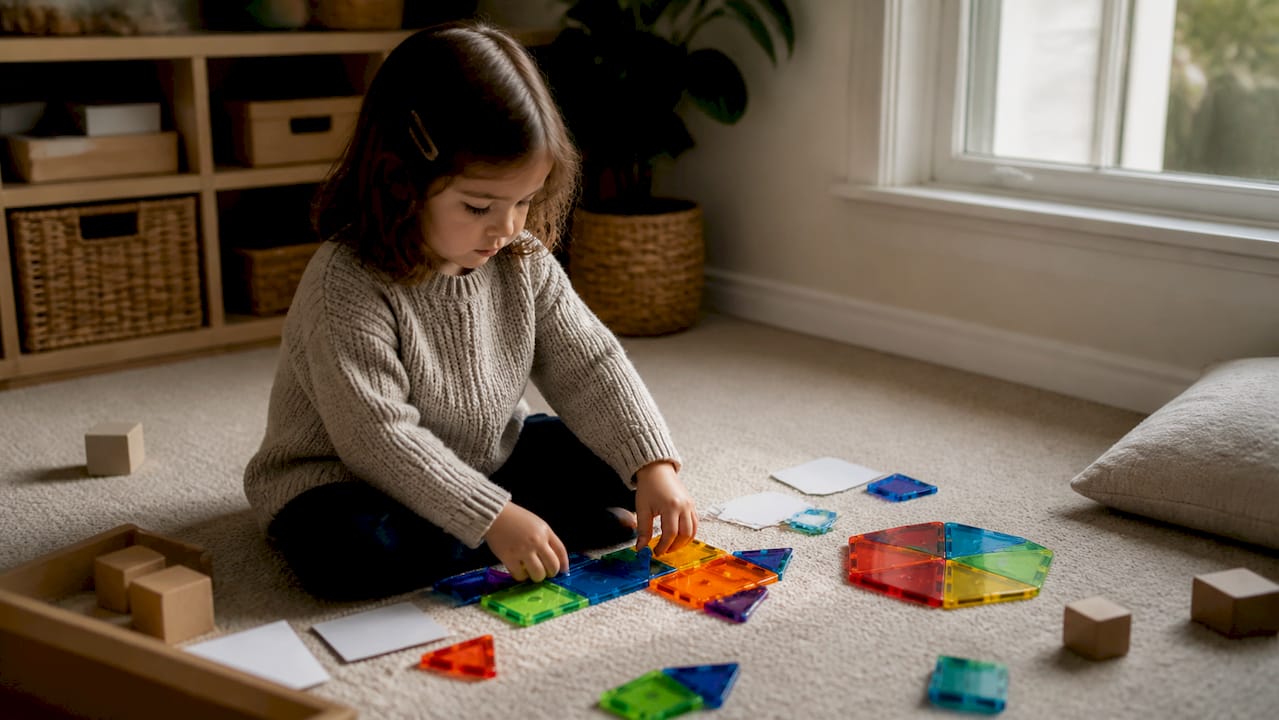
Geometry shows up constantly. Triangles and squares fit together to form hexagons and larger polygons, and asking “how many triangles make one hexagon?” turns a build into a math problem your child solves with their hands instead of a pencil. Counting sides, matching angles, and noticing which shapes tile flat versus which leave gaps are all early geometry lessons hiding inside normal construction.
Physics enters through ramps, bridges, and towers. A ramp introduces slope and gravity. A bridge introduces load and balance. A catapult, built from tiles with holes and a simple household axle, introduces force and trajectory in a way a child can adjust and retest immediately.
You don’t need to lecture through any of this. Ask a question instead of giving an answer: “Why do you think that side fell?” or “What happens if we make the ramp steeper?” Letting your child predict, test, and revise is the entire scientific method compressed into five minutes of floor time, and it’s exactly the kind of screen-free problem-solving that builds real STEM confidence over time.
Cooperative Builds for Siblings, Playdates, and Classrooms
Magnet tiles scale from solo play to a full group project without needing extra rules or refereeing. For two kids, try a split-build: each child constructs half of a structure, a bridge, a castle wall, a car track, and the two halves have to connect in the middle. It forces a small negotiation over height, color, or shape that mirrors real teamwork.
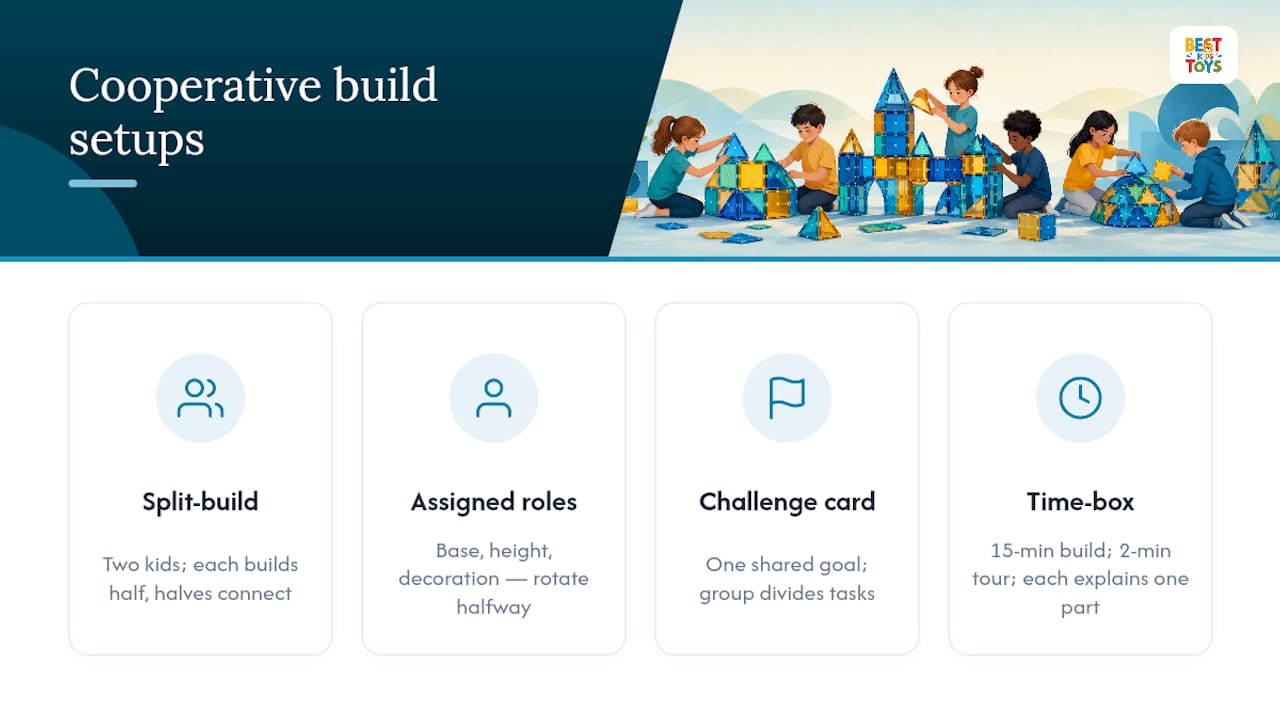
For three or more kids, assign roles instead of splitting the structure. One child manages the base and foundation, one handles height and walls, and one manages “decoration” or figures and props. Rotating roles halfway through keeps any one child from dominating the build.
A shared challenge card works well for group settings too: hand the group one card (“build a city with at least three buildings”) and let them figure out the division of labor themselves. Adults should resist stepping in early, most disagreements over whose tower is taller resolve faster without intervention than with it.
Classrooms and playdates both benefit from a simple time-boxed group build: fifteen minutes to construct, then a two-minute “tour” where each child explains one part they built. That short narration step matters more than it seems, it turns a silent building session into a language and presentation exercise, and it gives quieter kids a guaranteed moment to be heard.
Adjusting Activities for Every Age and Every Learner
The same tile set works from infancy through elementary school if you adjust the goal, not the toy. For babies under 18 months, the goal is sensory discovery: mouthing (supervised, with cracked tiles removed), stacking two pieces, and watching them cling to the fridge. For preschoolers, the goal shifts to shape and color logic: sorting, matching, and early construction with adult scaffolding. For elementary-age kids, the goal becomes engineering and narrative: multi-step builds, challenge cards, and storyplay with real plot structure.
For children with sensory sensitivities, magnet tiles offer a gentler alternative to messier sensory bins, the smooth surfaces, satisfying click of magnets, and predictable snapping motion appeal to kids who avoid textures like sand or slime. Reduce the color palette to two or three shades if visual overwhelm is a concern, and offer a quiet corner with a light table rather than a busy shared space.
For children who struggle with fine motor coordination, larger tiles are easier to grip and align than smaller sets, and starting with flat, single-layer patterns before attempting vertical stacking builds confidence without early frustration. For kids who need extra processing time, a challenge card with no time limit removes the pressure that a stopwatch-style game might create.
The through-line across every adaptation is the same: change the prompt and the pace, not the toy itself.
Combining Magnet Tiles With Other Toys for Bigger Builds
Magnet tiles get more interesting the moment they meet a toy from a completely different category. Small toy cars turn any flat build into a racetrack. Wooden blocks add texture and weight variation that pure tiles can’t offer alone. Play figures, animals, dolls, action characters, give a finished structure a reason to exist beyond the building itself.
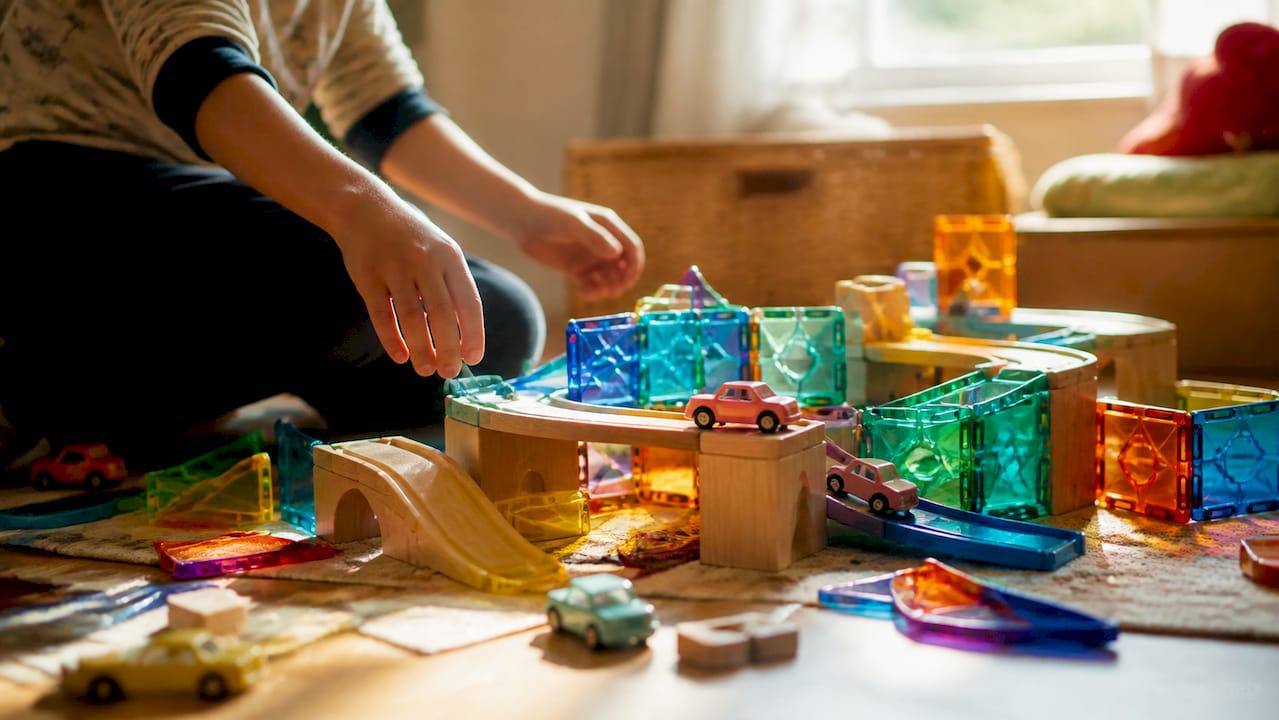
Combining tiles with simple household items like balls, spoons, and rubber bands is exactly how a flat panel becomes a working catapult. That same principle extends further than most parents expect. A cardboard box becomes a garage for a tile-built car ramp. Felt or fabric scraps become flags, capes, or water for a habitat build. Even a simple flashlight, aimed at a translucent tile wall, adds a shadow-play element to a story that started as a plain castle.
The goal isn’t to buy more toys, it’s to treat your existing toy box as a resource for whatever the tile structure needs next. Ask your child directly: “What does this building need that we don’t have yet?” More often than not, they’ll point at something already sitting on a shelf.
Why This List Works for Families
These activities work because they scale with your child rather than expiring after one use, the same bin of tiles supports a posting toddler and a catapult-building second grader. Start with one or two prompts from the quick games section, repeat the favorites for a week, then graduate to a construction challenge once your child asks for more.
Where to Start With Your Own Magnet Tile Set
If you’re building a collection from scratch or filling gaps in an existing one, our Magnetic Magna Tiles STEM Building Blocks set gives you enough squares and triangles to run nearly every challenge in this article, from the simple tower through the 26-tile car ramp, without needing a second purchase.
Every set Thebestkidstoys carries is chosen the same way we approach this list: fewer, better pieces that support longer, more independent play instead of a flashy toy that gets forgotten in a month. If your child is between the construction and storytelling stages, our ages 4 to 5 collection is built around exactly that transition, while our ages 5-plus collection leans further into open-ended STEM building for kids ready for catapults and multi-step challenges. Toddlers still working on posting and simple stacking fit best in our ages 3 to 4 collection, which favors chunkier pieces and gentler fine motor goals. Pick the collection that matches where your child is right now, add one tile set to your cart, and you’ll have a ready-to-run activity waiting the moment you open this article again.
Sources
- Ways to Play Magnetic Tiles for Endless Creativity - Stories of Play
- Easy Magnetic Tile Car Ramp for Kids (26 Tiles, Ages 4–8) – Panda Mommy Teacher
- Magnetic Tile Catapult | Nanny Anita | My Baba
FAQ
What age can start magnet tile activities? Most babies can start simple posting and fridge exploration around 8 months, always under direct supervision, with active building starting closer to age 2.
Are magnet tiles a choking hazard? Small tiles and any loose magnets that come free from a cracked piece present a real choking risk for children under 3. Check tiles regularly and remove any with damage.
How many magnet tiles do you need for good play? A basic 26-piece set covers most quick games and a car ramp build, while larger collections of 100 or more support elaborate group builds and detailed storyplay scenes.
How do you keep kids interested in magnet tiles long term? Rotate one variable at a time, color, shape, or a single loose part, rather than buying new toys. Limiting the tile selection also tends to spark more creative building than unlimited access.
Can magnet tiles teach real STEM skills? Yes. Ramps teach gravity and slope, bridges teach load and balance, and shape combinations teach early geometry, all through hands-on trial and error rather than instruction.
Recommended
- Magnetic Magna Tiles STEM Building Blocks – Best Kids Toys
- Engage Young Minds with Magnetic Magna Tiles STEM Building Blocks the Trending No Screen Spring Toy to Buy for Kids’ Outdoor Fun – Best Kids Toys
- Magnetic Toys: Why Magnetic Toys Are Perfect for STEM Learning and Ope – Best Kids Toys
- Unlock Your Child’s Creativity with Magnetic Magna Tiles STEM Building Blocks a Perfect Choice Among the Best Kids Toys and Trending No Screen Spring Toys