



Development Milestones by Age: Your 2026 Parent's Guide
Developmental milestones by age are standardized markers showing what 75% or more of children can typically do by specific ages, from 2 months through 5 years. Updated in 2022 by the CDC and endorsed by the American Academy of Pediatrics (AAP), these benchmarks cover four key domains: social/emotional, language/communication, cognitive, and movement/physical development. Think of them as a map, not a finish line. Your child’s path is their own, and knowing the general terrain helps you cheer them on with confidence.
Here’s a quick snapshot of the key age checkpoints to know:
- 2, 4, and 6 months: Early social smiles, head control, and the first babbling sounds
- 9 and 12 months: Crawling, pulling to stand, and saying “mama” or “dada”
- 15 and 18 months: Walking alone, pointing to show interest, and using a spoon
- 24 and 30 months: Two-word phrases, pretend play, and kicking a ball
- 3, 4, and 5 years: Full conversations, drawing shapes, hopping, and writing letters
Every child develops at their own pace, and natural variability is built into the system. Walking, for example, can begin anywhere from 8 to 18 months and still fall within the typical range. Milestones are guidelines, not grades.
What do development milestones by age actually look like?
The clearest way to understand childhood development is to see it broken down by age group, domain by domain. The table below captures key milestones across the four main areas, organized by age group.

| Age | Social/Emotional | Language/Communication | Cognitive | Movement/Physical |
|---|---|---|---|---|
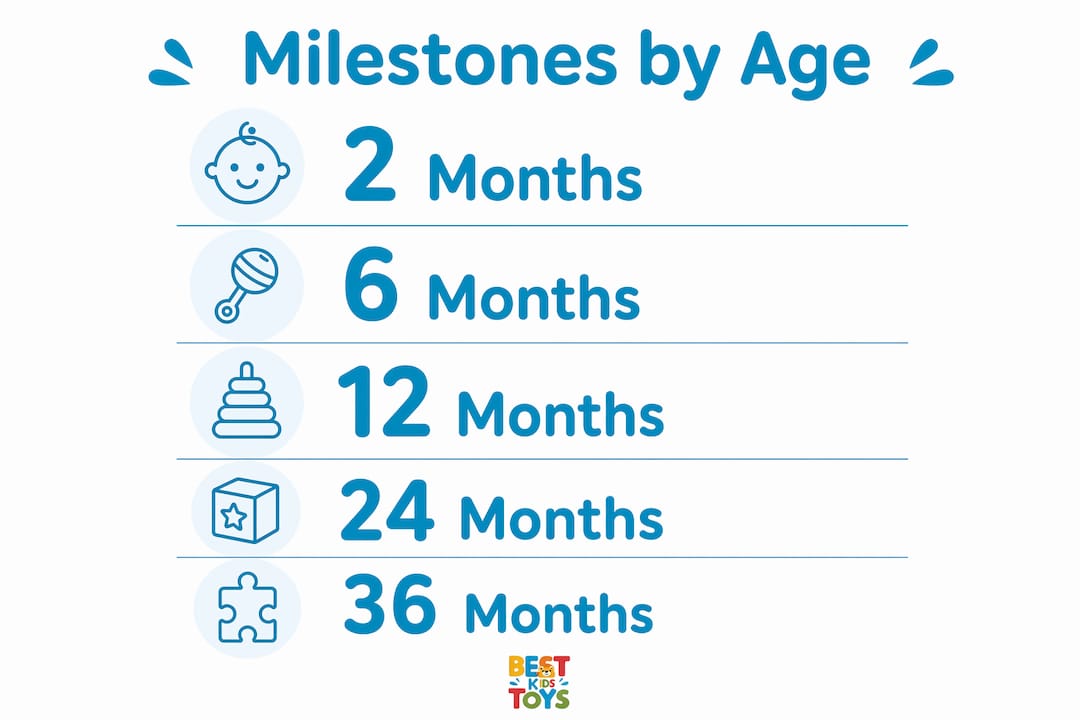
| 2 months | Smiles at people | Coos, makes gurgling sounds | Pays attention to faces | Holds head up during tummy time |
| 6 months | Knows familiar faces | Takes turns making sounds | Reaches for toys | Rolls from tummy to back |
| 12 months | Plays pat-a-cake | Says “mama,” “dada,” waves bye-bye | Puts a block in a cup | Pulls to stand, walks holding furniture |
| 18 months | Copies simple chores | Says 3+ words besides “mama/dada” | Points to show something interesting | Tries to use a spoon |
| 2 years | Looks at your face to gauge reactions | Says 2-word phrases like “More milk” | Uses toys for pretend play | Kicks a ball |
| 3 years | Notices other children and joins play | Talks in conversation; strangers understand most words | Draws a circle when shown | Uses a fork, walks up stairs |
| 4 years | Enjoys imaginative play with others | Answers “What is a coat for?” | Names a few colors | Hops on one foot, cuts with scissors |
| 5 years | Follows rules in group games | Tells stories, uses future tense | Counts to 10, writes some letters | Stands on one foot for 10 seconds |
A few things worth knowing as you read this:
- Premature babies born more than 3 weeks early should be assessed using their corrected age, not their birth date, for accurate milestone tracking.
- Screening checkpoints at 9, 18, and 30 months are specifically designed to catch delays early, when intervention is most effective.
- Milestone ranges are wide. Walking between 8 and 18 months is entirely typical. One child cruising furniture at 10 months and another taking first steps at 16 months are both right on track.
The Denver Developmental Screening Test and the Ages and Stages Questionnaires are two widely used tools that pediatricians use to assess these domains at well-child visits.
What should you do if your child seems to be missing milestones?
First, take a breath. Missing a single milestone at a checkup doesn’t mean something is wrong. Children practice skills over days and weeks, and a skill not shown in the doctor’s office may already be emerging at home. That said, knowing when to act is just as important as knowing when to wait.
Warning signs worth noting at any age:
- No social smiling by 3 months
- No babbling or pointing by 12 months
- No single words by 16 months, or no two-word phrases by 24 months
- Loss of previously acquired language or social skills at any age
Steps to take if you have a concern:
- Track what you observe. Keep a simple log of what your child does and doesn’t do over 2–4 weeks. Note the context, frequency, and any changes.
- Bring your notes to the pediatrician. Share specific examples rather than general worries. “She hasn’t waved bye-bye yet” is more useful than “I’m not sure about her development.”
- Request a developmental screening. The AAP recommends screenings at 9, 18, and 30 months for all children, plus autism screenings at 18 and 24 months. You don’t need to wait for a scheduled visit to ask.
- Ask for a referral if needed. If screening suggests a delay, your pediatrician can refer you to early intervention services, which may include physical, occupational, or speech therapy.
- Follow up. Early intervention works best when started early. Don’t wait to see if a concern resolves on its own if your gut says something is off.
“Learn the signs. Act early.” That’s the CDC’s core message to parents, and it’s backed by decades of research showing that children who receive early support for developmental delays have significantly better long-term outcomes than those who don’t.
Pro Tip: Download the CDC’s free Milestone Tracker app. It walks you through age-specific checklists, lets you log your child’s progress with photos and notes, and generates a summary you can share directly with your child’s doctor.
How active parenting and the right toys support your child’s growth
You are your child’s first teacher, and that’s not just a warm sentiment. Active caregiving, including reading aloud, speaking clearly, and building consistent play routines, directly supports cognitive and physical growth across every developmental stage. The good news? You don’t need a curriculum. You need presence and the right tools.
A few activities that genuinely move the needle:
- Read together daily. Even board books with babies build language pathways long before a child speaks.
- Narrate your day. “Now we’re washing hands. The water is warm.” This kind of talk builds vocabulary faster than any flashcard.
- Create simple routines. Predictable sequences, like a bath-book-bed pattern, help toddlers develop memory and emotional regulation.
- Let them struggle a little. Handing a child a shape sorter and stepping back, rather than showing them the answer, builds problem-solving confidence.
Toy selection matters more than most parents realize. Montessori-inspired educational toys, specifically those that encourage open-ended exploration rather than passive entertainment, are particularly well-suited to building focus, coordination, and independence. The key is matching the toy to the developmental stage.
Here’s a quick guide to toy types by age:
- 0–6 months: High-contrast visual cards, soft rattles, and tummy-time mirrors to stimulate sensory engagement and head control.
- 6–12 months: Object permanence boxes, stacking rings, and textured balls to build fine motor skills and early cognitive understanding.
- 12–24 months: Shape sorters, push toys, and simple puzzles to support walking, hand-eye coordination, and problem-solving.
- 2–3 years: Pretend play sets, simple wooden puzzles, and threading beads to grow language, imagination, and fine motor precision.
- 3–5 years: Building sets, art supplies, and cooperative games to develop creativity, early literacy, and social skills.
Pro Tip: When choosing toys for your child, look for open-ended designs with no single “right” answer. A set of wooden blocks teaches more across developmental stages than a toy that does one thing at the push of a button.
Thebestkidstoys curates toys with exactly this philosophy in mind. Every product is selected to support specific developmental skills, not just fill a toy box. Check out the best toys by age guide for stage-matched picks your child will actually use, or explore educational baby toys chosen specifically for cognitive and motor skill growth in the earliest months.
Where to find trusted resources for tracking your child’s development
You don’t have to navigate this alone. These are the most reliable, parent-friendly resources available in the United States for milestone tracking and developmental support.
- CDC’s Learn the Signs. Act Early. The gold standard for milestone information. Includes free downloadable checklists for every age from 2 months to 5 years, plus the free Milestone Tracker app available on iOS and Android.
- CDC Milestone Moments Booklet A printable, illustrated guide covering milestones from birth to age 5, with tips for encouraging development at each stage. Great to bring to well-child visits.
- HealthyChildren.org The AAP’s parent-facing website. Especially useful for parents of premature babies navigating corrected-age milestone tracking.
- MedlinePlus Developmental Milestones A clear, medically reviewed overview of milestones from infancy through adolescence, maintained by the National Library of Medicine.
- KidsHealth.org Pediatrician-reviewed articles on child development, written in plain language for parents.
- Wallfully Baby Milestone Posters Personalized milestone posters that let you celebrate and visually track your child’s achievements, from first smile to first steps. A beautiful way to make the journey feel as joyful as it is.
| Resource | Best for | Format |
|---|---|---|
| CDC Milestone Tracker app | Ongoing tracking with doctor-ready summaries | Mobile app (free) |
| CDC Milestone Moments Booklet | At-a-glance checklists for every age | Printable PDF |
| HealthyChildren.org | Premature baby milestone guidance | Website |
| MedlinePlus | Broad developmental overview | Website |
| KidsHealth.org | Plain-language parenting articles | Website |
Key Takeaways
Developmental milestones by age give parents a clear, evidence-based framework for tracking growth from 2 months through 5 years, with early screening and active play being the most powerful tools available.
| Point | Details |
|---|---|
| Milestones are 75% benchmarks | The CDC defines milestones as skills most children (75% or more) reach by specific ages. |
| Four domains to track | Social/emotional, language/communication, cognitive, and movement/physical development all matter equally. |
| Screen at 9, 18, and 30 months | The AAP recommends developmental screenings at these ages for all children, plus autism screenings at 18 and 24 months. |
| Premature babies need corrected age | Babies born more than 3 weeks early should be assessed using corrected age, not birth date. |
| Active play accelerates development | Reading aloud, narrating daily life, and open-ended toys directly support milestone achievement at every stage. |
Give your child’s development a head start

The right toy at the right stage doesn’t just entertain. It builds the exact skills your child is working on right now. The Little Learners Montessori Busy Book from Thebestkidstoys is designed to support multiple developmental skills in one place, from fine motor coordination to early problem-solving and language. For toddlers just beginning to explore letters and shapes, the My First Quiet Learning Book makes early literacy feel like pure play. Both are crafted with the same care and developmental intentionality that guides every product at Thebestkidstoys. Free shipping on orders over $60, with a 40% off sale running now.