



Block Stacking Milestones: A Parent's Age-by-Age Guide
Block stacking milestones are defined as the sequential motor and cognitive achievements toddlers reach as they learn to place, balance, and build with blocks, beginning as early as 9 months and progressing through age 3. These milestones matter because they reveal how a child’s fine motor control, hand-eye coordination, and spatial reasoning are developing together. Child development experts use stacking benchmarks as flexible guides, not rigid tests, to track a toddler’s overall growth. Understanding what to expect at each stage helps you support your child’s play with confidence and joy, rather than anxiety.
What are the typical block stacking milestones from 9 months to 3 years?
Stacking development follows a predictable arc, though the timing varies from child to child. Milestone charts work best as guides for observing progress, not as strict tests with pass or fail outcomes. Knowing the general sequence gives you a clear picture of what your toddler is working toward.
9–12 months: reaching and placing
At this stage, most toddlers grip a block and attempt to set it down on a surface. The goal is not a tower. It is the act of intentional placement. A child who can position a block but cannot yet release it cleanly has still achieved a cognitive milestone, because recognizing where to place the block comes before the fine motor precision needed to let go smoothly. This is a big deal, and worth celebrating.
12–18 months: first towers appear
Most children begin stacking one or two blocks around 11–12 months. By 15–18 months, many can build a tower of 2–3 blocks before it wobbles and falls. The voluntary release skill, which means deliberately letting go of an object into a container or onto a surface, develops alongside these early stacking attempts. Expect lots of toppling. Every collapse is a lesson in gravity and cause-and-effect.
18–24 months: growing steadiness
Toddlers in this range typically stack 4–6 blocks with improving control. Hand steadiness increases noticeably, and you will see children slow down, concentrate, and even hold their breath as they place each block. By around 22–24 months, stacking 4–6 blocks is a common benchmark, reflecting real advances in motor control and spatial thinking.
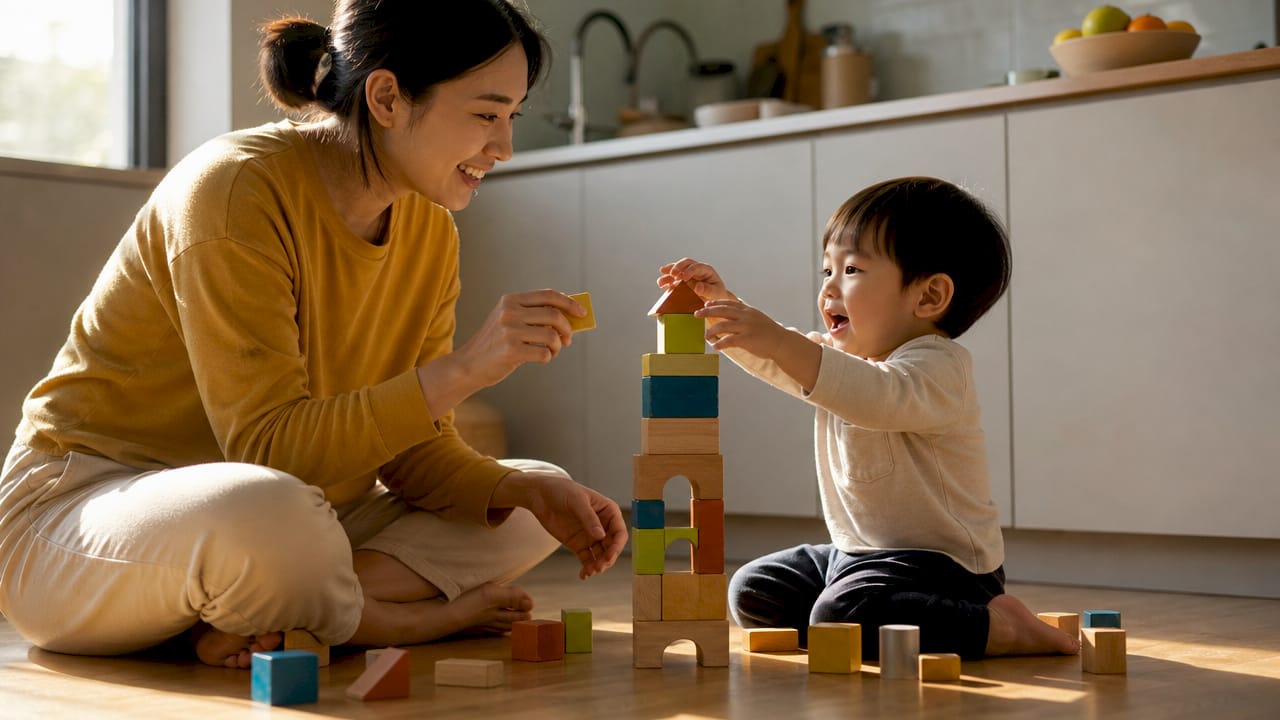
24–36 months: towers, rows, and early structures
Children in this range build taller towers and begin arranging blocks in rows or simple enclosures. They start to plan before they place, which is a meaningful cognitive leap. Expect more deliberate block selection and the first signs of design thinking, such as choosing a wider block for the base.
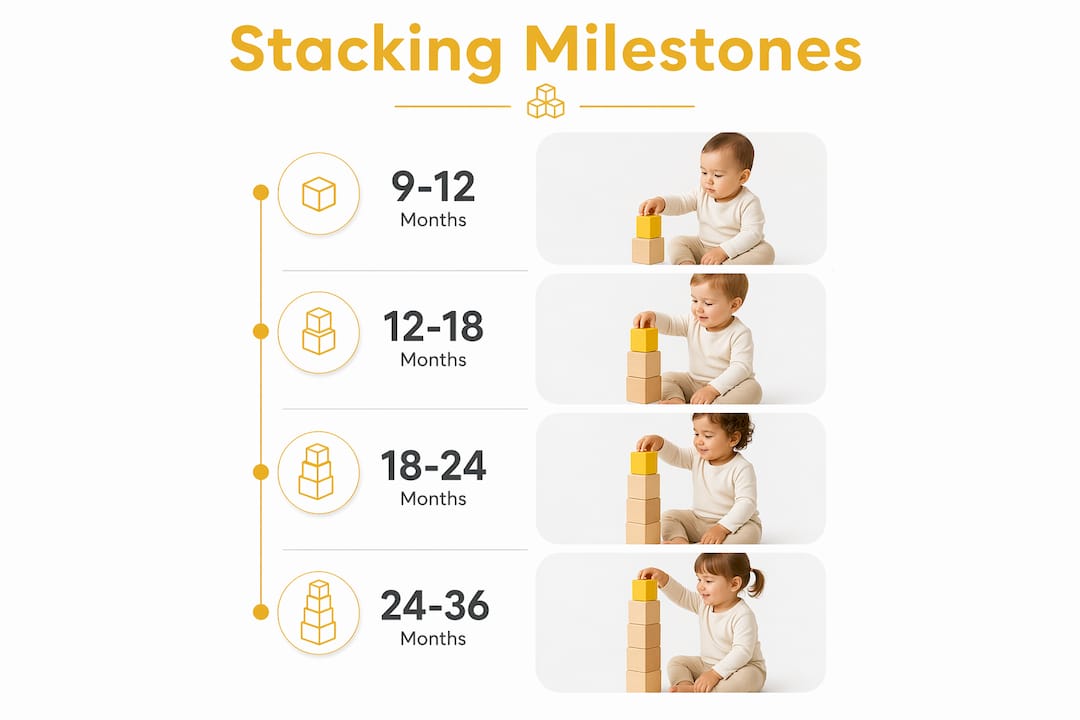
| Age range | Typical stacking skill | Key development |
|---|---|---|
| 9–12 months | Grasps and attempts placement | Intentional reach and release begins |
| 12–18 months | Stacks 1–3 blocks | Voluntary release and aim improve |
| 18–24 months | Stacks 4–6 blocks | Hand steadiness and focus increase |
| 24–36 months | Builds taller towers and rows | Planning and early design thinking emerge |
Pro Tip: Sit beside your toddler and build your own tower at the same time. Side-by-side modeling, without directing, gives children a visual reference without pressure.
How do block stacking milestones reflect fine motor and cognitive development?
Stacking blocks is not just a physical act. It is a window into how a toddler’s brain and body are learning to work together. Fine motor milestones such as the pinch grasp at 12 months and voluntary release into containers run parallel to early stacking abilities. Each of these skills feeds directly into a child’s capacity to pick up, aim, and set down a block with control.
The cognitive side of stacking is equally rich. Spatial reasoning and visual attention develop alongside fine motor skills and show up clearly in how toddlers approach block play. Watch for these signs of cognitive growth during stacking sessions:
- Pausing before placement. A child who stops and looks before setting a block down is practicing visual attention and planning.
- Turning blocks to find a flatter side. This behavior signals early visual problem-solving and design thinking, the same mental process behind later STEM learning.
- Correcting a wobbly block. Adjusting placement after noticing instability shows cause-and-effect reasoning in action.
- Repeating the same sequence. Building the same tower multiple times reflects memory, pattern recognition, and growing confidence.
The process of placing, adjusting, and correcting develops critical cognitive skills far more than achieving a tall tower does. A child who builds a three-block tower thoughtfully is doing more developmental work than one who rushes to stack six blocks without attention. Focus on the quality of engagement, not the height of the structure.
Pro Tip: Narrate what you observe without evaluating it. Say “You turned that block around” instead of “Good job.” Descriptive language builds your child’s awareness of their own thinking process.
What are common behaviors and variations in toddler block play?
Not every toddler rushes straight to stacking. Many children spend weeks, or even months, exploring blocks in other ways before building their first tower. This is developmentally normal and reflects a broader phase of sensory and physical exploration. Carrying blocks from room to room, lining them up in rows, or sorting them by color are all signs of active learning.
Here are the most common alternative block play behaviors and what each one tells you:
- Carrying and transporting. Toddlers who carry blocks around are practicing grip strength, body awareness, and spatial planning. They are learning how objects move through space.
- Lining up in rows. This behavior reflects early pattern thinking and an interest in order, both of which support later math and reading readiness.
- Grouping by size or color. Sorting is a foundational cognitive skill. A toddler who groups blocks by size is already practicing classification.
- Knocking towers down. Demolishing a tower is not destructive play. It is a cause-and-effect experiment, and toddlers who knock towers down are often processing the same physics concepts as those who build them.
- Mouthing and examining. Younger toddlers learn through sensory exploration. Feeling the weight, texture, and edges of a block is genuine learning about object properties.
Milestones act as a flexible map, and some children explore non-stacking behaviors extensively before advancing to stacking structures. There is no single correct order of progression. Your role is to provide the materials, the space, and the time, and then let curiosity lead.
What practical block stacking strategies support toddlers’ milestone achievements?
The right environment and the right materials make a measurable difference in how quickly and confidently toddlers progress through stacking stages. Large, soft, or interlocking blocks reduce frustration and build confidence in early stacking attempts for toddlers aged 12–24 months. Choosing the right block type is the single most practical thing you can do to support early stacking success.
-
Start with large, lightweight blocks. Foam blocks, large wooden cubes, and soft fabric blocks are ideal for the 9–18 month range. They are easy to grip, forgiving when dropped, and safe when towers fall on little feet.
-
Create a low-distraction play space. A clear floor area with a non-slip mat gives toddlers a stable surface and reduces the visual noise that competes for their attention. Block play rewards focus, and a calm space supports it.
-
Offer blocks in small sets. A pile of 20 blocks can feel chaotic. Start with 4–6 blocks and add more as your child’s interest and skill grow. Fewer choices at first means more concentrated practice.
-
Celebrate the process, not just the tower. When a toddler pauses to turn a block or carefully adjusts a placement, name what you see. “You checked if that was steady” teaches children that thoughtful effort matters more than the final result.
-
Rotate block types over time. As children approach 24–36 months, introduce unit blocks, interlocking sets, or blocks with varied shapes. New textures and forms reignite curiosity and push fine motor skills further. You can find age-matched options in the educational toys for toddlers collection at The Best Kids Toys.
-
Use stacking to introduce spatial language. Words like “on top,” “underneath,” “beside,” and “taller” build vocabulary and spatial reasoning at the same time. Narrate the build as it happens.
Pro Tip: If your toddler gets frustrated, reduce the number of blocks and lower the height goal. Success at a smaller scale rebuilds confidence faster than pushing through repeated failure.
Key takeaways
Block stacking milestones are flexible developmental markers, not fixed tests, and the quality of a toddler’s engagement with blocks matters more than the height of any tower they build.
| Point | Details |
|---|---|
| Milestones follow a range | Most toddlers stack 1–2 blocks by 12 months and 4–6 blocks by 22–24 months, with normal variation. |
| Cognition leads motor skill | Recognizing where to place a block precedes the fine motor precision needed to release it cleanly. |
| Non-stacking play counts | Carrying, lining up, and sorting blocks are normal developmental phases, not signs of delay. |
| Block choice matters | Large, soft, or interlocking blocks reduce frustration and support confident early stacking. |
| Process beats outcome | Adjusting, correcting, and pausing during block play builds more cognitive skill than tower height alone. |
What I’ve learned from watching toddlers stack blocks
Parents often ask me whether their child is “behind” because a neighbor’s toddler is already building six-block towers. My honest answer is always the same: the tower height tells you almost nothing on its own.
What I find far more telling is how a child engages with the blocks before the tower goes up. Does she pause and look? Does she turn a block to find a better side? Does she try again after a collapse without melting down? Those behaviors are the real milestones. They show a brain that is learning to plan, adjust, and persist. That is the foundation of every skill that comes later, from writing to problem-solving to reading comprehension.
The most useful mindset shift I can offer is this: treat milestone charts as a compass, not a scoreboard. They tell you the general direction of development, not whether your child is winning or losing. When you stop watching for the tower and start watching for the thinking behind it, block play becomes genuinely fascinating to observe. And your toddler will feel the difference in how you respond.
— Hugh
Toys that grow with your toddler’s stacking skills
Thebestkidstoys carries a curated selection of Montessori-inspired blocks and fine motor skill toys designed to match each stage of stacking development. From large soft sets ideal for first-time stackers to interlocking unit blocks for toddlers approaching age 3, every option has been reviewed for safety and long-term play value.
Parents and educators can browse the full educational toys collection to find age-matched picks that support spatial reasoning, fine motor growth, and independent play. Free shipping applies to orders over $60, and current sale pricing makes it easy to build a well-rounded toy shelf without overspending.
FAQ
When do most toddlers start stacking blocks?
Most children begin stacking one or two blocks around 11–12 months, with stacking ability growing steadily through age 2. By 22–24 months, stacking 4–6 blocks is a common developmental benchmark.
What if my toddler prefers carrying blocks instead of stacking them?
Carrying, lining up, and grouping blocks are normal phases of block exploration and reflect active learning about object properties. These behaviors typically precede stacking and are not signs of developmental delay.
How do I know if my toddler’s stacking skills are on track?
Use milestone charts as flexible guides rather than strict tests. If your toddler shows interest in blocks, attempts placement, and engages with the play process, development is generally progressing well.
What type of blocks are best for early stacking?
Large, soft, or interlocking blocks work best for toddlers aged 12–24 months because they are easier to grip, reduce frustration, and build confidence through early stacking success.
Does block play really support cognitive development?
Block play builds spatial reasoning, visual attention, and early problem-solving skills alongside fine motor control. Behaviors like turning a block to find a flatter side reflect the same design thinking that supports later STEM learning.