



Loose Parts Play: A Complete Guide for Parents and Educators
Loose parts play is an approach to children’s learning where open-ended, movable materials — things like pebbles, wooden discs, fabric scraps, and shells — are offered freely for children to arrange, build, and imagine with, without a predetermined outcome. The concept traces back to architect Simon Nicholson’s theory that environments with more “variables” produce more creativity. Ready to get started? Here are three things you can do right now:
- Start small. Collect a small number of safe household items (wooden spoons, jar lids, fabric squares) and place them in a tray.
- Pick age-appropriate materials. Avoid anything smaller than a film canister for children under three.
- Offer time and space. Set aside 20 uninterrupted minutes and step back — your child’s imagination will do the rest.
The sections below give you the research, the material lists, the safety rules, and a step-by-step rollout plan to make this a lasting part of your child’s day.
Key Takeaways
Loose parts play is one of the highest-return investments you can make in a child’s creative and cognitive development, and it costs almost nothing to start.
| Point | Details |
|---|---|
| Core definition | Loose parts are open-ended, movable materials children use freely to create, explore, and imagine. |
| Top developmental gains | Research links loose parts to divergent thinking, executive function, language growth, and motor skills. |
| Safety first | Remove any item small enough to be a choking hazard for children under three; inspect materials weekly. |
| Start small and rotate | Begin with one tray of five to ten items, then expand and rotate every one to two weeks to maintain engagement. |
| Thebestkidstoys | The open-ended and sensory toy collections offer durable, Montessori-inspired pieces that anchor any loose parts kit. |
Table of Contents
- What is loose parts play, and where did the idea come from?
- Why loose parts play is so good for children’s development
- What materials make great loose parts?
- How adults set up spaces and support play without taking over
- How to introduce loose parts step by step
- Age-appropriate use, safety, and hygiene
- What does the research actually say?
- Choosing manufactured products that work with loose parts
- Thebestkidstoys makes open-ended play easy to start
- Sources
What is loose parts play, and where did the idea come from?
Simon Nicholson, a British architect, introduced the theory of loose parts in 1971. His core argument was simple: the more variables a child has access to in an environment, the more inventive that child becomes. A “variable” is anything movable, transferable, or redesignable — a stick, a stone, a piece of rope. Nicholson believed that restricting children to fixed, single-purpose objects limited their creative potential.
That insight shapes how we define loose parts today. A loose part is any open-ended material a child can move, combine, and use in multiple ways. There is no right answer, no finished product, and no instruction manual.
Contrast that with closed-ended toys, which have one correct outcome (a puzzle with a single solution, a shape-sorter with fixed holes). Both have value, but they develop different skills.
| Feature | Open-ended loose parts | Closed-ended toys |
|---|---|---|
| Child outcome | Divergent thinking, creativity | Convergent thinking, problem-solving |
| Adult role | Facilitator, observer | Guide, corrector |
| Examples | Stones, fabric, wooden discs | Shape sorters, single-solution puzzles |
| Replayability | Infinite | Limited once mastered |
Post-war playwork in the United States and United Kingdom reinforced Nicholson’s ideas, with community adventure playgrounds built from donated and found materials. That history, documented by Redleaf Press, shows that low-cost, community-sourced materials have always been at the heart of this approach.
Why loose parts play is so good for children’s development
The developmental case for this kind of play is genuinely exciting. Head Start’s practitioner guidance identifies creativity, problem-solving, language, social skills, and motor development as areas that loose parts provision directly supports. Here is how those gains break down by domain:
Cognitive and executive function
- Children who sort, stack, and sequence loose parts practice working memory and flexible thinking.
- Stacking irregular stones, for example, builds spatial reasoning as children predict balance and weight.
- A narrative synthesis published in MDPI found promising links between loose parts play and divergent thinking, while noting that longer-term studies are still needed to confirm direct causal pathways.
Social-emotional development
- Negotiating who uses the “best” pinecone teaches turn-taking and conflict resolution.
- Collaborative building projects with loose parts require children to communicate a shared vision, which strengthens empathy and cooperation.
Language and communication
- Open-ended materials spark rich descriptive language: “bumpy,” “heavy,” “it looks like a volcano.”
- Adults who ask open questions during play (“What do you think will happen if you add another layer?”) extend vocabulary naturally.
Motor and spatial skills
- Pouring, threading, stacking, and arranging all build fine motor control.
- Larger outdoor loose parts — logs, crates, planks — develop gross motor strength, balance, and proprioception.
Creativity and imagination
- Because there is no wrong answer, children feel safe to experiment. A handful of pebbles becomes a campfire, a treasure map, or a counting game within the same session.
What materials make great loose parts?
The beauty of this approach is that great materials are often free or nearly free. Play Scotland’s toolkit highlights that many of the best items are upcycled, donated, or gathered from nature.
Indoor and household loose parts
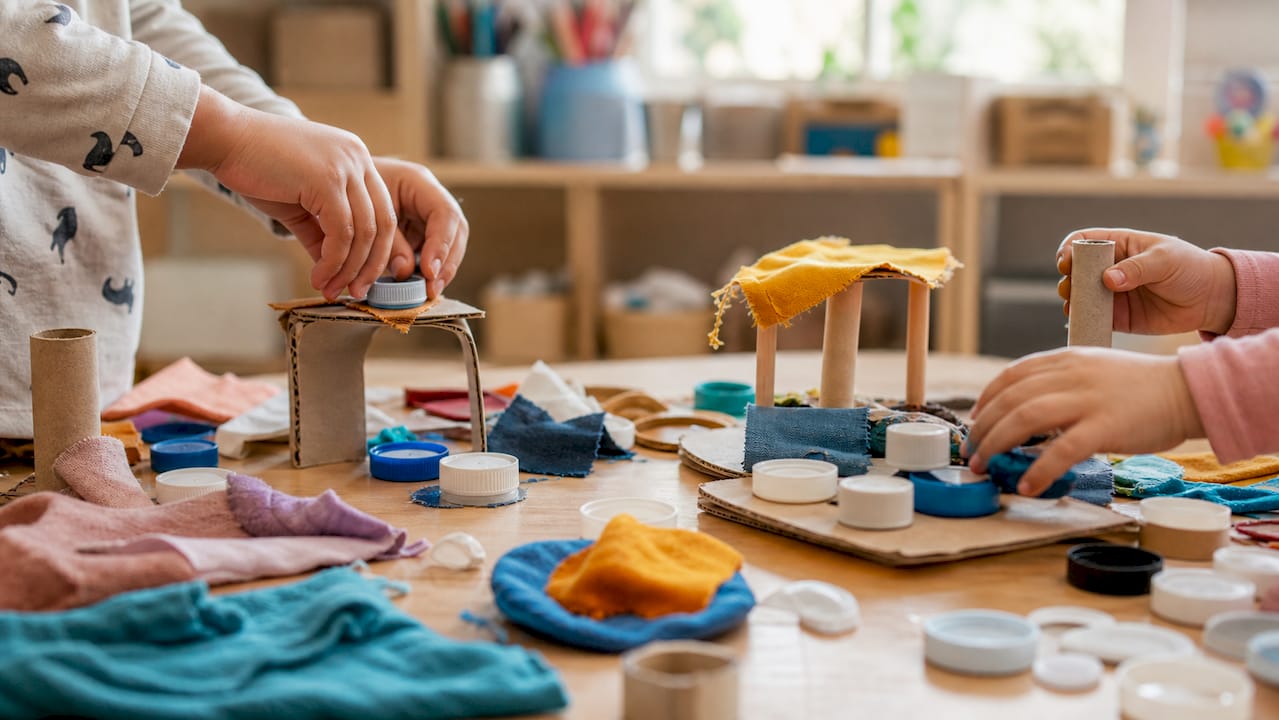
Raid your recycling bin and kitchen drawers first. Good indoor items include:
- Jar lids, bottle caps, and corks
- Fabric squares, ribbons, and scarves
- Wooden spoons, pegs, and craft sticks
- Small cardboard tubes and boxes
- Buttons, large beads (3+ years only), and smooth river stones
Safety note: For children under three, nothing smaller than a 35mm film canister. Check every item for sharp edges, splinters, or peeling paint before placing it in a tray.
Outdoor and natural loose parts
Nature provides an almost unlimited supply. Think:
- Sticks, pinecones, acorns, and seed pods
- Smooth pebbles and flat rocks
- Leaves, bark, and dried flowers
- Sand, gravel, and soil (in contained areas)
- Logs, stumps, and planks for larger construction
Store natural materials in breathable mesh bags or open crates so they dry out between sessions. Wet wood and leaves can develop mold quickly, especially in humid climates.
Upcycled and recycled items
Ask families to donate clean household items. Egg cartons, yogurt containers, cardboard packaging, and old keys are perennial favorites. Community groups, thrift stores, and local businesses (tile shops, fabric stores, hardware stores) are often happy to donate offcuts and samples.
Pro Tip: Set up a “loose parts donation box” at your classroom or front door. Label it clearly and refresh it monthly — families love contributing, and it keeps your collection growing without any budget.
For outdoor spaces, transforming your yard or garden into a dedicated play zone can give children a permanent, weather-ready space to use larger loose parts like planks, crates, and tires.
How adults set up spaces and support play without taking over
Your role is curator, not director. The goal is to prepare an environment that invites exploration, then get out of the way.
Setting up invitations to play
An “invitation to play” is a thoughtfully arranged collection of materials that sparks curiosity without prescribing an outcome. Place a handful of blue glass gems, a few shells, and a small bowl of water on a tray, and a child might build an ocean scene, sort by color, or pour and fill for 30 minutes. The arrangement does the inviting; you do not need to explain what to do.
Practical setup tips:
- Use low, open shelving or trays so children can see and reach materials independently.
- Group materials by texture, color, or theme to suggest (but not dictate) connections.
- Rotate collections every one to two weeks to maintain novelty.
- Leave white space on the tray — overcrowding kills curiosity.
Prompts that extend thinking
When you do step in, ask questions that open up thinking rather than close it down. Practitioner guidance from Care Learning emphasizes the adult’s role as a facilitator who asks open questions and scaffolds without directing. Try:
- “What are you making? Tell me about it.”
- “What would happen if you tried a different shape here?”
- “How did you decide to put those together?”
Observe for at least five minutes before joining. Children in deep play often self-correct, negotiate, and problem-solve without needing adult input. Interrupting too early breaks concentration and signals that adult approval is the goal.
Classroom rollout checklist
Before launching in a classroom, confirm:
- [ ] Materials are inspected and hazard-free
- [ ] Storage is child-accessible and labeled
- [ ] Staff understand the facilitator role
- [ ] Learning goals are linked to specific material sets
- [ ] A rotation schedule is in place
How to introduce loose parts step by step
A gradual rollout prevents overwhelm for both children and adults. The Play Scotland Toolkit frames loose parts as a planned, embedded practice rather than a random dump of materials, and that framing makes all the difference.
- Days 1–30: Start with one tray. Introduce a single, themed collection (natural materials only, or recycled items only). Observe how children engage. Note which materials get the most use and which sit untouched.
- Days 31–60: Add a second station. Introduce an outdoor collection or a sensory tray alongside the original. Begin linking materials to specific learning goals (fine motor, counting, color sorting).
- Days 61–90: Rotate and expand. Swap out materials that have lost novelty. Introduce larger construction loose parts if space allows. Involve children in choosing what to add next.
Storage and organization: Clear bins, wicker baskets, and rolling trolleys all work well. Label containers with pictures and words so children can find and return materials independently. That independence is part of the learning.
Cleanup routines: Make tidying part of the play. Give children small brushes, sorting trays, and labeled bins. A “five-minute tidy” signal (a chime or a song) works better than a verbal command and reduces resistance considerably.
Inventory tip: Every 30 days, do a quick sweep. Remove broken, dirty, or hazardous items. Replenish from your donation box or a quick nature walk.
Age-appropriate use, safety, and hygiene
Safety is non-negotiable, and it is also manageable with a clear system.
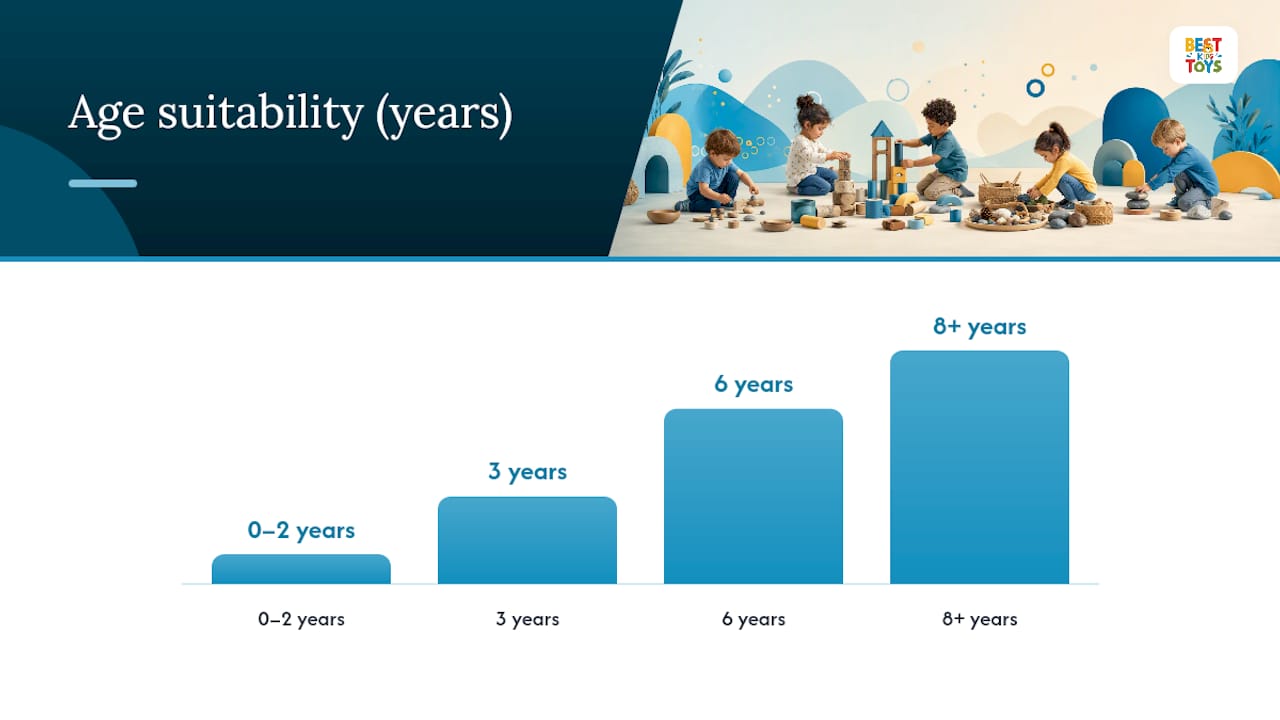
| Age group | Recommended materials | Key cautions |
|---|---|---|
| 0–2 years | Large smooth stones, soft fabric, large wooden rings | No small parts; supervise at all times |
| 3 years | Pebbles, pinecones, large buttons, corks, cardboard tubes | Check for splinters, sharp edges, peeling paint |
| 6 years | Full range including small beads, wire, nails (supervised) | Teach tool safety; inspect metal items for rust |
| 8+ years | Construction materials, tools, complex mixed media | Reinforce safe handling; rotate for challenge |
Cleaning routines by material:
- Natural items (stones, shells): Rinse with water and a mild soap solution weekly. Air-dry fully before returning to trays.
- Fabric and ribbon: Machine wash on a gentle cycle monthly, or more often if visibly soiled.
- Plastic and metal items: Wipe with a diluted white vinegar solution or a child-safe disinfectant spray.
- Cardboard and paper: Replace when wet, torn, or visibly dirty — these cannot be cleaned effectively.
Inclusion adaptations: Children with sensory sensitivities may need a gradual introduction to textures. Offer one new material at a time alongside familiar ones. For children with limited mobility, position trays at wheelchair height and use lightweight materials. Avoid strong-smelling items (dried herbs, scented oils) for children with sensory processing differences.
Red flags — remove immediately: Any item that is cracked, splintered, rusted, has a sharp edge, or has become small enough to be a choking hazard. When in doubt, throw it out.
What does the research actually say?
The evidence base for loose parts is growing, though it is still maturing. A narrative synthesis in MDPI’s journal of intelligence reviewed studies on loose parts play and preschool cognition, finding consistent associations with divergent thinking and aspects of executive function, including flexible problem-solving and self-regulation. The authors recommend observation-based measures and longer-term studies to clarify causal effects.
That hedged conclusion is actually useful for educators. It means you can point to a coherent, growing evidence base without overpromising. What you can say with confidence: children who engage regularly with open-ended materials show richer language, more sustained play, and greater willingness to take creative risks.
Observation prompts you can use today:
- Does the child try more than one solution before giving up?
- Are they using descriptive or comparative language (“bigger than,” “feels like”)?
- Do they invite peers to collaborate, or do they prefer solo exploration?
- How long does sustained engagement last compared to structured toy play?
A simple anecdotal note (date, child’s name, material used, observed behavior) takes 60 seconds and feeds directly into curriculum planning. Over a term, those notes reveal patterns that standardized assessments often miss.
Choosing manufactured products that work with loose parts
Not every loose part needs to be found or recycled. Thoughtfully chosen manufactured items can anchor a collection and give it longevity. When selecting products to pair with loose parts, look for:
- Durability: Solid wood or BPA-free materials that survive repeated handling and cleaning.
- Multipurpose use: A wooden disc can be a coin, a wheel, a stepping stone, or a plate — that versatility is what you are paying for.
- Neutral aesthetics: Natural colors and simple shapes let children project their own meaning rather than following a manufacturer’s narrative.
- Manageable size: Items should fit comfortably in a child’s hand and store neatly in a standard bin or tray.
Thebestkidstoys carries a range of open-ended toys that pair naturally with loose parts collections: wooden sorting trays, Montessori-inspired stacking sets, and sensory play materials that complement natural and recycled items beautifully. The Little Learners Montessori Busy Book is a particularly good companion for fine-motor invitations, offering structured activities that bridge the gap between open-ended exploration and skill-building tasks.
A quick buying checklist before you purchase:
- Does it serve more than one play purpose?
- Can it be cleaned easily?
- Will it store without taking over your space?
- Does it complement materials you already have?
- Is it sized appropriately for your child’s age group?
A note on the loose parts approach
The best loose parts collections mix found, donated, and purchased items. Curated kits from educational suppliers can be a helpful starting point when time or sourcing is limited, but the magic of this approach is that a $0 collection of pinecones and jar lids can be just as rich as a $50 kit. The goal is variety, not expense.
What Danica Hodge thinks about loose parts
The thing that surprises most parents when they first try this approach is how little children need adults to get started. You set out the tray, you step back, and within minutes the gears are turning. A child who struggles to focus during structured activities will often spend 40 minutes arranging and rearranging a collection of pebbles and sticks. That sustained engagement is not accidental — it happens because there is no wrong answer, no pressure to perform, and no adult waiting to correct them.
The research confirms what good early childhood educators have observed for decades: open-ended materials build the kind of flexible, creative thinking that no worksheet can replicate. What the research does not fully capture yet is the confidence children develop when they realize their ideas are worth pursuing. That is the part worth watching for.
Thebestkidstoys makes open-ended play easy to start
Putting together a quality loose parts kit takes time, and that is exactly where Thebestkidstoys helps. Rather than hunting across a dozen stores for safe, developmentally appropriate materials, you get a curated selection of Montessori-inspired, screen-free toys that slot directly into loose parts play setups — wooden pieces, sensory trays, and fine-motor materials all reviewed for safety and long-term play value.
The sensory toys collection is a natural starting point for parents building a first loose parts tray at home, and the open-ended toy range gives educators the durable, multipurpose pieces that hold up to daily classroom use. Free shipping on orders over $60 means you can stock a solid starter kit without stretching the budget. Browse the full collection and pick three pieces to anchor your first invitation to play.
Sources
- Loose parts: What does this mean? — Penn State Extension/Better Kid Care
- Let your imagination loose: Loose parts — Head Start (Play the Head Start Way)
- Loose parts play and preschool cognition: a narrative synthesis — MDPI
- Loose Parts Play — Play Scotland