



The Best Human Body Toys for Curious Kids and Classrooms
For hands-on anatomy learning, five toy types do the heavy lifting: magnetic layer kits for systems-level thinking (ages 8+), removable-organ torso models for tactile exploration of function (ages 6+), squishy-organ sets for sensory-first learners (ages 4+), anatomy puzzles for early vocabulary building (ages 3+), and interactive talking models for independent, audio-guided practice (ages 5+). Each one teaches the human body differently, and the right pick depends less on price and more on how your child (or classroom) actually learns.
Interactive features matter more than novelty. Toys with quiz modes and audio content help younger learners stay engaged and practice independently when there is no adult around to test them. Pair any of these five with a short guided activity, and retention jumps noticeably compared to open-ended free play.
- Magnetic layer kits — best for ages 8+, teaches how body systems stack and interact
- Removable-organ torsos — best for ages 6+, builds vocabulary through hands-on assembly
- Squishy-organ kits — best for ages 4+, ideal for sensory learners and first exposure
- Anatomy puzzles — best for ages 3+, strengthens spatial reasoning and part naming
- Interactive/talking models — best for ages 5+, supports independent quiz-based review
Key Takeaways
The most effective human body toys combine hands-on manipulation with a guided activity, since interactive features alone rarely drive learning without structured use.
| Point | Details |
|---|---|
| Match toy type to skill | Magnetic kits teach systems, torsos teach function, puzzles teach vocabulary. |
| Age fit prevents frustration | Toddlers need large pieces; tweens are ready for multi-layer builds. |
| Pair toys with activities | Role-play, sequencing challenges, and quizzes boost retention significantly. |
| Check safety labels first | Look for ASTM F963 and CPSIA compliance plus accurate age warnings. |
| Thebestkidstoys curates for longevity | Products are selected for durability, labeled parts, and lasting educational value. |
Table of Contents
- What Makes a Good Human Body Toy for Learning?
- Which Anatomy Toys Fit Which Age Group?
- How Do You Turn a Body Toy Into a Real Lesson?
- What Should You Check Before Buying an Anatomy Toy?
- How Thebestkidstoys Chooses Anatomy Toys Worth Buying
- How Do You Keep Anatomy Toys Clean and Long-Lasting?
- How Do You Match a Toy to Your Child’s Learning Style?
- The Overlooked Problem With How Parents Shop for Anatomy Toys
- Find Montessori-Aligned Anatomy Toys at Thebestkidstoys
- Frequently Asked Questions
- Sources
What Makes a Good Human Body Toy for Learning?
Not every “anatomy toy” teaches the same lesson, and that’s the part most buying guides skip over. A magnetic organ set and a talking torso model both claim to teach the body, but they build completely different skills.
Magnetic layer kits work like a life-size flip book for the torso. Kids stack pieces from the skeleton up through the muscular, digestive, nervous, circulatory, and respiratory layers, watching how one system sits on top of another. The MyBODY kit, for example, spans all seven layers with color-coded, oversized magnetic pieces, plus info sheets and QR codes that link to extra facts. This format shines for systems-level lessons: kids stop thinking of the body as one blob and start seeing it as layered infrastructure.
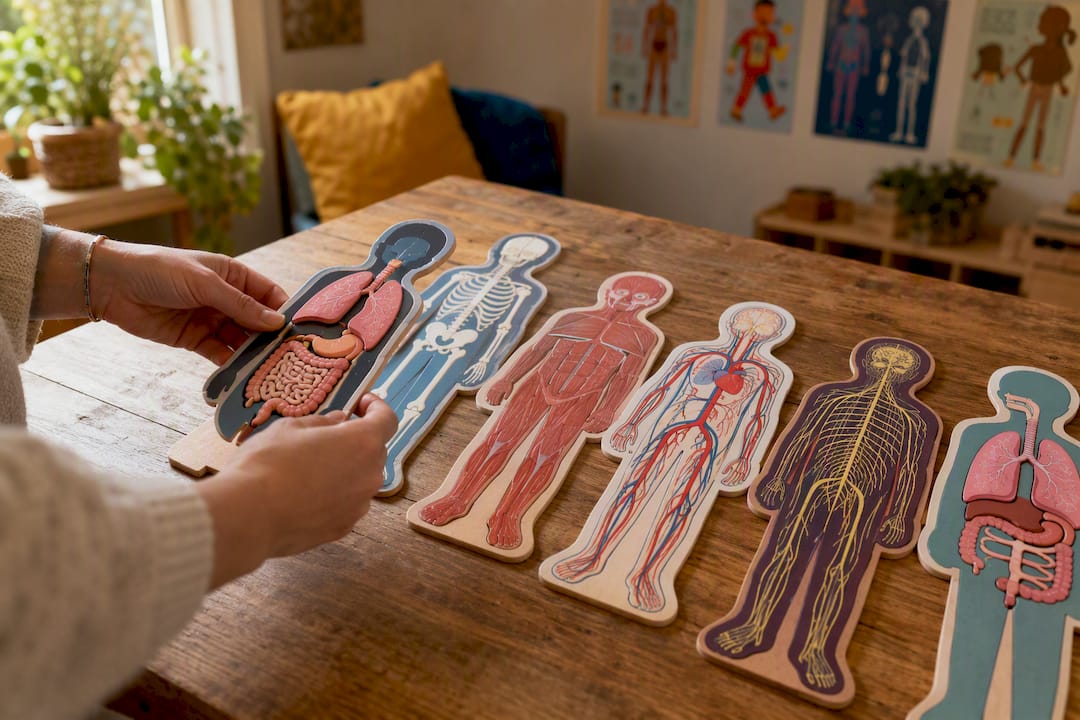
Removable-organ torsos flip the approach. Instead of building layer by layer, kids remove and replace individual organs, which turns anatomy into dissection-style play without any of the mess. Many torso kits on the market include 10 to 20 removable parts bundled with an illustrated guide or quiz cards, which gives structure to what could otherwise become aimless poking around.
Squishy-organ kits trade precision for texture. A soft, oversized lung or stomach is far more inviting to a four-year-old than a hard plastic piece, and that sensory hook is exactly the point. These work best as an introduction, not a deep dive.

Puzzles and jigsaws remain the cheapest, most flexible option. Labeled human body puzzles build spatial awareness and vocabulary at the same time, and they scale from toddler-size floor puzzles to detailed 100-piece sets for tweens.
Interactive talking models close the loop with audio. Smart-pen kits with quiz modes let a child self-test without a parent quizzing them, which matters most for early readers who want to explore solo.
- Magnetic kits: systems and sequence
- Removable-organ torsos: function and vocabulary
- Squishy sets: sensory introduction
- Puzzles: spatial reasoning
- Talking models: independent review
Which Anatomy Toys Fit Which Age Group?
Age fit isn’t just a suggestion printed on the box. It determines whether a toy gets played with for months or abandoned after one afternoon. A three-year-old handed a 40-piece magnetic torso will get frustrated fast, while an eleven-year-old handed a chunky 6-piece puzzle will find it boring in under a minute.
Toddlers (2 to 4) need large pieces, close supervision, and simple goals: naming a heart, pointing to a stomach, matching a puzzle piece to its outline. Skip anything with small magnets or detachable parts under an inch.
Early elementary (5 to 8) is where role-play sets and audio features earn their keep. Removable parts with labels build vocabulary fast, and talking models let kids quiz themselves between homework and dinner.
Upper elementary and tweens (9 to 13) are ready for multi-layer kits that show how systems connect. This is the age to introduce a full seven-layer magnetic build or a detailed torso model with organ function facts.
| Age group | Best toy types | What to check |
|---|---|---|
| Toddlers (2 to 4) | Large-piece puzzles, soft squishy organs | Piece size over 1 inch, no small magnets |
| Early elementary (5 to 8) | Removable-organ torsos, talking models | Labeled parts, audio/quiz modes, 10 to 15 removable pieces |
| Tweens (9 to 13) | Magnetic layer kits, detailed torso models | Multi-system layers, durable ABS construction |
Pro Tip: Count the removable pieces before buying. A torso with 15 well-labeled organs teaches more than one with 30 generic chunks a child can’t name.
How Do You Turn a Body Toy Into a Real Lesson?
A toy sitting in a bin teaches nothing. The same toy paired with a five-minute activity teaches a lot, and educators have known this for years, but it’s the step most parents skip.
- Run a role-play doctor visit. One child plays doctor, one plays patient, and the “doctor” has to locate and name three organs before writing a pretend diagnosis. Our guide to pretend doctor play has ready-to-use prompts if you want a script instead of winging it.
- Try a layer sequencing challenge. Time how fast a child can rebuild a magnetic torso from skeleton to skin, then ask what would happen if one layer were missing. This builds cause-and-effect thinking, not just memorization.
- Play a quiz game. Use the audio mode on a talking model, or make flashcards from a torso kit’s included guide, and turn organ identification into a fast-paced game with points.
- Combine it with reading and drawing. Have a child sketch an organ after removing it from the torso, then find it in a picture book. This cross-curricular link is where retention really sticks.
Broader role-play toys that mirror real-world scenarios work the same way: the toy is the prop, the activity is the lesson.
Pro Tip: After any activity, ask one open-ended question (“Why do you think the heart is near the lungs?”) instead of a yes/no question. It forces reasoning instead of guessing.
What Should You Check Before Buying an Anatomy Toy?
Anatomy toys involve small parts, magnets, and sometimes electronics, so the label matters as much as the price tag. Look for compliance with ASTM F963 (the US toy safety standard) and CPSIA certification on the packaging or product description before adding anything to your cart.
- Confirm the recommended age on the listing, since many anatomy kits carry small-part warnings and “not for under 3” labels that are easy to miss in product photos.
- Prefer BPA-free, durable ABS plastic and non-toxic paints over unlabeled soft vinyl, especially for squishy-organ sets that go straight into little hands and mouths.
- Avoid kits with weak, exposed magnets for children under 6, since a magnet swallowed alongside another can cause serious injury.
- Check for a replacement-parts policy. Torso kits lose small organs under couches; a retailer that sells replacement pieces saves you from tossing the whole set.
Prices generally run $15 to $30 for puzzles and squishy sets, $30 to $60 for removable-organ torsos, and $50 to $100 for full magnetic layer kits or talking models with audio pens. Classroom buyers often save by ordering multiples directly from the manufacturer rather than a marketplace reseller.
How Thebestkidstoys Chooses Anatomy Toys Worth Buying
Curation starts with a simple filter: does this toy hold up to repeat play, or is it a one-week novelty? Thebestkidstoys applies the same Montessori-minded lens to anatomy toys that it applies to every product in the catalog.
- Montessori alignment: does the toy invite independent, hands-on exploration instead of passive watching?
- Longevity of play: can a child return to it at age 5 and again at age 9 with new things to learn?
- Safety checks: are parts sized and labeled appropriately for the stated age range?
- Educational depth: does it teach function and vocabulary, not just shape recognition?
A good anatomy toy should survive being taken apart a hundred times and still teach something new on the hundred-and-first. That durability, both physical and educational, is the real test.
Written by Danica Hodge, drawing on Montessori-based toy curation practices and classroom activity design. For more hands-on learning ideas, see our notes on STEM learning toys and logical thinking.
How Do You Keep Anatomy Toys Clean and Long-Lasting?
Anatomy toys get more handling than most toys in the bin, since kids constantly remove, swap, and reassemble parts. That wear adds up fast if you skip basic upkeep.
Wipe hard plastic pieces, like torso shells and organ inserts, with a damp cloth and mild soap after each use, especially if a toy travels between home and a classroom shared by multiple kids. Avoid submerging any piece with an audio chip or electronic pen in water. A quick wipe with a disinfecting wipe works better and won’t fry the electronics inside a talking model.
Squishy-organ sets need gentler care. Hand wash with lukewarm water and let pieces air dry fully before storing, since trapped moisture inside foam organs can lead to mildew over time. Check seams regularly for small tears, since that’s usually where a squishy toy fails first.
Store small removable parts in a labeled zip pouch or a small divided bin rather than tossing everything into one large toy box. This single habit prevents most of the “missing kidney” panics that come with 15-piece torso kits. For magnetic kits, keep pieces away from electronics and credit cards, and check magnet strength occasionally, since repeated separation can weaken them over years of play.
A quick monthly inspection, five minutes, tops, catches loose parts, fading labels, or cracked seams before they turn into safety issues or lost pieces.
How Do You Match a Toy to Your Child’s Learning Style?
The best anatomy toy for your neighbor’s kid might flop with yours, and that’s normal. Learning style matters more than age alone once you get past the basic safety filters.
Sensory-driven kids, the ones who touch everything and get bored watching, do best with squishy-organ kits and removable-organ torsos. The tactile feedback of squeezing a soft lung or popping out a plastic liver keeps them engaged far longer than a flat diagram ever could.
Visual and pattern-oriented kids tend to gravitate toward puzzles and magnetic layer kits, where the reward is seeing a complete picture snap into place. If your child likes building sets or organizing by color, a seven-layer magnetic kit will hold their attention.
Auditory learners, especially early readers who aren’t confident enough for a full picture book yet, respond best to talking models with quiz modes. Hearing an organ’s name and function repeated back builds recall without requiring independent reading.
Kids who love role-play and storytelling get the most out of removable-organ torsos paired with a doctor-visit script, turning anatomy into a narrative rather than a memorization task. If you’re unsure where your child fits, watch what they gravitate to during free play. A child who lines up pieces by size is signaling something different than one who immediately starts making up stories with the toy in hand. Fine motor readiness matters here too. Our breakdown of fine motor toys and dexterity can help you gauge whether small removable parts are appropriate yet.
The Overlooked Problem With How Parents Shop for Anatomy Toys
Most buying guides rank anatomy toys by price or piece count, which misses the point entirely. A 30-piece torso model isn’t automatically better than a 10-piece one. It’s often worse, because kids can’t name 30 organs and lose interest in a pile of unlabeled parts.
The conventional advice, buy the biggest or most “realistic” set you can afford, ignores that anatomy toys succeed or fail based on how they’re used, not how they’re built. A $20 puzzle paired with five minutes of guided questioning teaches more than an $80 talking model left untouched on a shelf. That’s not a knock on ambitious kits. It’s a case for pairing any toy with structure.
If there’s one thing worth prioritizing, it’s matching the toy’s complexity to how your child actually plays, sensory, visual, auditory, or narrative, rather than to an age number on a box. The activities matter as much as the toy itself, and that’s the piece most parents skip when they’re standing in an aisle comparing price tags.
Find Montessori-Aligned Anatomy Toys at Thebestkidstoys
Thebestkidstoys built its catalog around one question: will this toy still teach something after fifty play sessions, not just the first one? That’s the same standard applied here. Instead of chasing the flashiest anatomy set on the market, Thebestkidstoys curates toys for longevity, labeled parts, and genuine educational depth, the same criteria covered throughout this guide.
If you’re building a home learning shelf or restocking a classroom science corner, the Little Learners Montessori Busy Book is a strong next pick alongside any anatomy toy, since it reinforces the same hands-on, screen-free approach to skill building. Parents managing body-awareness conversations at home may also find value in family health resources like the My Wren lactation massager for related caregiving needs. Browse the current best-selling educational toys and pick one anatomy toy plus one guided activity to start with this week.
Frequently Asked Questions
What age should a child start playing with human body toys? Most anatomy toys are appropriate starting around age 3 with large-piece puzzles, while removable-part torsos and talking models are better suited to ages 5 and up due to small-part safety concerns.
Are magnetic anatomy kits safe for young kids? Magnetic layer kits are generally best for children age 8 and older, since strong small magnets pose a swallowing risk for younger children who still put objects in their mouths.
Do interactive audio models actually help kids learn? Yes. Audio and quiz features let kids practice independently without an adult quizzing them, which is especially useful for early readers building confidence with anatomy vocabulary.
How much should I expect to spend on a good anatomy toy? Puzzles and squishy sets typically run $15 to $30, removable-organ torsos fall between $30 and $60, and full magnetic layer kits or talking models range from $50 to $100.
Can anatomy toys be used in a classroom setting? Yes, especially puzzles and torso models with quiz cards, which scale well for small groups and pair easily with role-play or sequencing activities during science lessons.
Sources
- Smart Anatomy - Interactive Human Body - SA218 - Oregon Scientific US
- MyBODY Human Body Anatomy & Assembly Model (for Kids & Teens)
- Human Body Jigsaw Puzzle: ProProfs Games