



Pretend Doctor Play: A Parent's Guide to Getting Started
Pretend doctor play is a form of imaginative role play where a child examines, treats, and comforts a “patient,” typically a stuffed animal, doll, or parent, using toy medical tools. It builds empathy, language, and body confidence while giving toddlers and preschoolers a safe way to process real medical experiences. Start simple: hand your child one prop, like a toy stethoscope, and let them decide what happens next. You’ll be surprised how quickly their imagination fills in the rest.
Before your first session, gather a few basics:
- A toy stethoscope
- Soft bandages or wraps
- A patient stand-in (stuffed animal, doll, or willing parent)
Skip the complicated setup for now. The Best Kids Toys — Pretend Doctor Play Set bundles these essentials into one kit designed specifically for little hands, and it’s the set we recommend for families who want to start playing today without piecing together supplies from three different stores.
Key Takeaways
Pretend doctor play works best when it pairs safe, toy-grade props with child-led scripts, because realism increases fear while imagination reduces it.
| Point | Details |
|---|---|
| Start with one prop | Hand your child a stethoscope and let them lead; don’t script the scene in advance. |
| Toy tools beat real ones | Toy medical props reduce anxiety more reliably than realistic equipment, per the BMJ Open review. |
| Follow, repeat, ask | Use BBC Tiny Happy People’s technique: repeat the child’s words, then ask an open question. |
| Build zones, not clutter | A waiting area, exam room, and pharmacy corner keep play organized and repeatable. |
| Choose the right kit | The Best Kids Toys Pretend Doctor Play Set offers durable, non-toxic tools sized for ages 3 to 6, reviewed for safety before it ships. |
Table of Contents
- What’s Inside the Recommended Doctor Play Set
- How Do You Start a Pretend Doctor Play Session?
- What Does Research Say About Doctor Play’s Benefits?
- Building a Doctor Dramatic-Play Center at Home
- Keeping Doctor Play Safe and Emotionally Comfortable
- Which Props and Scripts Fit Which Age?
- What Should You Look for When Buying a Doctor Play Set?
- Six Doctor Props You Can Make at Home Tonight
- Why Guided, Child-Led Play Beats a Script Every Time
- Where to Find the Recommended Doctor Play Set
- Sources
What’s Inside the Recommended Doctor Play Set
A good doctor play set earns its place in your toy bin by doing two things at once: sparking imagination and teaching real cause-and-effect thinking about health and care. Best Kids Toys built its Pretend Doctor Play Set with both goals in mind, and it’s designed for children roughly ages 3 to 6, right in the sweet spot where medical role play does its best developmental work.
The kit typically includes a toy stethoscope, blood pressure cuff, thermometer, reflex hammer, otoscope, and a soft carrying case that doubles as a doctor’s bag. Some versions add bandages, a syringe with no needle, and a name tag so your child can “become” Dr. Smith or Nurse Alex for the afternoon.
Here’s why the toy-versus-real distinction matters more than it might seem. A systematic review published in BMJ Open looked at medical play across multiple studies and found that when children used real medical equipment during play, some reported increased fear rather than comfort. Toy versions that look and feel like the real thing, without sharp edges, without functioning parts, without the visual weight of a hospital tray, give kids the exam-room experience minus the trigger.
What to look for in the set:
- Rounded, chunky pieces sized for small hands and too large to swallow
- BPA-free, non-toxic plastic or wood construction
- A zippered or snap-close bag for independent storage and cleanup
- Pieces that make gentle sounds or clicks (not blaring electronic noise)
- Age labeling that matches your child’s stage, not just “3+”
Durability matters here more than in most toy categories, because doctor kits get dragged to grandma’s house, dropped in the yard, and “sterilized” in imaginary ways that involve a lot of banging around. Look for a set built to survive rough play, not just gentle demonstration.
Pro Tip: Rotate which “patient” gets the checkup each week, a stuffed bear one day, a sibling the next, a parent after that. Varying the patient keeps the scenario fresh and pushes your child to adapt their language and approach instead of running the same script every time.
Ready to add this to your cart? The Pretend Doctor Play Set collection ships with clear age guidance printed right on the box, so you’re not guessing whether it fits your child’s stage.
How Do You Start a Pretend Doctor Play Session?
You don’t need a script memorized or a medical degree. You need about ten minutes, one prop, and a willingness to follow wherever your child takes the story. Here’s a simple four-step flow that works for almost any doctor scenario:
- Greeting. Sit down with the patient (stuffed animal, doll, or you) and ask, “What’s wrong with your patient today?” Let your child name the problem, even if it’s “purple spots” or “a broken wing.”
- Exam. Hand over the stethoscope or thermometer and ask, “What do you hear?” or “What does the thermometer say?” Resist correcting them. If they say the bear has a fever of “one hundred bananas,” go with it.
- Treatment. Offer a bandage or ask what medicine the patient needs. This is where kids often invent their own remedies, “sleep medicine,” “hug medicine”, which is a great sign of imaginative flexibility.
- Wrap-up. Ask, “Is the patient feeling better now?” and let your child decide the ending. Some kids want a happy recovery; others want to repeat the whole exam three more times. Both are fine.
Specific scenarios you can rotate through:
The routine check-up. Classic and low-stakes. Patient comes in for a “regular visit,” gets weighed, listened to, and sent home with a sticker.

Gentle emergency triage. A stuffed animal “hurt its paw.” Keep the drama light, this isn’t about simulating trauma, it’s about practicing calm problem-solving.
Teddy-bear hospital. Set up several patients in a row and let your child move between them, checking each one. This scenario naturally teaches sequencing and prioritization.
Pharmacy visit. After the “exam,” walk to a separate area of the room where your child hands out pretend medicine, counts pills, or writes a prescription. It’s a natural bridge into counting and early literacy.
Before-appointment rehearsal. If your child has a real doctor’s visit coming up, run through it in pretend form first. Let them be the doctor examining you, so the real appointment feels familiar rather than frightening.
The single most useful technique across every scenario comes from BBC Tiny Happy People’s guidance on toddler pretend play: follow the child’s lead, repeat what they say back to them, and ask open questions instead of yes/no ones. If your child says, “The bear is sick,” don’t jump to “Is it a cold?” Instead try, “The bear is sick. What’s making the bear feel sick?” That small shift keeps the story theirs and stretches their vocabulary at the same time.
Save this sequence somewhere handy: greeting, exam, treatment, wrap-up. It works whether you have two minutes before dinner or twenty minutes on a rainy afternoon.
What Does Research Say About Doctor Play’s Benefits?
The developmental case for pretend doctor play is stronger than most parents realize, but it comes with one important caveat about realism; you can read more about the benefits of pretend play for child development in this detailed article from The Zoofamily.
The BMJ Open systematic review examined ten studies on medical play conducted through November 2020. Most studies found genuinely positive outcomes: lower anxiety before real medical visits and improved understanding of healthcare concepts. But the results weren’t uniformly positive. A subset of studies found that play involving real (not toy) medical equipment sometimes increased fear rather than reducing it. The takeaway for parents is straightforward: toy tools tend to serve the anxiety-reduction goal better than the real thing.
That finding lines up with what child-life specialists already practice in clinical settings. McKesson’s overview of therapeutic medical play describes how structured medical play, often guided by trained child-life specialists, reduces procedural distress and increases a child’s cooperation during actual medical care. When a child rehearses a blood pressure check on a teddy bear first, the real version at the pediatrician’s office feels less like an ambush and more like something they already understand.
BBC Tiny Happy People’s guidance reinforces the mechanism behind why this works: repeating a child’s words back to them and asking open questions helps them process what they’re feeling, not just what they’re doing. It turns play from passive entertainment into active emotional work, without ever feeling like “therapy” to the child.
An exploratory study on parent engagement in medical play adds a useful wrinkle here: parents naturally fall into different roles, from passive play-follower to active instructor, and that style shapes how the child engages with medical themes. Neither style is wrong, but noticing which one you default to helps you consciously dial it up or down depending on what your child needs that day.
Pro Tip: If your child seems hesitant or fixated on one worry (like needles), default to toy tools and light supervision rather than “helpful” real equipment. The evidence favors playful, low-realism props for most children overprecise medical accuracy.
Building a Doctor Dramatic-Play Center at Home
A dedicated play space turns a five-minute activity into something your child returns to for weeks. You don’t need a spare room, a corner of the living room works fine, but organizing it into distinct zones makes the play more coherent and lets kids practice sequencing and routine.
EarlyLearningIdeas recommends structuring the space around three zones:
- Waiting area. A few chairs, some books or magazines, and a sign-in clipboard. This zone teaches patience and turn-taking, especially useful if you have more than one child playing.
- Exam room. The heart of the action: a small table or blanket for the patient, the doctor kit, and a chart on the wall or floor listing height and weight (even if the numbers are made up).
- Pharmacy or lab. A separate table where “medicine” gets dispensed, pills get counted into small cups, and prescriptions get written on index cards.
Materials to gather (most substitutable with household items):
- A clipboard and paper for patient charts
- Index cards for appointment reminders and prescriptions
- Small cups or an egg carton for sorting pretend pills
- A shoebox labeled “pharmacy” for storage between sessions
- Stuffed animals or dolls as recurring patients
- A simple bell or sign-in sheet for the waiting room
Add a printable patient chart or appointment card if you want to sneak in early literacy and number practice, filling in a “weight” or a “temperature” gives your child low-stakes writing and counting reps. PreKinders has documented this kind of classroom setup working well even with large groups of preschoolers, which tells you it scales down easily to a single child at home, too.
Quick setup checklist:
- Pick a corner or table you can leave set up for at least a few days
- Assign one zone to each activity (waiting, exam, pharmacy)
- Stock each zone with two or three props, not ten
- Store loose pieces in labeled bins your child can open independently
- Refresh the “patients” every week or two to keep interest high
Keeping Doctor Play Safe and Emotionally Comfortable
Doctor play is one of the safer categories of pretend play, but a few ground rules keep it that way.
The non-negotiables:
- Never use real needles, real medication, or real medical instruments, even ones that seem harmless.
- Check all small pieces (like tiny pills or otoscope tips) against a choking-hazard guide before handing them to a child under three.
- Supervise directly whenever a child under four is playing with cords, straps, or small clip-on pieces like blood pressure cuffs.
- Keep bandages and wraps away from a child’s neck or face during play.
Emotional safety matters just as much as physical safety here. If your child’s play starts to feel distressed rather than curious, if they’re re-enacting a scary hospital visit with real tension in their voice, or repeating the same fearful scene over and over without resolution, that’s your cue to step in gently. Switch roles so you’re the “patient” and they’re in control. Scale back any realistic props. Let them lead the pace rather than pushing toward a resolution.
Watch for a few red flags: sustained fear that doesn’t ease after a few sessions, repetitive reenactment of a specific traumatic event, or refusal to engage with the theme at all after a real medical experience. These are reasonable moments to pause the play and talk to your pediatrician or a child-life specialist, who can help you understand whether something deeper needs attention.
Before-you-play checklist:
- Confirm no real medical items are in the play area
- Check prop sizes against your child’s age
- Set a calm tone before starting (avoid launching into play right after a stressful moment)
- Stay nearby for children under four
Which Props and Scripts Fit Which Age?
Doctor play looks different at two years old than it does at five, and matching your setup to your child’s stage keeps everyone engaged instead of frustrated.
| Age Range | Recommended Props | Language Complexity | Supervision Level |
|---|---|---|---|
| 2–3 years | One or two soft, oversized tools (stethoscope, soft brush “thermometer”) | Single words, simple labeling (“ear,” “tummy”) | Direct, hands-on supervision |
| 3–4 years | Full toy kit with 3–4 tools, soft bandages | Short sentences, cause-and-effect (“The bear is sick because…”) | Nearby supervision, occasional check-ins |
| 4–6 years | Complete kit plus pharmacy props, charts, prescription pad | Multi-step storytelling, dialogue between roles | Light supervision, mostly independent |
Toddlers around 2 to 3 are still building fine motor control, so oversized, soft-edged tools work better than fiddly ones. Preschoolers age 3 to 4 start layering cause-and-effect language onto their play (“the bear is sick because he ate too much honey”), which is exactly the kind of reasoning doctor play is good at reinforcing. By 4 to 6, kids can juggle multiple roles in one session, doctor, nurse, patient, pharmacist, and switch between them fluidly.
If you have siblings of different ages playing together, give the younger child a simpler, single-function role (patient, or “assistant” holding the bandages) while the older sibling runs the exam. That keeps both kids genuinely participating instead of one dominating the whole scene.
What Should You Look for When Buying a Doctor Play Set?
Not every doctor kit on the shelf is built the same, and the differences matter more than the price tag suggests. Run through this checklist before you buy:
- Non-toxic materials. Look for BPA-free plastic or untreated wood, especially since kits often end up in a toddler’s mouth at some point.
- No real needles or sharp components. Every “syringe” or “shot” piece should be blunt, oversized, and obviously a toy.
- Choking-hazard sizing. Pieces should be too large to swallow, particularly for kits marketed to children under four.
- Easy-to-clean surfaces. Wipeable plastic or fabric holds up better than porous materials that trap grime.
- Clear storage. A dedicated bag or bin keeps pieces from scattering across the house and helps your child pack up independently.
- Accurate age labeling. A kit labeled “3+” with tiny detachable pieces isn’t really a 3+ kit; check reviews and photos, not just the box copy.
Broadly, doctor kits fall into two categories: basic accessory sets (a handful of tools with no storage system or extras) and detailed role-play kits that include a carrying case, name tag, and pharmacy-style extras. The basic sets are fine for a first try or a gift-under-$20 situation. The detailed kits earn their higher price through durability and expandability, they tend to survive years of play and multiple children, not just one enthusiastic week.
Match the kit’s complexity to your child’s actual interest level. A child who’s mildly curious about doctors needs a simple stethoscope-and-bandage combo. A child who’s obsessed, asking to “play doctor” daily, watching medical cartoons, quizzing you about hospitals, is ready for a fuller kit with more roles to explore.
Six Doctor Props You Can Make at Home Tonight
You don’t need to buy anything to start playing doctor today. These six props use items most households already have on hand:
- Paper stethoscope. Cut a long strip of paper or yarn, tape a small circle of cardboard or a bottle cap to each end. Drape it around your neck like the real thing.
- Popsicle-stick thermometer. Color one end red with a marker. Slide it under an arm (never in the mouth) for a quick temperature check.
- Cardboard x-ray box. Cut a rectangular window into a cereal box and tape wax paper over the opening. Hold it up to a stuffed animal and describe what you “see” inside.
- Prescription pad. Any small notepad works. Let your child scribble “medicine instructions” and hand them to the patient.
- Bandage station. Cut strips of an old pillowcase or use washi tape as pretend bandages. Set up a small basket where your child can grab and apply them.
- Pretend syringe, no needle. Use an empty (cleaned) medicine dropper or a capped marker as a stand-in. The goal is the gesture, not realism.
How Wee Learn documents several of these exact substitutions and notes that homemade props work just as well developmentally as store-bought ones, sometimes better, because building the prop together becomes its own bonding activity.
Pro Tip: Keep DIY props deliberately simple and a little cartoonish rather than realistic. A stick with a red tip reads as “thermometer” to a three-year-old’s imagination just fine, and the lack of precision actually keeps the play feeling safe rather than clinical.
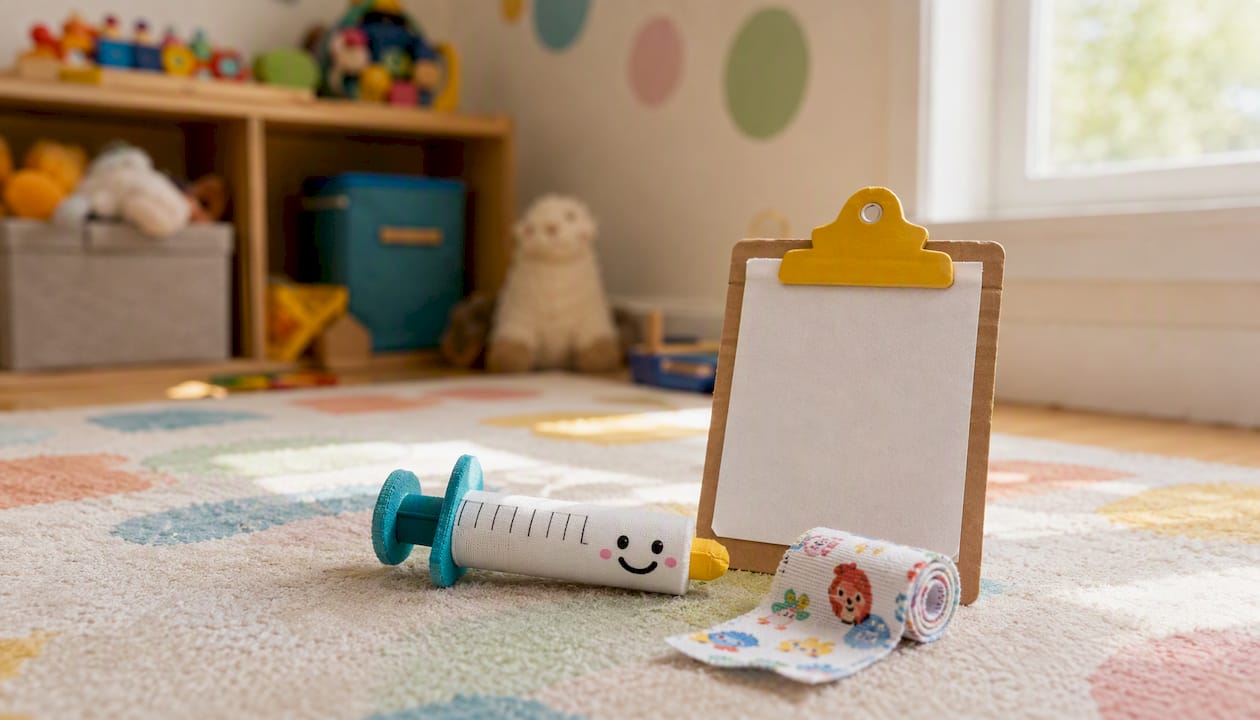
If your child gravitates toward the storytelling side of doctor play more than the tools themselves, pair these DIY props with imaginative play toys that lean into narrative building, puppets, storybooks, or figures they can weave into the hospital scenario.
Why Guided, Child-Led Play Beats a Script Every Time
Doctor play works best when parents resist the urge to run it like a lesson plan. The research is fairly consistent on this point: children process fear, curiosity, and understanding through play they control, not play they’re directed through. A kit full of tools means nothing if the adult in the room insists on the “correct” way to listen to a heartbeat.
What tends to get underestimated is how much the choice of props shapes the emotional tone of the whole session. A cartoonish, toy-grade stethoscope invites silliness and safety. A hyper-realistic one, especially paired with anxious parental energy, can tip play toward the fear responses the BMJ Open review flagged. That’s part of why Thebestkidstoys builds its play sets around Montessori-inspired principles: durable, safe, screen-free tools designed to support a child’s independent exploration rather than dictate outcomes.
The best pretend doctor play isn’t the most anatomically accurate. It’s the version where your child is doing most of the talking, and you’re doing most of the listening.
Where to Find the Recommended Doctor Play Set
If you’re ready to bring pretend doctor play into your home this week, Thebestkidstoys makes it simple: one carefully designed kit, sized right for the age range where medical role play does the most developmental good.
The Pretend Doctor Play Set includes the core tools your child needs, stethoscope, blood pressure cuff, thermometer, and reflex hammer, packed in a durable, easy-to-clean carrying case built for years of dragging around the house. It’s designed for children roughly ages 3 to 6, with rounded, oversized pieces that pass a reasonable choking-hazard check for that range. Every piece goes through Best Kids Toys’ safety and quality review before it reaches your cart, so you’re not stuck cross-referencing recall lists after the fact.
Looking to round out the play center? Pair the kit with a Montessori-style busy book for quiet moments between checkups, or browse the full collection for ages 4 to 5 to find complementary pretend-play pieces. Head to the product page now and get the kit in your cart before your child’s next “I want to be a doctor” moment passes you by.
Sources
- Set Up a Doctor Dramatic Play Center or Pretend Hospital — EarlyLearningIdeas
- What is medical play, and why does it matter in pediatric care? — McKesson
- ‘Do you want to play doctors?’ An exploratory study of parent engagement in medical play with preschool children
If your child shows sustained fear or repetitive distressing reenactment during play, a pediatrician or child-life specialist can offer guidance beyond what any article or toy set can provide.