



Therapist Backed Open Ended Gross Motor Toys for Homes and Classrooms
Open-ended balance boards, climbing structures, ride-ons, and tunnels are the most effective gross motor toys because they grow with your child instead of losing their appeal after a week. Thebestkidstoys curates safe, Montessori-informed versions of exactly these categories so families and classrooms don’t have to guess which options are worth the shelf space.
TL;DR:
- Open-ended toys like climbing structures and balance tools grow with children, providing ongoing developmental benefits across multiple skill areas.
- Safety, durability, room to progress, space requirements, and budget are key factors to evaluate before investing in gross motor toys.
- Toys such as Pikler triangles, wobble boards, tunnels, and ride-ons should match the child’s current age and weight limits for safety and longevity.
- Incorporating these toys into obstacle courses and layered challenges enhances motor planning, coordination, and confidence through active play.
- Frequent rotation of a few well-chosen, versatile toys promotes sustained engagement and skill development over time.
Table of Contents
- Gross Motor Toy Categories Every Family Should Know
- How to Choose Gross Motor Toys: A 6-Point Framework
- Inclusive Choices and Adaptations for Special Needs
- Obstacle Courses and Challenge-Layer Play Ideas
- Safety, Sizing, and Storage: What to Check Before You Buy
- Why Thebestkidstoys Recommends Open-Ended, Therapy-Informed Picks
- Price Ranges and Budget Considerations
- Typical Lifespan and Maintenance Tips
- Recommended Brands and Top-Rated Product Examples
- What I’ve Noticed Watching Kids Use These Toys
- Curated Starter Sets to Get Moving Today
- Sources
Gross Motor Toy Categories Every Family Should Know
Gross motor toys work by engaging large muscle groups. Every category below builds a different combination of core strength, balance, coordination, and motor planning, and pediatric therapy guidance groups recommendations by age, starting with tummy time for newborns and moving toward complex climbing sequences by age six.
Ride-on toys teach leg strength and steering coordination long before a child can pedal a bike. Push cars for one-year-olds build the same muscle patterns that later support tricycle riding, and most models handle indoor hallways just as well as a driveway.
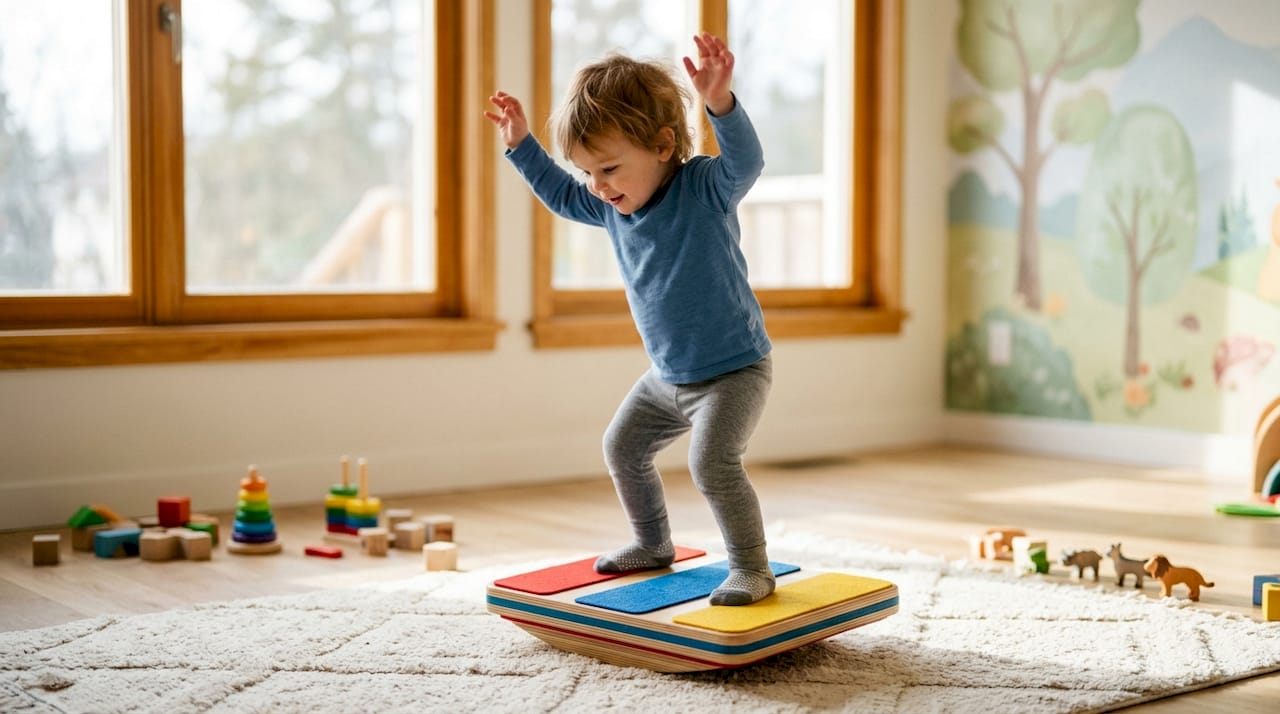
Balance tools are where a lot of the real developmental payoff happens. Wobble boards, balance beams, and stepping stones ask a child’s body to make constant tiny corrections, which is exactly the input that strengthens postural control. A wobble board that starts as a sitting activity for a toddler can later become a standing challenge for a five-year-old, which is part of why open-ended balance tools tend to outlast single-purpose toys in a toy rotation.
Climbing structures including Pikler triangles, modular foam climbers, and indoor slides build the upper-body and core strength kids need for everything from playground monkey bars to getting themselves in and out of a chair. Readiness usually shows up around 18 months, when a toddler starts climbing onto furniture on their own. That’s your cue they’re ready for a structure built for it.
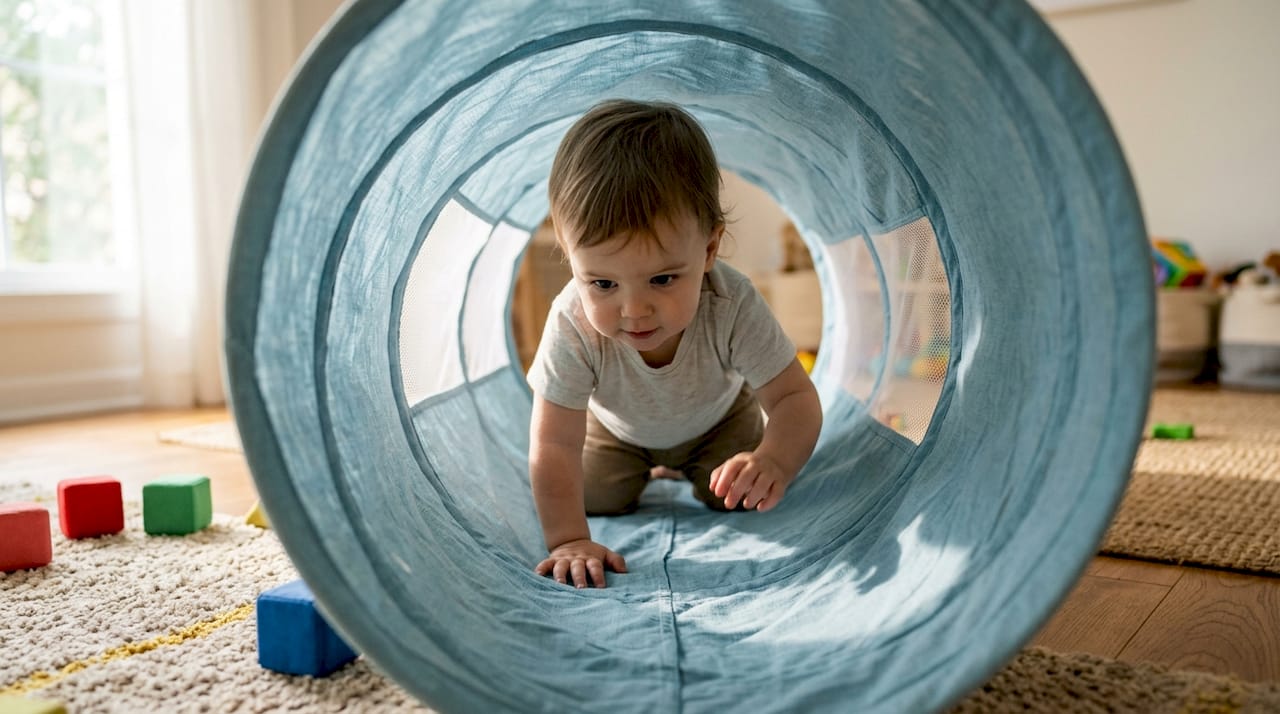
Tunnels look simple, but crawling through one demands bilateral coordination (using both sides of the body together) and spatial awareness. They pack flat for storage and work for infants learning to crawl through to school-age kids using them as the crawling leg of an obstacle course.
Trampolines and bouncers deliver vestibular input, meaning the sensory feedback that helps a child understand where their body is in space. Mini trampolines with handlebars suit toddlers around age two, while larger enclosed models fit five-and-up.
Balls for throwing and catching build hand-eye coordination and the kind of bilateral timing that shows up later in sports. Soft, oversized balls work for two-year-olds; smaller balls that require a real grip suit kids four and up.
A few quick footprint notes worth knowing before you buy:
- Indoor climbers and Pikler triangles typically need at least a 3 by 3 foot clear floor space with a mat underneath.
- Ride-on toys with wide wheelbases handle carpet better than narrow-wheeled models.
- Most home balance beams and stepping stone sets have weight limits appropriate for growing children. Check this before assuming a toy will “grow with” an older sibling too.
- Outdoor trampolines need level ground and enough surrounding clearance that a fall doesn’t land near a fence or wall.
How to Choose Gross Motor Toys: A 6-Point Framework
Not every toy that promises to build coordination actually does. Run any candidate through these six checks before it lands in your cart.
- Safety first. Confirm the age and weight rating matches your child now, not the child you hope they’ll grow into next year.
- Build quality. Press on seams, check for wobble in the base, and look for rounded edges on anything designed for climbing or standing.
- Open-endedness. Ask whether a child can invent three different ways to play with it. If the answer is no, it’s likely a one-trick toy.
- Room to progress. The best gross motor toys let a toddler start at one skill level and a five-year-old find a harder version of the same challenge.
- Space and storage. Measure your play area before buying anything that climbs, folds, or rolls.
- Budget and upkeep. Factor in whether the toy needs batteries, inflation, or replacement parts down the line.
Pro Tip: Before buying, ask yourself: will this toy still get used in a year, or does it only work for the exact skill level my child has right now? Open-ended toys almost always win that test.
Editorial testing on active-play gear consistently flags durability and multi-functionality as the biggest predictors of long-term use, which lines up with what shows up in most households: the toys that fold away easily or double as furniture get pulled out far more often than bulky single-purpose equipment.
Inclusive Choices and Adaptations for Special Needs
Gross motor toys double as therapy tools for kids with sensory processing differences, motor delays, or coordination challenges, and pediatric occupational and physical therapists frequently reach for the same handful of categories to meet very different goals.
A few toy types show up again and again in therapy settings:
- Weighted balls provide proprioceptive input (deep pressure and body awareness feedback) that helps some kids regulate before or during an activity.
- Tactile tunnels with varied textures on the inside add a sensory layer to the same crawling task other kids use for coordination alone.
- Stable spinning or rocking boards support vestibular input without the unpredictability of a fast spin. Therapists generally favor slow, controllable motion over high-velocity spinning for kids who need heavy vestibular input, since it’s more regulating and safer for early sessions.
Simple adaptations go a long way at home. Place a crash mat at the bottom of a climbing structure to lower the stakes of a fall. Break a balance challenge into smaller steps, starting with sitting on a wobble board before ever asking a child to stand on one. Hand-over-hand guidance, where you gently support a child’s hands through a movement, can make an activity accessible before they’re ready to do it independently.
If your child has a diagnosed delay or you’re noticing consistent frustration with certain movements, a pediatric physical or occupational therapist can help translate specific goals into toy choices. Sharing what you’re working on at home lets them suggest adaptations tailored to that goal rather than a general recommendation. Thebestkidstoys’ sensory-friendly toy collection and guide to toys for autistic kids are both built with these adaptations in mind.
Obstacle Courses and Challenge-Layer Play Ideas
The real trick to gross motor play isn’t buying more toys. It’s combining what you already own into progressively harder challenges.
- Small-space course (apartment or playroom): Line up a tunnel, a wobble board, and a row of floor cushions as “stepping stones.” Have your child crawl through, balance across, then hop the cushions to the end.
- Medium room course: Add a Pikler triangle or small climber to the small-space setup. Kids climb up, cross a balance beam, crawl through a tunnel, then finish by tossing a beanbag into a basket.
- Outdoor yard course: Combine a ride-on loop, a balance beam or log walk, and a trampoline “finish line.” This version works well for group play with siblings or a small class.
Stacking skills into one activity multiplies the benefit. Have a child catch a beanbag while standing on a balance board, or follow a two-step direction (“crawl through, then grab the red ball”) while moving through a tunnel. That kind of layering combines motor planning with balance or coordination in a single rep instead of practicing each skill in isolation.
Ten to fifteen minutes a day beats one long weekend session. Rotate which obstacle comes first, add a timer for older kids, or turn it into a “can you beat yesterday” game to keep the same setup feeling new.
Safety, Sizing, and Storage: What to Check Before You Buy
Age and weight ratings on the box aren’t a suggestion. They reflect the tested limits of a structure’s frame, so a toy rated for 50 pounds shouldn’t be pressed into service for a 70 pound seven-year-old just because they still fit visually.
Watch for these red flags before you buy or during regular use:
- A wobbly base on any climbing or standing toy, even when the box says it’s assembled correctly.
- Mounting hardware that isn’t fully secured, especially on swings or hanging equipment.
- Small, removable parts on toys meant for active, fast-moving play, since those combinations increase choking risk during a fall or tumble.
- Frayed straps or cracked plastic on ride-ons and balance tools, both signs a toy is past its safe lifespan.
Pro Tip: Store balance boards and stepping stones flat against a wall rather than stacked in a pile. A pile invites kids to climb the storage itself, which is a common and preventable source of falls.
Keep walkways clear of ride-on toys when they’re not in use. A tripping hazard in a hallway defeats the purpose of a toy meant to build coordination in the first place.
Why Thebestkidstoys Recommends Open-Ended, Therapy-Informed Picks
This guide is written by Danica Hodge, drawing on pediatric therapy guidance and hands-on toy testing standards to identify which gross motor toys deliver real developmental value versus which ones just look good in a catalog photo.
Thebestkidstoys builds its collections around that same standard. Every item is reviewed for safety and long-term play value before it earns a spot in the catalog, with a deliberate lean toward Montessori-informed, open-ended pieces that support independent play rather than toys that do the thinking for the child. If you’re weighing your first purchase, the step-by-step guide to choosing toys for all ages and the toddler climbing toys break down both walk through age-specific picks in more detail.
Price Ranges and Budget Considerations
Gross motor toys span a wide price spread, and the sticker price doesn’t always predict how much use you’ll get.
Small balance tools like wobble boards or stepping stone sets typically run $20 to $60. Tunnels fall in a similar range, often $25 to $50 depending on length and material. Ride-on toys for toddlers usually land between $30 and $100, with pedal-free balance bikes toward the higher end.
Climbing structures represent the biggest jump. A basic foldable climber might cost $80 to $150, while a full Pikler triangle with a ramp or slide attachment can run $150 to $350. Trampolines vary just as widely: a toddler bouncer with a handlebar starts around $40, while a full-size enclosed backyard trampoline climbs into the hundreds.
The smartest budget move is prioritizing open-ended pieces over novelty items. A $150 climbing triangle that gets used daily for three years costs less per use than three $40 single-purpose toys that each get abandoned after a month. If you’re building a starter collection, spread the budget across one balance tool, one climbing or tunnel piece, and one ride-on rather than sinking it all into a single big-ticket item.
Typical Lifespan and Maintenance Tips
A well-built gross motor toy should last through multiple developmental stages, not just one. Wooden climbing structures and balance boards, in particular, tend to outlast plastic equivalents by years when properly maintained, since solid wood resists the stress cracking that plastic joints develop under repeated weight-bearing use.
Expect a quality Pikler triangle or wobble board to hold up for three to five years of regular use, often getting passed down to a younger sibling afterward. Ride-on toys with plastic wheels tend to wear faster, especially on outdoor pavement, and may need replacement wheels or bearings after a year or two of heavy use. Tunnels and soft-sided equipment typically show wear first at the seams, so check stitching every few months if a tunnel gets daily use.
Basic maintenance extends all of it. Wipe down plastic and wood surfaces monthly with a mild soap and water solution rather than harsh cleaners, which can degrade finishes over time. Tighten any bolts on climbing structures every few months, since repeated use loosens hardware gradually. Store balance boards and ride-ons out of direct sunlight when possible. UV exposure fades and weakens plastic components faster than indoor storage.
Recommended Brands and Top-Rated Product Examples
Editorial roundups on active indoor play consistently point to a similar shortlist: durable ride-ons, wobble boards, tunnels, trampolines, and modular climbers as the highest-value investments for keeping kids moving in indoor attractions.
Specific therapist-recommended items include the Teeter Popper for standing balance work, Bilibo shells for open-ended rocking and spinning play, and basic fabric tunnels for crawling and motor planning drills. These aren’t flashy toys, but pediatric therapy resources repeatedly cite them because they scale across age groups better than most electronic or single-function alternatives.
Beyond individual items, certain toy formats show up again and again in parent and educator testing as the best long-term value: foldable gymnastics mats that store flat under a bed, modular foam climbers that reconfigure into new shapes as kids age, and Pikler-style triangles that convert from a simple climb to a ramp or slide setup. Thebestkidstoys’ open-ended toys collection leans heavily on this same category of gear, prioritizing pieces built to be reconfigured rather than replaced.
What I’ve Noticed Watching Kids Use These Toys
I’ve watched plenty of hesitant toddlers turn into confident climbers over a matter of weeks once a Pikler triangle became part of their normal routine. The change wasn’t dramatic day to day, but the balance and self-assurance were obvious a month in.
Rotation matters more than volume. Keep three or four toys visible and swap them out every couple of weeks instead of leaving everything out at once, which tends to overwhelm rather than invite play. A basket by the door with just the current rotation works better than a toy chest full of options nobody digs through.
Pair movement with a small learning task when you can. Counting steps across a balance beam or naming colors while tossing a ball turns a physical activity into a two-for-one without feeling like extra work.
— Danica Hodge
Curated Starter Sets to Get Moving Today
Once you know the categories that matter, the fastest way to start is with a bundle built around your actual space and goals rather than piecing one together item by item. Thebestkidstoys puts together starter collections for exactly this reason.
A small-space starter pairs a fabric tunnel with a compact wobble board, ideal for apartments or playrooms with limited floor space. A climbing and balance starter combines a Pikler triangle with a balance beam, built for families with a dedicated play corner who want a setup that scales from age two through six. An inclusive sensory starter brings together a tactile tunnel, a weighted ball, and a stable rocking board, put together with input from the same therapy-informed thinking that guides the rest of this guide.
These are starting points, not prescriptions. Match your first pick to the space you actually have and the skill you most want to build, then grow the collection from there. Browse the full best-sellers collection or take a look at a family favorite, the Little Learners Montessori Busy Book, if you want to pair movement play with a quieter independent activity for the same child.
Sources
- Practicing gross motor skills at home | NAPA Center
- Therapy tools and toys that help children with developmental delays | Gold Star Rehab
- Gift guide: the best indoor gross motor toys for active kids | What Moms Love