



Best Wooden Blocks for Toddlers and Preschoolers: Montessori Picks
The Best Kids Toys Montessori Wooden Unit Blocks are the best wooden blocks for most families. They combine true Montessori proportional sizing, child-safe natural finishes, and open-ended play value that grows with your child from toddler stacking to preschool architecture. Three quick alternates for common needs:
- Small-space starter: A classroom-style starter set designed for young children gives you proportional shapes without overwhelming your living room floor. Budget: mid-range.
- Budget toddler pick: A painted birch set with rounded corners that keeps costs low and cleanup simple. This category includes sets like the IKEA UNDERHÅLLA 40-piece set, designed for younger children and tested for safety. Budget: entry-level.
- Heirloom/expandable set: A solid-hardwood unit set with a storage tray anchors a collection you can grow with open-stock add-ons. Budget: mid-to-upper range.
Table of Contents
- What are the best wooden blocks by age and need?
- Why unit blocks are the gold standard for long-term development
- How to choose wooden blocks: a parent’s checklist
- What safety checks should you do before buying wooden blocks?
- How do you clean and care for wooden blocks?
- How we chose these picks
- Which wooden block brands have the strongest reputation?
- How do popular wooden block sets compare?
- Where can you buy quality wooden block sets?
- What extras and accessories come with wooden block sets?
- Key Takeaways
- Why Montessori unit blocks are worth choosing over the alternatives
- The Best Kids Toys Montessori Wooden Unit Blocks are ready for your family
What are the best wooden blocks by age and need?
Matching a set to your child’s age and your home’s reality makes all the difference. Here’s a ranked shortlist you can scan in seconds. For a deeper look at block stacking milestones, age-by-age guidance is worth bookmarking alongside this list.
-
Best Kids Toys Montessori Wooden Unit Blocks (Top overall pick, ages 2–6) Natural hardwood, proportional unit sizing, non-toxic finish. Mid-range price. The gold standard for open-ended Montessori play that scales from simple stacking to early math concepts.
-
Painted Birch Toddler Set — 40 pieces (Best for babies and young toddlers, 18–36 months) Solid birch, rounded corners, bright colors for sensory engagement. Entry-level price. The IKEA UNDERHÅLLA set is a widely available example of this category: 40 pieces, safety-tested, designed for 18 months and up.
-
Lakeshore Best-Buy Wooden Blocks Starter Set (Best for small spaces and classrooms, ages 3+) 50 blocks in 9 shapes, largest piece roughly 8¼ inches. Proportionally related sizes in a compact footprint. Great classroom-style starter when floor space is limited.
-
Melissa & Doug 60-Piece Solid-Wood Unit Blocks (Best expandable heirloom set, ages 2–8) Natural hardwood finish, wooden storage tray included, marketed for early math and open-ended building. Parents consistently praise the heavy, well-sanded feel. The tray adds bulk, so measure your shelf first.
-
Montessori Colorful Wooden Craft Kit (Best for toddlers who love color, ages 18 months–3 years) Bright, activity-focused painted pieces that invite sorting and color-matching alongside stacking. A natural companion to natural-wood sets as children grow.
-
Wooden Color Stones Stacking Set (Best sensory starter, 12–18 months) Chunky, smooth pieces sized for small hands. Ideal for babies working on grip and early cause-and-effect play before graduating to unit blocks.
Why unit blocks are the gold standard for long-term development
Not every wooden block set earns the “unit block” label. True unit blocks follow strict proportional relationships: a double unit is exactly twice the length of a single unit, and a quadruple unit is four times as long. That mathematical precision is not just a manufacturing detail. It is the mechanism through which children absorb geometry, fractions, and spatial reasoning through play, long before they encounter those concepts in a classroom.
Here is what that looks like in practice:
- A child who lines up two double units and one single unit to match a quad is physically experiencing the concept of fractions without a worksheet.
- A child building a stable arch discovers that two half-circle pieces equal one full curve, and that symmetry is what keeps the structure standing.
These are not accidental discoveries. They happen because the pieces are mathematically honest. Block play development research consistently links proportional block sets to stronger spatial reasoning outcomes compared to sets with arbitrary sizing.
Expandability matters here too. Because true unit blocks follow a single proportional system, any open-stock pieces you add later slot seamlessly into what your child already owns. You are not starting over; you are building on a foundation.
How to choose wooden blocks: a parent’s checklist
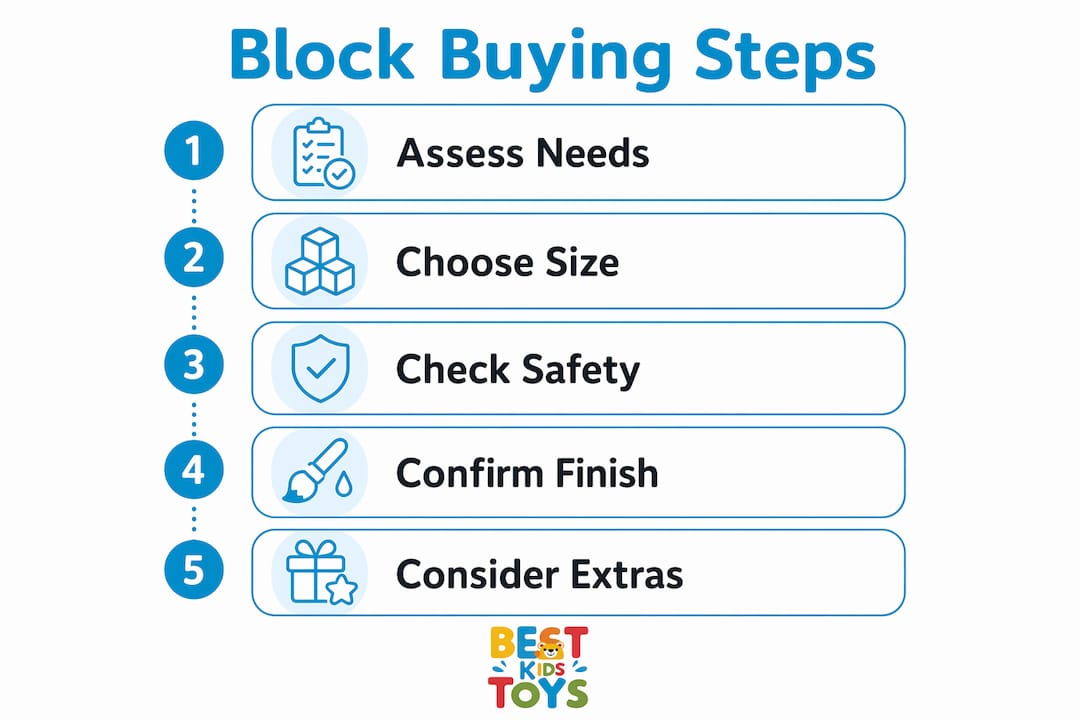
Buying the right set comes down to seven criteria. Work through them in order and you will not waste money on a set that sits in a corner.
- Age fit: Pieces must be large enough to eliminate choking risk for children under 3. Look for a minimum dimension above 1.25 inches on all sides.
- Unit proportions: Confirm the set uses a true unit system (unit, double, quad). Not every set labeled “unit blocks” meets that standard.
- Piece mix: A useful starter set includes units, doubles, quads, half-units, and at least one arch or curve shape. Variety drives more complex building.
- Material and finish: Hardwood (maple, beech, or birch) outlasts softwood. Natural or water-based finishes are safer and easier to maintain than painted surfaces for sets used by children under 3.
- Storage and footprint: Quad blocks are long. Measure your storage shelf before you order. Parents frequently underestimate the footprint of a full collection, so plan storage first.
- Price range: Starter sets typically run in the affordable range. Expandable mid-range sets are moderately priced. Heirloom or classroom-quality collections tend to be higher priced.
- Open-stock availability: A brand that sells individual shapes separately lets you add pieces over time rather than replacing the whole set.
Pro Tip: If your play space is tight, buy a 40–50 piece starter set focused on units and doubles, then add open-stock quads and arches once your child is ready for more complex building. You will spend the same amount over time but avoid the storage headache up front.
If you have limited space: start with units, doubles, and one arch shape. Add quads and curves when your child is consistently building multi-level structures.
What safety checks should you do before buying wooden blocks?
Always verify non-toxic finishes and compliance with U.S. toy-safety standards before purchasing any wooden block set. In the United States, children’s toys must meet CPSC and ASTM F963 standards, which cover chemical safety, mechanical hazards, and age-appropriate labeling.
Before you click “add to cart,” confirm these five things on the product page:
- Material type: Solid hardwood or solid birch, not MDF or particleboard, which can splinter or absorb moisture.
- Finish: Water-based, non-toxic, or “no-VOC” paint or sealant. Avoid sets with no finish information listed.
- Piece dimensions: For children under 3, every piece should be too large to fit entirely in a child’s mouth. The CPSC small-parts cylinder test uses a 1.25-inch diameter as the threshold.
- Certification statement: Look for explicit ASTM F963 compliance or a third-party lab test certificate. A CE mark (common on European sets like the IKEA UNDERHÅLLA) indicates testing to European EN71 standards, which are broadly comparable but not identical to U.S. ASTM requirements.
- Recommended age range: Manufacturer age labels are safety determinations, not just marketing. A set labeled 3+ has been assessed for small-part risk at that age.
Paint vs. natural finish: Natural or oiled hardwood sets are the safest choice for children under 3 because there is no paint layer to chip. For older toddlers and preschoolers, water-based painted sets are safe when the certification is confirmed. Avoid any set where the manufacturer does not disclose the finish type.
How do you clean and care for wooden blocks?
Properly cared-for hardwood blocks can last for decades and pass through siblings without losing their smooth finish. The routine is simple.
- Wipe after play: Use a lightly damp cloth to remove dust and fingerprints. Never submerge wooden blocks in water; moisture warps and cracks the wood.
- Tackle stains promptly: For sticky residue, a cloth dampened with diluted white vinegar works without damaging the finish. Dry immediately.
- Sand minor damage: Light scratches or rough edges can be smoothed with fine-grit sandpaper (220 grit). Always sand with the grain, not against it.
- Reapply finish when needed: Natural-finish heirloom sets benefit from a thin coat of food-safe mineral oil or beeswax once or twice a year. This keeps the wood from drying out and cracking.
- Store off the floor: A dedicated shelf or open-top bin keeps blocks dry and prevents warping from floor-level humidity.
Pro Tip: Before putting blocks away for a season, do a quick inspection: check for splinters, loose paint on painted sets, and any pieces that have developed rough edges. A five-minute sanding session now prevents a splinter surprise later.
Toy rotation also extends block life. Cycling blocks in and out of the play rotation every few weeks keeps children engaged and reduces the wear that comes from constant, high-volume play.
How we chose these picks
Every set in this article was evaluated against seven criteria: developmental fit, unit proportionality, material and finish quality, safety compliance, durability, real-parent review patterns, and price-to-value ratio. Sets that could not confirm ASTM F963 compliance or non-toxic finishes were excluded regardless of price or popularity.
Our review criteria in full:
- Developmental fit: Does the set match the stated age range in terms of piece size, complexity, and play patterns?
- Unit proportionality: Do the pieces follow a true mathematical unit system, or are the sizes arbitrary?
- Material and finish: Solid hardwood preferred; water-based or natural finish required for sets targeting under-3s.
- Safety compliance: CPSC/ASTM F963 or equivalent certification confirmed on the product page.
- Durability: Parent reviews and product construction assessed for long-term wear.
- Parent review patterns: Consistent praise for sanding quality, weight, and longevity weighted positively; repeated complaints about splinters or paint chipping weighted negatively.
- Price and value: Assessed relative to piece count, material quality, and open-stock availability.
Product specs and educational claims were verified directly against retail product pages. Sets with vague or unverifiable claims were noted and scored lower on transparency.
Which wooden block brands have the strongest reputation?
Among widely available wooden block sets, a few brands consistently earn strong parent reviews for quality and longevity. Melissa & Doug has built a decades-long reputation for solid-hardwood construction and well-sanded finishes; their 60-piece unit set remains a go-to recommendation in parent communities and Montessori forums alike. Lakeshore Learning is trusted in classroom settings for its precisely proportioned pieces and durable natural finishes. IKEA’s UNDERHÅLLA set earns praise for accessibility and toddler-friendly sizing, though it targets a younger age range and uses a painted finish rather than natural hardwood.
Parent communities on platforms like Reddit’s r/Montessori consistently highlight the same priorities: smooth sanding, true unit proportions, and sets that hold up to years of play. Complaints cluster around two issues: inadequate storage solutions and sets that claim unit proportions but do not deliver them. That gap between marketing language and actual proportional accuracy is exactly why verifying specs before buying matters.
Thebestkidstoys curates its wooden block selection with those same priorities in mind, focusing on Montessori-aligned sets that meet real developmental standards rather than just carrying the label.
How do popular wooden block sets compare?
| Set | Best for | Material | Pieces | Price range | Open stock | Safety |
|---|---|---|---|---|---|---|
| Best Kids Toys Montessori Unit Blocks | Ages 2–6, Montessori play | Natural hardwood | Varies by set | Mid-range | Yes | Non-toxic finish |
| Melissa & Doug Unit Blocks | Ages 2–8, heirloom/expandable | Solid hardwood | 60 | Mid-to-upper | Limited | ASTM-compliant |
| Lakeshore Starter Set | Ages 3+, small spaces | Natural hardwood | 50 | Mid-range | Yes | Classroom-grade |
| IKEA UNDERHÅLLA | Ages 18 months+, toddlers | Solid birch | 40 | Entry-level | No | CE-marked |
The clearest trade-off in this category is between natural hardwood with true unit proportions (better for long-term Montessori play) and painted entry-level sets (more accessible for very young toddlers and tighter budgets). Neither is wrong; they serve different stages. The Montessori unit-block approach wins on longevity and developmental depth. Painted toddler sets win on color engagement and initial cost.
Where can you buy quality wooden block sets?
Most of the sets covered here are available through multiple channels, which gives you flexibility on price and shipping speed.
- Thebestkidstoys.com: The Best Kids Toys Montessori Wooden Unit Blocks are available directly, often with promotional pricing and free shipping on orders over $60.
- Target: Melissa & Doug sets are widely stocked in-store and online, with easy returns.
- Lakeshore Learning: Available through the Lakeshore website and retail stores, with classroom-quantity options.
- IKEA: The UNDERHÅLLA set is available in IKEA stores and online, though stock varies by location.
Buying directly from a brand’s own site or a specialty educational toy retailer typically gives you better access to product specs, certification details, and customer support if a piece is damaged.
What extras and accessories come with wooden block sets?
Accessories vary widely by set, and a few extras genuinely add play value rather than just padding the box.
- Storage trays and bags: The Melissa & Doug 60-piece set includes a wooden storage tray, which keeps pieces organized but adds weight and shelf footprint. Fabric drawstring bags are lighter and easier for young children to manage independently, which aligns better with Montessori self-sufficiency goals.
- Shape variety cards or inspiration booklets: Some sets include illustrated building cards that show children structures to recreate. These are useful for preschoolers who need a starting point but can limit open-ended creativity if overused.
- Color-coding: Painted sets sometimes use color to indicate shape families, which supports early sorting and categorization play.
The most useful “extra” is actually open-stock availability: a brand that lets you buy individual shapes separately is worth more long-term than one that bundles in a storage bag you will never use.
Key Takeaways
Proportional unit blocks from a Montessori-aligned brand give children the most developmental value per dollar, especially when the set is sized to your space and expandable over time.
| Point | Details |
|---|---|
| Top overall pick | Best Kids Toys Montessori Wooden Unit Blocks offer true unit proportions, safe finishes, and long-term play value. |
| Match set to age | Painted 40-piece birch sets suit 18-month-olds; natural hardwood unit sets serve ages 2–6 and beyond. |
| Verify safety first | Confirm ASTM F963 compliance and non-toxic finish on every product page before purchasing. |
| Start small, expand later | A 40–50 piece starter set plus open-stock add-ons beats a massive set that overwhelms your storage. |
| Thebestkidstoys pick | The Montessori Wooden Unit Blocks at Thebestkidstoys are the recommended buy for families prioritizing developmental depth and quality. |
Why Montessori unit blocks are worth choosing over the alternatives
There is a temptation to treat all wooden blocks as roughly equivalent and just buy whatever is cheapest or most colorful. That instinct is understandable, but it misses something real. A set with arbitrary piece sizes is a stacking toy. A set with true unit proportions is a thinking tool. The child who spends two years building with proportional blocks arrives at kindergarten with spatial reasoning and early math intuition that no worksheet can replicate in the same timeframe.
The space and budget trade-offs are real too. A full classroom-scale unit collection is genuinely impractical for most homes. But that is exactly why starting with a well-chosen 40–60 piece set and expanding via open stock is such a sound approach. You get the developmental architecture of a true unit system without the storage nightmare. And because the pieces are mathematically consistent, every new shape you add reinforces what your child already knows rather than introducing a new, unrelated system.
Safety and quality are not negotiable here. A set that chips, splinters, or carries an unverified finish is not a bargain at any price. The extra few minutes spent confirming ASTM compliance and finish type on a product page are the most valuable minutes in this whole buying process.
The Best Kids Toys Montessori Wooden Unit Blocks are ready for your family
If you have been weighing your options and want a set that checks every box, the Montessori Wooden Unit Blocks at Thebestkidstoys are built for exactly this moment. Natural hardwood construction, Montessori-proportioned sizing, and a non-toxic finish make them safe for toddlers and engaging enough to hold a preschooler’s attention for years.
Right now, Thebestkidstoys is offering up to 40% off select sets, and orders over $60 ship free. That makes this the right time to grab the set your child will still be playing with in three years. Head to the Thebestkidstoys store to check current pricing, see the full spec sheet, and place your order today.