



Water Play Toys for Montessori Sensory Learning
For Montessori-friendly water play, the best choice is an open-ended water station: a water table, sensory basin, or modular water track that invites pouring, pumping, and cause-and-effect discovery rather than passive splashing. These designs put children in charge of their own exploration, which is exactly what Montessori learning looks like in action. Browse the outdoor toys collection at Thebestkidstoys to find curated options reviewed for developmental fit and safety.
Table of Contents
- Why do water play toys support Montessori learning?
- How do you choose the right water play toy?
- Which water play toy categories best support Montessori goals?
- Safety, setup, cleaning, and maintenance for water play
- How can you use water play toys year-round?
- What should you budget for a Montessori water play toy?
- Key Takeaways
- Why open-ended water play is worth the investment
- Thebestkidstoys has the water play toys your child will love
- Useful sources and safety references
Why do water play toys support Montessori learning?
Water play is one of the most naturally Montessori-aligned activities a child can do. It builds sensory integration, fine motor control, spatial reasoning, and early scientific thinking, all at once, all child-led. When a toddler pours water from a pitcher into a smaller cup, she is practicing hand-eye coordination, estimating volume, and testing gravity. No flashcard needed.
“Sand and water play gives children opportunities to develop fine motor skills and engage in early science inquiry through purposeful, hands-on exploration.” — NAEYC
Montessori principles ask that children use real materials purposefully and independently. Water stations deliver on both counts. Features like reveal-walls, pumps, and targeted pouring tasks turn simple splashing into genuine sensory discovery, encouraging observation and hypothesis testing the way a science lab does for older students.
Parents and educators can expect to see these outcomes with regular water play:
- Fine motor development: gripping, pouring, and pumping strengthen hand muscles used later for writing
- Cause-and-effect reasoning: children learn that tilting a cup changes the water’s direction
- Social play: shared water tables naturally prompt turn-taking and cooperative problem-solving
- Language growth: describing what they observe (“it’s overflowing!”) builds vocabulary in context
How do you choose the right water play toy?
Start with open-ended designs built to child scale, made from durable, non-toxic materials. A toy that only does one thing will lose a child’s interest in an afternoon; one that invites pouring, building, and experimenting keeps the brain gears churning across seasons.
A quick decision checklist:
- Age and skill match. Check the manufacturer’s recommended age range and any weight limits before buying.
- Indoor vs. outdoor. Decide where the toy will live most of the time. Compact basins work indoors; large inflatables need a yard.
- Wet/dry convertibility. Can the same station be used with sand, rice, or beads when water is not practical? Multi-purpose designs stretch your investment.
- Materials and UV resistance. Look for BPA-free, non-toxic plastics. Outdoor toys should specify UV-resistant materials to prevent cracking and fading.
- Expandability. Modular tracks and add-on trays let the toy grow with the child, which aligns with Montessori’s emphasis on toys that grow with your child.
Questions to ask before checkout: What are the assembled dimensions? Does the blower (if included) come with a GFCI plug? What is the warranty period and return policy?
Red flags to avoid: small detachable parts for children under three, plastics with no UV or BPA-free labeling, large inflatables with no anchoring instructions, and any listing that omits age or weight guidance entirely.
Trust signals to look for: CPSC or ASTM safety mentions, clear BPA-free labeling, explicit age and weight guidance, and curated review badges like those Thebestkidstoys applies to its product listings.
Pro Tip: If a product page cannot tell you the assembled footprint and the recommended age range in the first two sentences, keep scrolling. That missing information is a quality signal, not an oversight.
Which water play toy categories best support Montessori goals?
Each category below maps to specific developmental outcomes. Choosing the right type for your child’s age and space makes all the difference.
| Category | Best Age Range | Key Skills Supported | Indoor/Outdoor |
|---|---|---|---|
| Water table / sensory basin | toddler to 5 years | Fine motor, cause-and-effect, social play | Both |
| Modular water track system | preschool to early school age | Spatial reasoning, problem-solving, engineering thinking | Outdoor (covered) |
| Pouring and pitcher sets | 1 to 4 years | Hand-eye coordination, volume estimation | Both |
| Compact inflatable play center | 2–5 years | Gross motor, sensory stimulation | Outdoor |
| Large inflatable water park | school-age (weight limit ~120 lb) | Active play, coordination, social interaction | Outdoor only |
Water tables and sensory basins are the most versatile Montessori option. They sit at child height, invite purposeful pouring, and convert easily to dry-play stations with sand or rice. Look for BPA-free plastics and a drain plug for easy emptying.
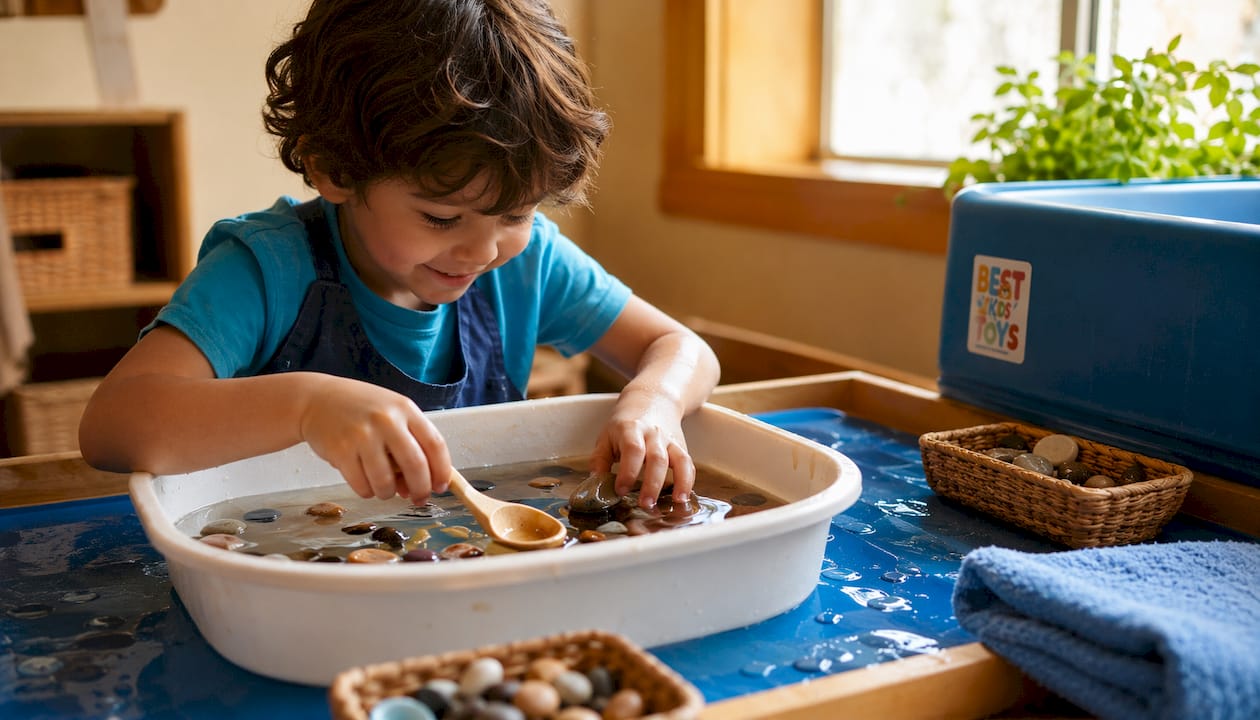
Modular water track systems use fastening clips and rubber seals with UV-resistant plastics, so children can reconfigure layouts and expand with extra track pieces as their problem-solving skills grow. Prioritize units with replaceable seals over permanently bonded joints; they last longer and stay expandable.
Pouring and pitcher sets are the simplest entry point for toddlers. A few cups, a small pitcher, and a shallow basin are all a one-year-old needs to begin exploring volume and control.
Compact inflatable play centers sized under six feet connect to a standard garden hose for continuous spray and work well for toddlers who are not yet ready for deeper water. They pack flat for easy storage.
“Water-reveal coloring walls and multi-access sprinklers turn a simple splash into a discovery task, giving children a reason to aim, observe, and repeat.” — Plum Play product design notes
Large inflatable water parks are sized for school-age children. Assembled dimensions vary by model, and reputable models include a GFCI-equipped blower and weight limits suited to school-age children.
Safety, setup, cleaning, and maintenance for water play
The single non-negotiable rule: never leave children unattended near water, even shallow water. Everything else builds from there.
Safety checklist:
- Keep water depth shallow for toddlers (under two inches in open basins)
- Use slip-resistant mats under and around any water station
- Plug blowers into a GFCI-protected outlet only; never use a standard extension cord near water
- Anchor large inflatables with stakes and water bags; wind displacement is a real hazard
- Check age and weight limits before each use, especially for inflatables
Cleaning schedule:
- Daily: rinse all surfaces with clean water after use
- Weekly: wash with mild soap and water; rinse thoroughly and air-dry before storing
- Monthly: fully drain, dry, and inspect for mold, cracks, or worn seals
For storage, keep inflatables deflated in a cool, dry place away from direct sunlight. UV degradation shortens the life of any plastic toy left outside year-round.
Maintenance tips: inspect fastening clips and rubber seals on modular tracks before each season. Check blower cords for fraying and confirm the GFCI trips correctly by pressing the test button. Replace worn parts rather than patching them.
Pro Tip: Keep a small bucket of clean rinse water near the play area so children can rinse hands and feet before stepping onto dry surfaces. It cuts cleanup time significantly and teaches a tidy routine.
How can you use water play toys year-round?
The smartest purchase is a multi-purpose design that works without water too. Sand-and-water combo tables, removable trays, and sensory basins all convert to dry-play stations in minutes, extending the toy’s usefulness well past summer.
Indoor adaptations: lay a waterproof tarp or splash mat under the station, use a low water volume (one to two inches), keep towels within reach, and limit sessions to 15–20 minutes to manage cleanup. The Splash Turtle ring toss fountain from Thebestkidstoys is sized for bathtub use, making it a practical cold-weather option.
Dry-play alternatives using the same bins: fill with kinetic sand, dried rice, or sensory beads for tactile exploration. Painting with water on a reveal-wall surface works beautifully as a dry-adjacent activity that still delivers the satisfying “disappearing” effect children love.
For children with sensory sensitivities: introduce water play gradually. Start with a dry bin, then add a small damp sponge, then a shallow layer of water over several sessions. Offer gloves or tools (cups, spoons) so children can engage without direct skin contact if that feels more comfortable. Predictable routines, like always starting with the same pouring activity, help children feel safe enough to explore.
What should you budget for a Montessori water play toy?
Price tiers track closely with size, materials, and expandability.
- Budget ($15–$40): basic pouring sets, small splash mats, and compact sensory basins. BPA-free plastics are common at this tier; UV resistance is less consistent. Good for indoor use or younger toddlers.
- Mid-range ($40–$100): water tables with drain plugs, compact inflatable play centers, and starter modular track sets. Expect better material specs, clearer age guidance, and at least a 90-day warranty.
- Premium ($100–$250+): large inflatable water parks, full modular waterway systems with expansion packs, and multi-station playcenters. Look for GFCI-equipped blowers, UV-resistant plastics, replaceable parts, and warranties of one year or longer.
Before you buy, confirm:
- Age and weight limits match your child
- BPA-free and non-toxic labeling is explicit
- Warranty terms and return window are clearly stated
- GFCI specs are listed if the toy includes a blower or pump
For longevity, UV resistance and replaceable parts matter more than brand name. A mid-range table with a drain plug and UV-treated plastic will outlast a premium-priced one that lacks both.
Key Takeaways
Open-ended water stations that convert between wet and dry play deliver the strongest Montessori developmental return across all ages and seasons.
| Point | Details |
|---|---|
| Prioritize open-ended designs | Water tables, sensory basins, and modular tracks support child-led exploration better than single-function toys. |
| Match age and safety specs | Always confirm age range, weight limits, BPA-free materials, and GFCI specs before purchasing. |
| Plan for year-round use | Wet/dry convertible designs extend value beyond summer using sand, rice, or sensory beads in the same basin. |
| Supervise constantly near water | Never leave children unattended; keep water shallow for toddlers and use GFCI outlets for any blower. |
| Shop Thebestkidstoys for curated picks | Thebestkidstoys reviews each water play toy for developmental fit, material safety, and Montessori alignment. |
Why open-ended water play is worth the investment
Here is a perspective that most buying guides skip: the developmental value of a water play toy has almost nothing to do with how many features it has. A water table with a single pouring cup and a drain plug will teach a three-year-old more about volume, gravity, and patience than a six-station playcenter that does everything for her.
The Montessori insight is that children learn by doing, not by watching a toy perform. Reveal-walls, pumps, and modular tracks earn their place because they require the child to act, to aim, to adjust, and to try again. Passive sprinklers and light-up fountains are fun, but they do not build the same cognitive habits. When you are choosing between two options at the same price point, ask which one requires more from the child, not which one does more on its own. That question will steer you right almost every time.
Thebestkidstoys has the water play toys your child will love
Every outdoor water play toy in the Thebestkidstoys collection has been reviewed for developmental fit, material safety, and Montessori alignment before it earns a spot on the site. Right now, the outdoor toys collection includes options across all age ranges and price points, from compact bath-time fountains to backyard sensory stations. Orders over $60 ship free, and a 40% off sale is currently running on select items.
If you are shopping by age, the ages 4–5 collection and the ages 5+ collection make it easy to find the right developmental fit without guesswork. Browse the collections today and find the water play station that will keep your child learning, splashing, and discovering all season long.
Useful sources and safety references
- NAEYC: Sand and Water Play — Early childhood educator guidance on how water and sand stations support fine motor development and early science inquiry. The authoritative source for developmental claims in this article.
- CPSC Toy Safety — The U.S. Consumer Product Safety Commission sets and enforces toy safety standards. Check product listings for CPSC compliance notes, especially for inflatables and electrical blowers.
- ASTM F963 (Toy Safety Standard) — The American Society for Testing and Materials’ voluntary toy safety standard widely adopted by U.S. manufacturers. Look for ASTM F963 mentions on product pages as a baseline quality signal.
- Thebestkidstoys: Splash Turtle Ring Toss Fountain — Example of a curated, developmentally reviewed water play product with safety and age guidance included on the product page.
- Manufacturer and retailer product pages — Always check assembled dimensions, recommended age ranges, weight limits, and blower/GFCI specs directly on the product page before purchasing. These specifications vary by model and are the most reliable source for setup and safety decisions.