



Puppet Play Benefits: How Puppets Build Real Skills in Kids
Puppet play boosts language development, social-emotional skills, memory, motor coordination, and creativity, and the research backing this up is more solid than most parents realize. A survey of 121 early-years educators found that 76% consider puppet play genuinely beneficial to their practice, and educators who use puppets frequently report far bigger gains than those who dabble occasionally. The mechanism behind the magic is surprisingly physical: kids move and gesture more when they’re animating a puppet, and that movement is linked to better story memory and comprehension than simply watching a show.
Here’s what the evidence points to when it comes to puppet play:
- Language growth: Puppets model dialogue, encourage repetition, and give shy talkers a reason to speak up.
- Social-emotional skills: A puppet gives kids emotional distance to name feelings and practice empathy without the pressure of direct eye contact.
- Memory and sequencing: The physical act of moving a puppet through a story helps kids retain plot details and follow multi-step instructions.
- Motor coordination: From wiggling a finger puppet to working a hand puppet’s mouth, kids build fine-motor control with every play session.
- Creativity and narrative skill: Puppets let children test out characters, motives, and “what if” scenarios in a low-stakes way.
Try this tonight: hand your child a sock puppet and ask it a question. Watch how quickly they answer as the puppet, often more freely than they’d answer you directly.
Table of Contents
- What Are the Language and Literacy Benefits of Puppet Play?
- How Does Puppet Play Support Social and Emotional Growth?
- Why Do Puppets Boost Memory and Attention Span?
- How Does Manipulating Puppets Build Motor Skills?
- Can Puppets Really Spark Imagination and Storytelling?
- What Does the Research Actually Say About Puppet Play?
- How Do You Start Using Puppets With Kids Today?
- Why Do So Many Adults Avoid Using Puppets?
- How Can Puppet Play Tie Into Classroom Learning Goals?
- Who Stands Behind This Research and Guidance?
- How Does Puppet Play Help Children With Special Needs?
- How Do You Choose the Right Puppet Type and Material?
- Should Puppet Play Include Screens and Digital Tools?
- Why Does Cultural Representation Matter in Puppet Play?
- What Does the Evidence Actually Tell Parents and Educators?
- Where Can You Find Puppets and Pretend-Play Toys That Last?
- Sources
What Are the Language and Literacy Benefits of Puppet Play?
Puppets turn passive listening into active talking, and that shift matters more than most parents expect. When a child holds a puppet and makes it “speak,” they’re rehearsing sentence structure, practicing new vocabulary, and building the confidence to use words out loud instead of just hearing them.
The research supports this beyond intuition. Active engagement with puppets, where children move and gesture the character through a story, correlates with better factual recall than watching a puppet show passively. The body seems to help the brain hold onto the plot. Practitioner guides on storytelling with puppets point to the same pattern: interactive puppet stories that invite kids to fill in lines or predict what happens next produce more spoken language per session than a straight read-aloud.
Here are three activities you can start using right away:
- Puppet retell: After reading a short book, hand your child a puppet and ask them to “tell the story again” in their own words, using the puppet as the narrator. This builds narrative sequencing and vocabulary recall.
- Echo lines: The puppet says a simple phrase (“I’m hungry for breakfast!”), and your child repeats it back through their own puppet. This is especially useful for toddlers still building sentence length.
- Vocabulary puppetry: Introduce a new word each week, and have the puppet use it in three different sentences across the day. Repetition through play sticks better than flashcards.
Age matters here. Toddlers do best with single-word or short-phrase prompts and lots of repetition, since their working memory for language is still developing. Preschoolers can handle open-ended prompts like “What does the puppet think will happen next?” and can start building two- and three-sentence responses on their own.
Pro Tip: Keep a “puppet phrase of the week” on the fridge. Whoever remembers to use it in a sentence, including you, gets to pick the next puppet story.
How Does Puppet Play Support Social and Emotional Growth?
A puppet acts like a safety barrier between a child and a hard conversation. Kids who freeze up when asked directly “How are you feeling?” will often answer without hesitation when a puppet asks the same question, because the puppet absorbs the social risk. This isn’t a minor party trick. Research on shy or reluctant speakers shows that projecting through a puppet consistently raises communicative confidence in children who otherwise clam up around adults.
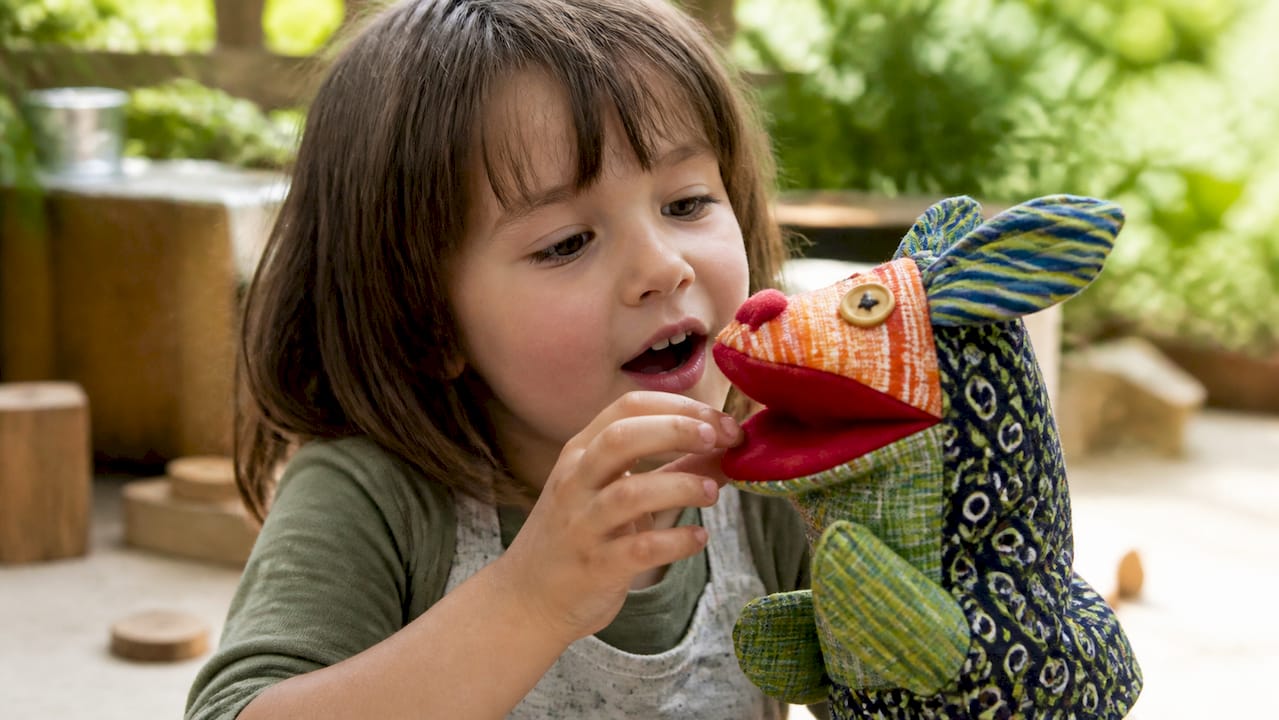
The emotional benefits go further than confidence. Puppet theatre intervention programs have produced measurable gains in emotional expressiveness, regulation, empathy, and cooperation, with some domains showing medium to strong effect sizes. That’s a meaningful signal for a play-based activity: it suggests puppets aren’t just fun, they’re doing real developmental work.
Practical ways to use this at home or in the classroom:
- Emotion puppet interviews: Hold up a puppet and ask, “How is Frog feeling today, and why?” Kids project their own emotional state onto the puppet more freely than they’d describe it themselves.
- Puppet problem-solver scenarios: Set up a simple conflict, two puppets who want the same toy, and ask your child to help them work it out. This practices negotiation and perspective-taking.
- Cooperative puppet plays: Give two children a puppet each and a loose scenario (a birthday party, a lost pet), then let them build the story together. This forces turn-taking without you having to referee.
When prompting emotional labeling, resist the urge to feed the answer. Instead of “Is the puppet sad?”, try “What do you think the puppet is feeling right now?” and let the pause sit. Adults who jump in too fast rob kids of the chance to generate the emotional vocabulary themselves. Researchers describe puppet play as occupying a middle ground between open-ended pretend play and structured instruction, which is exactly why it works so well for guided social-skill practice without feeling like a lesson.
Why Do Puppets Boost Memory and Attention Span?
Puppet play is embodied learning, and that’s not just a nice phrase. Kids gesture and move more while animating a puppet, and that physical movement correlates with better memory for story details and facts than sitting still and watching. The body appears to give the brain extra hooks to hang information on, which is why a child might forget a book’s plot by dinnertime but still remember exactly how “their” puppet hopped like a frog.
A survey of 121 early-years educators found 76% reported puppet play beneficial, and among frequent users, 92% saw improved engagement and 78% saw improved behavior, according to the Sage exploratory study.
That gap between frequent and infrequent users matters. It suggests memory and attention gains aren’t automatic from owning a puppet. They build with repeated, consistent use.
Simple games to practice working memory and sequencing:
- Sequence-a-story: Act out a familiar story out of order with puppets, then ask your child to put the scenes back in the correct sequence.
- Puppet-led instruction-following: Have a puppet give a short chain of directions (“hop twice, then sit down, then wave”), and let your child follow along as the puppet.
- Memory match: Introduce three puppet characters with distinct traits, then quiz your child later in the day on which puppet did what.
For tracking progress, a simple checklist works better than anything formal. Note how many steps a child can follow in a puppet-led instruction game, how much of a story they recall unprompted, and whether their attention holds for longer sessions over a few weeks.
How Does Manipulating Puppets Build Motor Skills?
Different puppet types demand different motor skills, and that progression maps almost perfectly onto a child’s developing dexterity. Finger puppets require basic grip and isolated finger movement, ideal for toddlers still working on pincer grasp. Hand puppets step things up, requiring coordinated wrist rotation and the ability to open and close a “mouth” while talking. Rod or string puppets, the most advanced option, demand bilateral coordination since one hand often controls the body while the other manages a separate limb or rod.
A logical progression looks like this:
- Start with finger puppets for children under three, focusing on simple grasp and release.
- Move to hand puppets around age three or four, practicing the pincer-and-release motion needed to make a mouth “talk.”
- Introduce rod or string puppets for children five and up, building the bilateral coordination needed to manage two separate movements at once.
Quick exercises to strengthen the skills along the way include having a child “walk” a finger puppet across a table one finger-hop at a time, or practicing opening and closing a hand puppet’s mouth in time with a simple song.
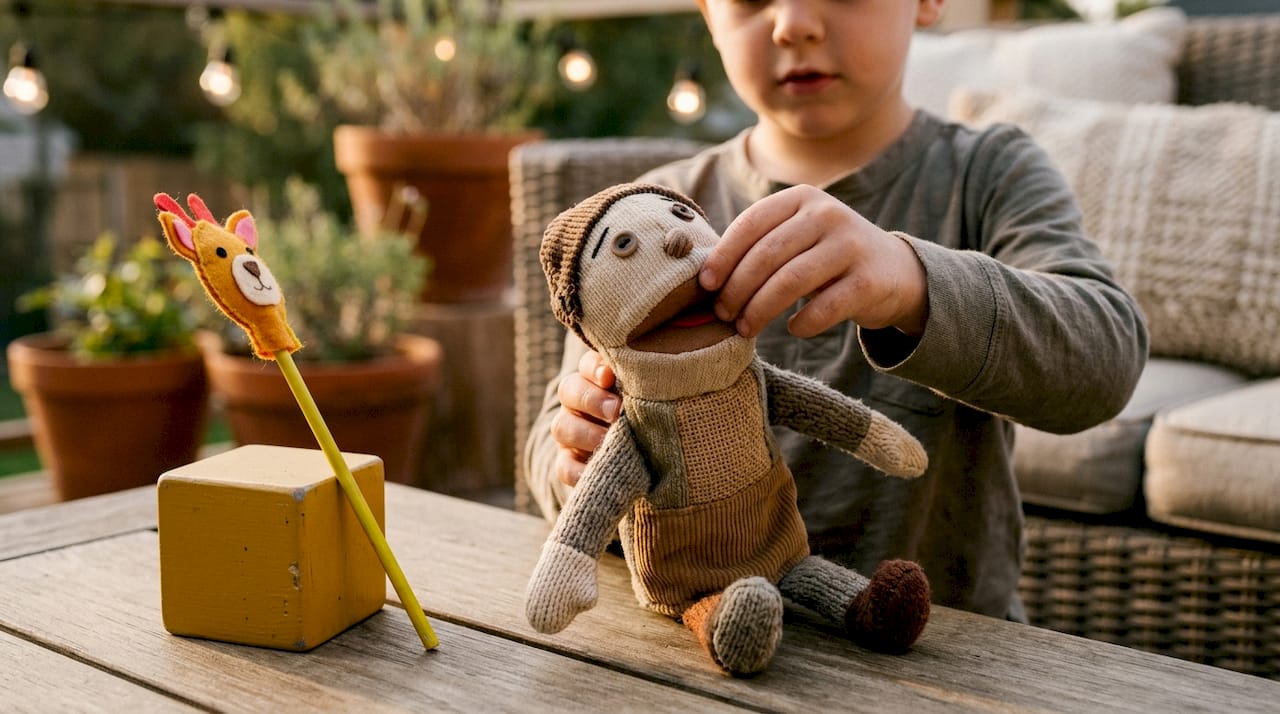
For children with motor or sensory needs, adaptations matter more than perfection. Larger, looser-fitting hand puppets reduce the grip strength required. Puppets with textured fabric can support sensory-seeking kids, while smooth, simple designs work better for children who find heavy texture overwhelming. A puppet mounted on a stick or dowel can also reduce the fine-motor demand for kids who struggle with a traditional hand-puppet grip, letting them focus on the story instead of the mechanics.
Can Puppets Really Spark Imagination and Storytelling?
A puppet gives a child permission to explore motives and consequences without any personal risk. If the puppet is the one who makes a bad choice, gets scared, or says something mean, the child gets to examine that behavior from a safe distance. This is a big part of why puppet play scaffolds narrative complexity so effectively: kids build entire character arcs for a sock or a paper bag long before they could explain their own feelings in the same depth.
Creative prompts worth trying:
- Ask “What does this puppet want more than anything?” and build a whole story around the answer.
- Combine puppets with drawing by having your child sketch a “puppet world” backdrop before acting out a scene in front of it.
- Add sound: a simple drum or shaker for entrances, exits, or dramatic moments turns a two-minute puppet scene into a mini production.
As children get older, encourage longer narratives with low-effort nudges rather than big productions. A simple “And then what happened?” after a puppet finishes a sentence often produces another three or four sentences of plot the child wouldn’t have added on their own. Rotating in new puppet characters every few weeks also keeps stories fresh, since a new character brings a new voice, a new problem, and a reason to keep the narrative going.
What Does the Research Actually Say About Puppet Play?
The evidence for puppet play benefits is stronger than most people assume, but it’s worth being honest about what’s well-established versus what’s still emerging. On the well-supported side, the Sage exploratory study of 121 early-years educators found most viewed puppets as beneficial, with frequent users reporting higher gains in both engagement and behavior compared to occasional users. That gap is one of the most useful findings in the whole body of research: puppets don’t work like magic on first contact. Their benefits accumulate with consistent use.
Intervention research adds weight to the socio-emotional claims specifically. A puppet theatre program with preschoolers produced statistically significant improvements in emotional expressiveness, regulation, empathy, and cooperation, with medium to strong effect sizes in several domains.
The clearest pattern across this research isn’t that puppets are a novelty toy. It’s that active, repeated, embodied use, kids moving, gesturing, and speaking through the puppet themselves, drives the learning. Passive puppet shows don’t produce the same gains as hands-on puppet play.
What’s promising but needs more study is the precise dosage: how many sessions per week, for how long, produce reliable gains. What’s clear is the direction: more consistent, hands-on use beats occasional use every time.
- Educators should treat puppets as a regular tool, not an occasional novelty.
- Effect sizes vary by domain, so expect stronger gains in confidence and engagement than in, say, complex sequencing skills.
- Implementation quality (how the puppet is used) likely matters more than which puppet is used.
How Do You Start Using Puppets With Kids Today?
You don’t need a script or a stage to get started. Here are three short session plans you can run today, each under 15 minutes.
- Language-focused (10 minutes): Read a short picture book, then hand your child a puppet and ask them to retell it in their own words. Prompt with “And then what did the puppet do?” if they stall.
- Social-emotional focused (10 minutes): Introduce two puppets with a simple conflict (they both want the last cookie). Ask your child to help the puppets solve it, prompting with “How do you think Puppet A feels right now?”
- Creativity-focused (15 minutes): Give your child a blank puppet (a sock or paper bag) and ask them to name it, decide what it loves, and act out one adventure. Add a drawn backdrop if time allows.
For materials, you don’t need to spend much. A clean sock, a paper lunch bag with a drawn face, or a wooden spoon with a fabric scrap all work as functional DIY puppets. If you’re looking for something more durable, pretend play toys designed for role-playing tend to hold up better across repeated sessions than homemade options.
Pro Tip: Keep a small basket of two or three puppets by the dinner table. A five-minute puppet check-in (“How was Puppet’s day?”) is an easy way to get kids talking about their own day sideways.
To track progress, jot a quick note after each session: did your child use new vocabulary, initiate the story themselves, or need heavy prompting? Sharing these small observations with family members turns a quick playtime activity into a shared record of growth.
Why Do So Many Adults Avoid Using Puppets?
The biggest barrier isn’t lack of evidence, it’s adult self-consciousness. Many parents and educators worry they’ll look silly or don’t have “the voice” for it, so the puppet sits in a drawer.
The fix is lowering the bar, not raising your performance skills. A puppet doesn’t need a funny voice to work. Kids respond just as well to a puppet that simply asks questions in your normal voice.
- Barrier: “I don’t have time to plan a puppet activity.” Fix: Use a puppet as a “helper” during an existing routine, like brushing teeth or cleaning up toys, with zero extra prep.
- Barrier: “I feel silly performing.” Fix: Skip the performance. A puppet that just listens and asks simple questions works fine.
- Barrier: “I don’t own any puppets.” Fix: A sock or paper bag with a drawn face gets the same developmental benefits as a store-bought one.
How Can Puppet Play Tie Into Classroom Learning Goals?
Puppet play maps cleanly onto learning objectives educators already track, which makes it easier to justify beyond “just for fun.”
- Language goals: Vocabulary use, sentence length, and story sequencing during puppet retells.
- Social-emotional goals: Emotion labeling accuracy and turn-taking during cooperative puppet scenes.
- Fine-motor goals: Grip control and bilateral coordination as children progress from finger puppets to hand puppets.
For documentation, keep it simple. A short anecdotal note after a session (“Used ‘frustrated’ correctly during puppet conflict”) takes less than a minute and builds a useful record over weeks. A basic observation checklist tracking vocabulary, emotional language, and motor control gives you concrete data points without a formal assessment.
To communicate this to families and administrators, a quick photo of a puppet activity paired with a one-line note (“Practiced sequencing today with a puppet retell”) does more than a lengthy report. Parents and administrators alike respond better to a specific, visible example of learning in action.
Who Stands Behind This Research and Guidance?
This guide draws on peer-reviewed research, including the Sage exploratory study on educator-reported puppet play outcomes and intervention research on puppet theatre and socio-emotional development, combined with practical classroom experience.
- Written with input from Danica Hodge,.
- Thebestkidstoys reviews every product for safety and educational value before it’s added to the catalog, evaluating durability, age-appropriateness, and developmental relevance.
Thebestkidstoys built its toy selection process around a simple filter: does this toy actually support a child’s development, or is it just entertainment? Puppets and pretend-play tools get evaluated the same way, checked for safe materials, durable construction, and genuine play value that holds up over months, not days.
How Does Puppet Play Help Children With Special Needs?
Puppets give children with developmental delays or special needs a communication channel that doesn’t rely on direct eye contact or verbal fluency under pressure. For children on the autism spectrum, a puppet can reduce the social intensity of a conversation, making it easier to practice turn-taking, emotion recognition, and requesting help.
Speech-language contexts benefit too. A puppet that “struggles” to find a word and asks for help models language-repair strategies in a way that feels like play rather than correction. For children with motor delays, simplified puppet designs, oversized finger puppets or puppets with looser openings, reduce the physical demand while preserving the social and language benefits.
The key adaptation across all these cases is flexibility. There’s no single “right” way to use a puppet with a child who has different needs. Shortening sessions, using fewer verbal prompts, or letting the child control the pace of the puppet’s actions all preserve the core benefits while removing unnecessary friction. A puppet’s low-stakes nature, already valuable for typically developing kids, becomes even more important for children who find direct social interaction demanding.
How Do You Choose the Right Puppet Type and Material?
Puppet choice should follow a child’s age and motor ability more than aesthetic appeal. Finger puppets suit toddlers building basic grip skills. Hand puppets, with an opening large enough for small fingers to work the “mouth,” fit preschoolers building coordination and language skills together. Rod and string puppets work best for children five and up who have the bilateral coordination to manage more complex movement.
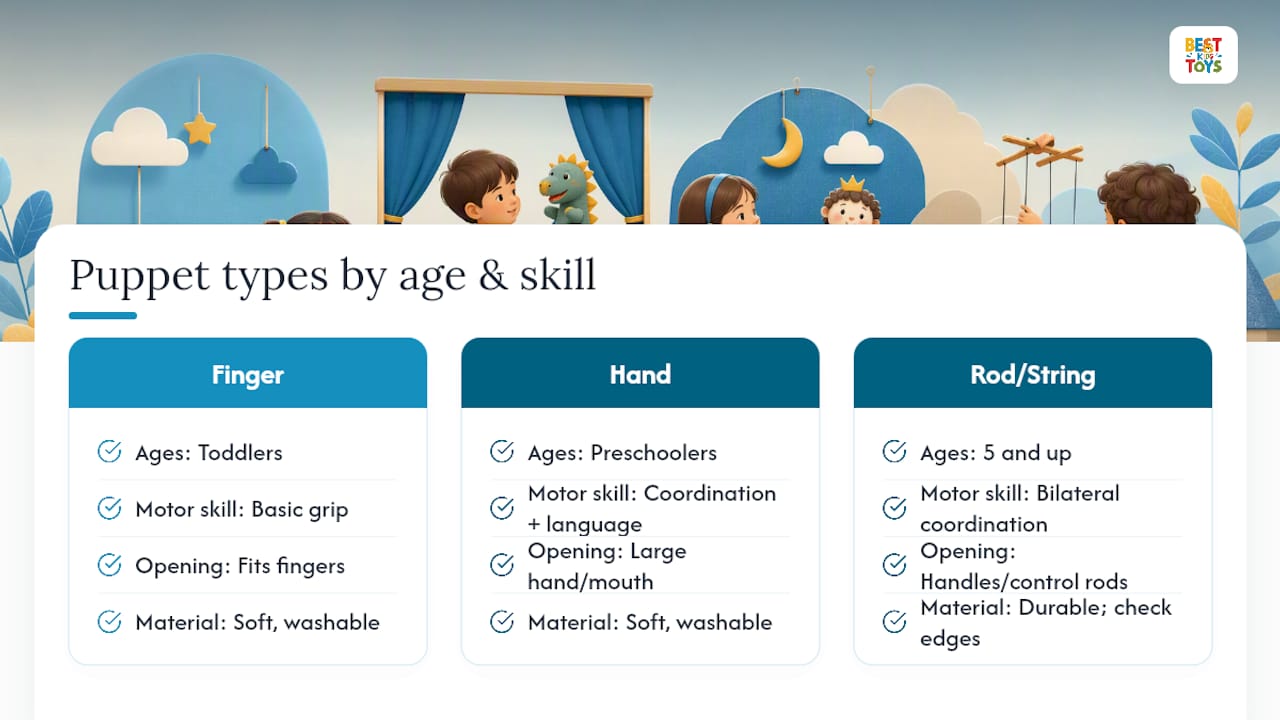
Material matters for safety and sensory comfort. Soft fabric puppets, machine washable when possible, hold up to repeated handling and drool-prone toddlers. Wooden or hard-bodied puppets can offer more durability but should be checked for smooth edges and secure, non-detachable parts for children who still mouth toys. For kids with sensory sensitivities, a plush texture may be soothing, while another child might prefer something smoother and less textured.
If you’re shopping for age-appropriate options, toys for kids ages 4 to 5 include pretend-play pieces suited to the coordination and attention span of that stage, while toys for toddlers ages 3 to 4 lean toward simpler, sturdier designs. Whatever you choose, prioritize washable materials, secure seams, and an opening size that actually fits your child’s hand.
Should Puppet Play Include Screens and Digital Tools?
Puppet play works best as a screen-free, hands-on activity, and that’s precisely where it earns its value. Still, technology has a supporting role worth considering. A short video demo of a puppet storytelling technique can help a nervous parent or new educator build confidence before trying it live, without replacing the actual hands-on practice.
Digital tools can also extend puppet stories without dominating them. Recording a child’s puppet show on a phone and replaying it lets them see their own storytelling from the outside, often prompting them to add more detail or dialogue the second time around. Some classrooms use a simple audio recorder instead of video, capturing dialogue only, which keeps the focus on language rather than performance.
The line to hold is clear: digital tools should support puppet play, not replace the physical manipulation and live interaction that drive its actual benefits. A screen showing a puppet show does not deliver the same gesture, movement, and social engagement as a real puppet in a child’s hand.
Why Does Cultural Representation Matter in Puppet Play?
Puppets that reflect a variety of skin tones, hair textures, clothing styles, and family structures help every child see themselves reflected in play, and help all children build familiarity with lives different from their own. This isn’t a minor detail. Representation in play materials shapes how children think about identity and difference from a very young age.
Beyond appearance, cultural puppetry traditions themselves offer rich material. Shadow puppetry, glove puppets, and marionette traditions from different regions of the world can introduce children to storytelling styles beyond the typical Western hand-puppet format, adding both cultural learning and creative variety.
Practically, this means choosing a puppet collection that includes diverse characters rather than a single default look, and occasionally introducing stories or folk tales from different cultural traditions through puppet retellings. A simple, low-cost way to start: rotate in puppets that represent different professions, family types, and backgrounds, and let the stories that emerge reflect that same range.
Puppet play reliably strengthens language, social-emotional skills, memory, motor coordination, and creativity when used consistently rather than occasionally.
| Point | Details |
|---|---|
| Frequency drives results | Educators who use puppets often report far bigger gains in engagement and behavior than occasional users, per the Sage survey. |
| Movement supports memory | Active, gesture-based puppet play correlates with better story recall than passive puppet shows. |
| Puppets lower social pressure | Shy or reluctant speakers often talk more freely through a puppet than directly to an adult. |
| Motor skills scale with puppet type | Progress from finger puppets to hand puppets to rod or string puppets as coordination develops. |
| Thebestkidstoys supports age-matched play | Thebestkidstoys curates pretend-play and puppet-friendly toys reviewed for safety and developmental fit across age ranges. |
What Does the Evidence Actually Tell Parents and Educators?
The conventional advice on puppet play stops at “kids like it,” which undersells what the research actually shows. The real finding worth acting on is the frequency effect: puppets used occasionally look like a nice extra, but puppets used consistently produce measurably better engagement and behavior. That’s a different message than most parenting content sends.
What’s overrated is puppet performance skill. Parents delay starting because they think they need a funny voice or a script. The research doesn’t support that worry. A puppet that simply asks a plain question in your normal voice gets the same social and language benefits as an elaborate show.
What I’d prioritize first: pick one simple puppet, use it for five minutes a day around an existing routine, and stick with it for a few weeks before judging whether it “works.” Consistency, not creativity, is the lever that actually moves the needle here.
— Danica Hodge
Where Can You Find Puppets and Pretend-Play Toys That Last?
If you’re ready to bring more puppet play into your home or classroom, the toy itself matters more than most parents expect. A puppet with a loose seam or scratchy fabric gets abandoned after one session, no matter how good your prompts are. Thebestkidstoys builds its collection around durability and developmental fit first, so a puppet or pretend-play set survives daily use instead of falling apart after a week of enthusiastic play.
Every item in the collection gets reviewed for safe materials, age-appropriate design, and genuine play value, the same standards this article’s research points to as the difference between a toy that gets used once and one that gets used for months. For preschoolers building language and social skills through puppet retells and cooperative stories, the toys for kids ages 4 to 5 collection includes pretend-play pieces sized and designed for that stage of coordination. For sensory-sensitive kids who need softer textures or simpler grips, the sensory toy collection offers gentler alternatives that still support the same developmental goals.
Browse the current selection, check what fits your child’s age and needs, and add a puppet or pretend-play set to your cart today to start building these skills at home this week.
Sources
- Jbrary — New to Storytime: Using Puppets
- The impact of puppet theatre among preschoolers’ socio-emotional abilities development