



Montessori Flash Cards: Best Picks for Early Learners
What are Montessori flash cards and why do they work?
Montessori flash cards are specialized educational tools that help children build vocabulary, sharpen memory, and connect words to the real world through hands-on, child-led exploration. Unlike traditional drill cards, they prioritize discovery over repetition.
The classic format is the three-part card system: a Master Card pairing an image with its label, a Picture Card showing the image alone, and a Label Card with only the word. Children match and self-correct independently, building confidence without needing adult approval at every step.
What makes these cards genuinely different is the imagery. Real photographs replace cartoons so children connect learning to actual objects in their world. That grounding in reality supports genuine vocabulary growth rather than rote memorization.
Key developmental benefits include:
- Memory reinforcement through repeated, self-directed matching
- Critical thinking through sorting and categorizing
- Language acquisition tied to concrete, real-world objects
- Independence through self-correcting card design
- Sensory engagement that keeps young learners curious and active
Types of Montessori learning cards you should know
Montessori learning cards span a surprisingly wide range of subjects and age groups. Knowing which type fits your child’s stage makes all the difference.
- Nomenclature (3-part) cards: The foundation of Montessori language work. Sets cover botany, zoology, geography, and everyday objects. Each set includes Master, Picture, and Label cards for independent matching.
- Talking and vocabulary cards: These build conversational skills by introducing words in context. Children say the word aloud, use it in a sentence, and connect it to a picture.
- Geography flashcards: Maps and country name cards, such as North American countries or U.S. state sets, make abstract geography tangible for young learners.
- Phonics series cards: Blue Series and Pink Series nomenclature cards target early readers ages 5–7, pairing consonant blend words with realistic photographs.
- Classification cards: Children sort images into categories like animals, fruits, or musical instruments, building logical reasoning alongside vocabulary.
- Sensory stimulation cards: High-contrast, simple image cards designed for infants and very young toddlers to support visual development before language begins.
- Bilingual vocabulary cards: Label cards in two languages support families raising children with more than one language from an early age.
Pro Tip: For pre-readers, choose text-free vocabulary cards. Keep a private control sheet listing each card’s correct term so you can guide the lesson without the child seeing the answers.
Where to buy Montessori flashcards in the United States
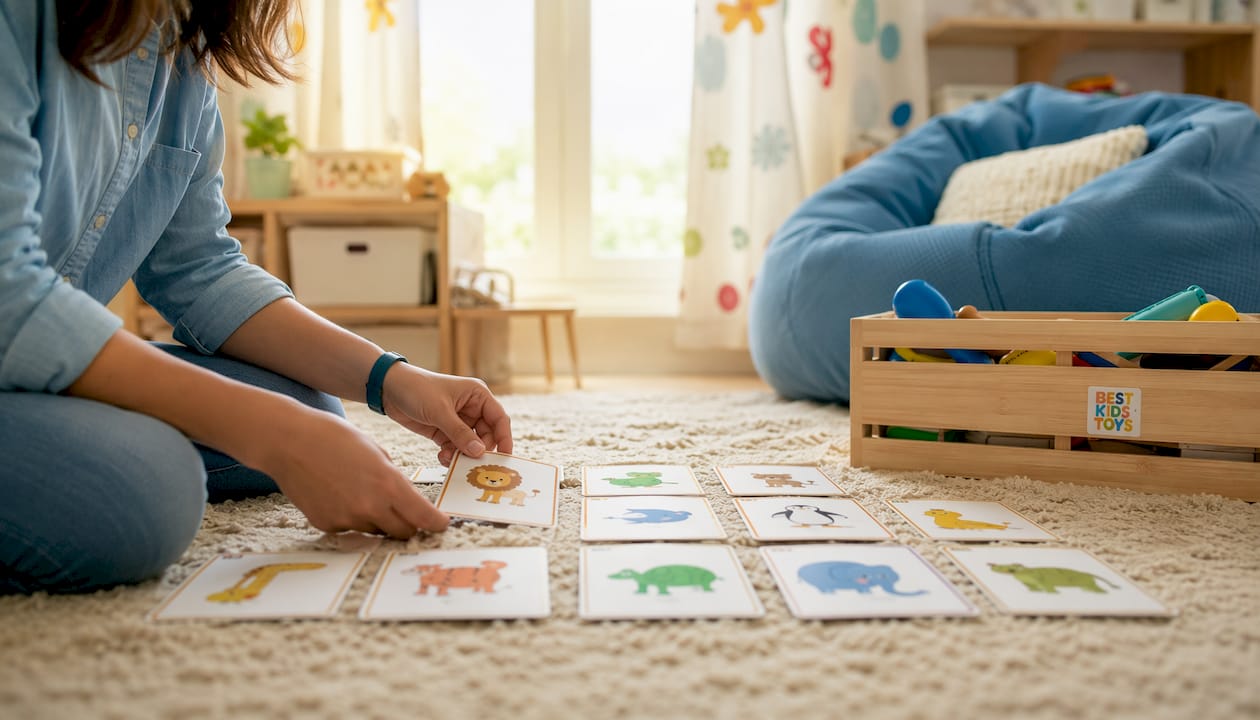
Three trusted U.S. suppliers stand out for parents and educators shopping for quality Montessori materials.
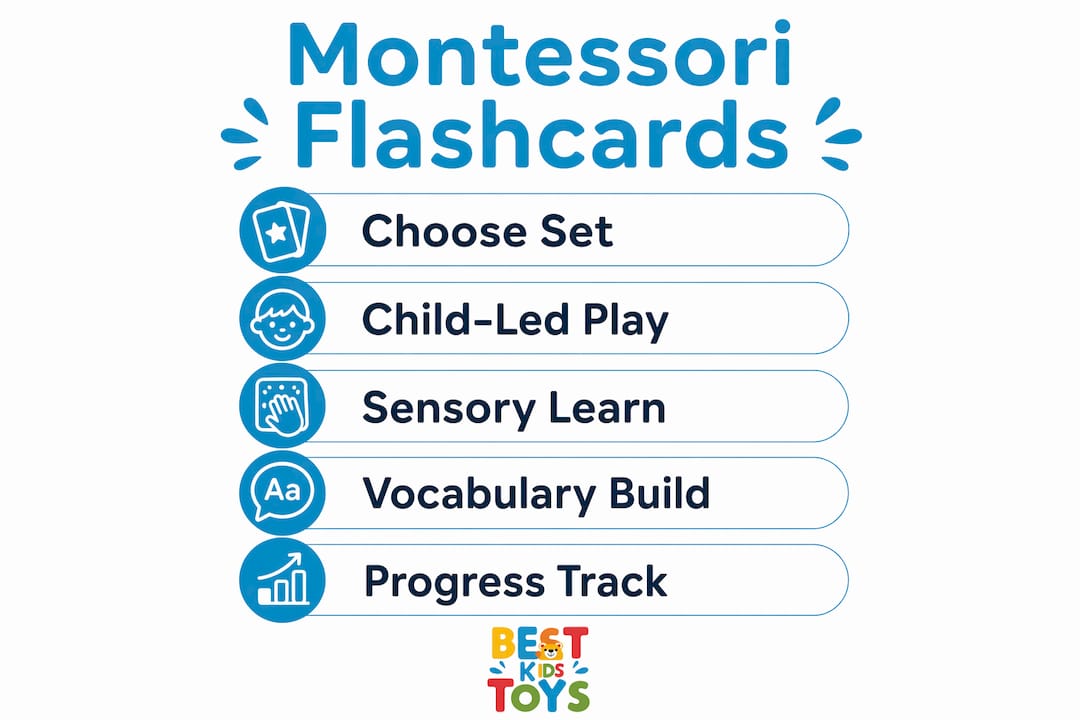
| Supplier | Product range | Pricing examples | Shipping and promotions | Rating |
|---|---|---|---|---|
| Kid Advance Montessori | Full Montessori curriculum materials, classroom packages, furniture, educational toys | $19.99–$269.99 per set | Free shipping on orders over $300 | 4.9★ (17 reviews) |
| Alison’s Montessori & Educational Materials | Classroom packages, homeschool materials, furniture, printed curriculum, timelines | Items available at lower price points; furniture offered at a range of prices. | 10% off and free shipping over $300 with promo codes | 5★ (9 reviews) |
| The Montessori Marketplace | Diverse Montessori teaching resources for classrooms and homeschoolers | Not publicly listed | Not publicly listed | 5★ (1 review) |
Kid Advance Montessori has been supplying Montessori homes and classrooms since 2001, making it one of the most established names in the U.S. market. Their catalog covers everything from individual card sets to full classroom packages, with pricing like $269.99 for a Montessori Pink Level set and $19.99 for wooden activity games.
Alison’s Montessori is a strong pick for homeschool families who want variety without a large upfront investment. Their “under $20” category gives budget-conscious parents an easy entry point, and the 10% discount with free shipping on orders over $300 rewards larger purchases.
The Montessori Marketplace serves educators and parents looking for a verified local source of Montessori materials, supporting both classroom and homeschool needs across the U.S.
How to use Montessori flashcards effectively at home or in class
The biggest mistake parents make is rushing. Montessori vocabulary cards work best when children set the pace, exploring and matching at their own rhythm rather than being drilled for speed.
- Start with Master Cards. Introduce 3–5 cards at a time. Name each image aloud and invite your child to repeat it.
- Move to matching games. Spread Picture Cards and Label Cards separately, then ask your child to pair them. This reinforces both visual recognition and word recall.
- Pair cards with real objects. Effectiveness improves when children handle physical objects before matching them to two-dimensional photos. Hold up an actual apple before introducing the apple card.
- Use sorting activities. Ask children to group cards by category: animals, colors, or foods. Sorting builds classification skills alongside vocabulary.
- Adapt by age. Toddlers (ages 2–3) work best with 3–5 cards per session. Children ages 4–7 can handle larger sets and enjoy memory-style matching games.
- Store cards carefully. Keep each set in a labeled envelope or small basket. Laminating cards before cutting extends their life significantly.
Pro Tip: Let your child choose which card set to work with that day. Child-led selection increases engagement and mirrors the Montessori principle of following the child’s natural curiosity.
Vocabulary and sensory development in everyday play
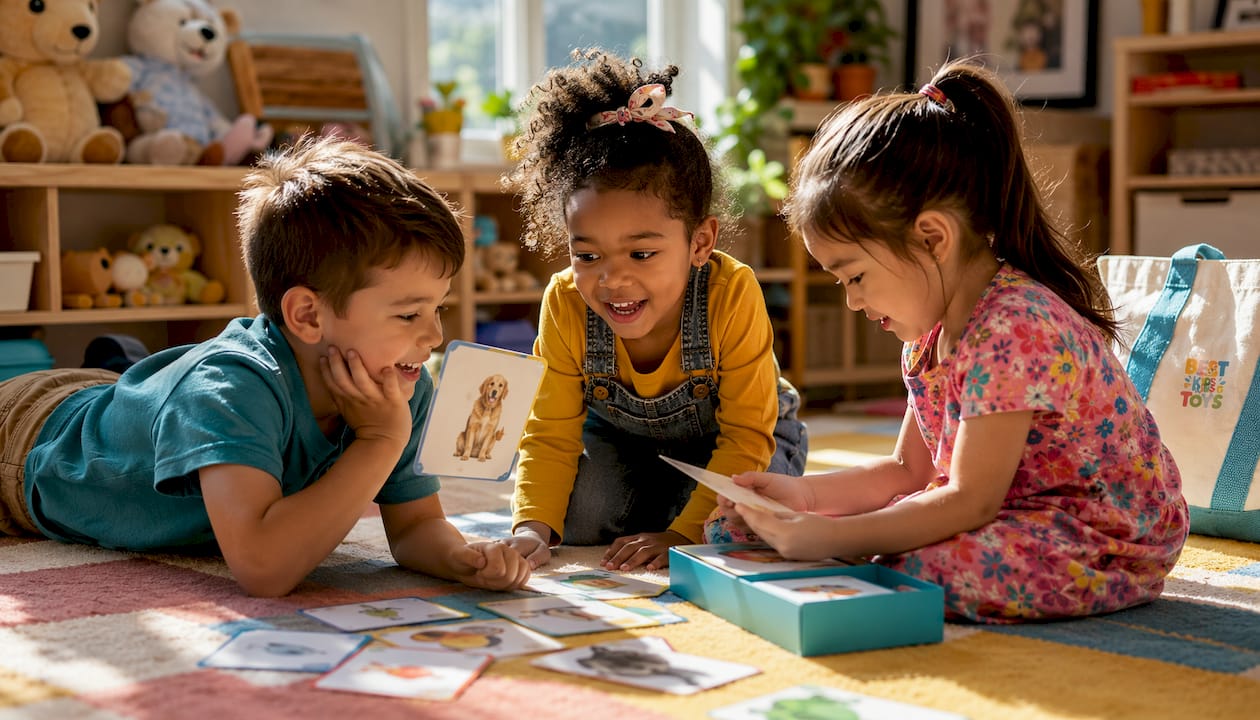
Montessori cards fit naturally into daily routines, not just formal learning sessions. During breakfast, pull out a food vocabulary set and name what’s on the table. On a walk, match nature cards to leaves or flowers your child collects. This concrete-to-abstract approach grounds new words in lived experience, which is far more memorable than a worksheet.
For sensory development, high-contrast infant cards placed in a baby’s visual field during tummy time stimulate early visual tracking. Toddlers benefit from texture-paired activities where a card showing “rough” accompanies a piece of sandpaper to touch. The Montessori method’s flexibility means these cards adapt to the child’s current interest, keeping engagement alive across months of use.
How to make your own DIY Montessori flashcards
Creating your own cards at home is genuinely straightforward. The key is staying true to Montessori principles: real images, clean design, and a self-correcting structure.
- Choose a theme your child is currently curious about, such as backyard birds, kitchen tools, or U.S. states.
- Source real photographs, not cartoons. Free image sites or your own photos work well.
- Print on cardstock at standard 8.5 x 11 inches for durability.
- Create three versions of each card: Master (image plus label), Picture (image only), and Label (word only).
- Laminate before cutting to protect cards from small, enthusiastic hands.
- Keep labels simple. One word per card, printed in a clean, readable font.
- Add a control sheet listing each card’s correct term so you can guide sessions without showing answers.
A Montessori wooden spelling game pairs beautifully with DIY cards, letting children build the words they’ve just matched.
Fitting Montessori cards into your home or classroom curriculum
Cards work best as one part of a broader Montessori environment, not a standalone activity; consider adding a Keter Kids Funtivity Outdoor Playhouse to enrich hands-on, imaginative learning. Place card sets on a low, accessible shelf so children can choose them independently. Rotate sets every two to three weeks to maintain novelty. In a classroom, connect card themes to current unit studies: geography cards during a world cultures unit, botany cards during a nature study.
For Montessori toys by age, pairing cards with hands-on materials deepens learning. A geography card set works alongside a puzzle map; a botany card set pairs with a real plant on the science shelf.
How to track your child’s progress with Montessori flashcards
Progress in Montessori looks different from a gold star on a quiz. Watch for these concrete signs of growth:
- Independent matching without prompting or hints from you
- Spontaneous naming of card images during unrelated activities, like spotting a cardinal and saying “cardinal” without a card present
- Sorting accuracy improving over time as categories become more nuanced
- Increased card sets a child can handle in one session, moving from 3 cards to 10 or more
Keep a simple observation journal. Note the date, the card set, and what your child did independently. Over weeks, patterns emerge that show exactly where vocabulary is growing and where a child needs more time with concrete objects before moving to cards.
Thebestkidstoys brings Montessori-inspired learning home
If you love the Montessori approach but want to go beyond paper cards, Thebestkidstoys offers a curated collection of Montessori-inspired learning toys that support the same developmental goals: vocabulary, independence, sensory exploration, and screen-free play. Products like the Little Learners Montessori Busy Book and sensory toys are selected for safety, long-term play value, and real developmental benefit. Right now, families can take advantage of a 40% off sale and free shipping on orders over $60, making it easy to build a rich learning environment at home without a big budget.
Key Takeaways
Montessori flash cards support early childhood learning best when paired with real objects, child-led pacing, and a rotating selection of themed sets.
| Point | Details |
|---|---|
| Three-part card structure | Master, Picture, and Label cards let children self-correct independently, building confidence without adult intervention. |
| Real images matter | Photographs of actual objects connect vocabulary to the real world far more effectively than cartoons. |
| Age-appropriate use | Toddlers work best with 3–5 cards per session; children ages 4–7 can handle larger sets and memory-style games. |
| Top U.S. suppliers | Kid Advance Montessori (since 2001) and Alison’s Montessori both offer free shipping on orders over $300. |
| Thebestkidstoys option | Thebestkidstoys offers Montessori-inspired toys and busy books with 40% off and free shipping over $60 as a hands-on complement to card-based learning. |