



Best Language Development Toys for Toddlers: SLP Guide
Open-ended pretend-play sets, wooden blocks, board books, figurines, and simple cause-and-effect toys are the most effective language development toys — and ASHA along with speech-language pathologists (SLPs) consistently recommend them over battery-operated alternatives. Thebestkidstoys curates Montessori-inspired picks in exactly these categories, so you can shop with confidence knowing each toy is chosen with communication growth in mind.
Quick starter picks you can grab or repurpose today:
- Wooden unit blocks (stacking, sorting, requesting)
- Toy kitchen with play food (labeling, pretend sequences)
- Farm or animal figure sets (animal sounds, action words)
- Board books with simple, repetitive text
- Bubbles (requesting “more,” turn-taking)
- Empty cardboard boxes (open-ended, caregiver-led vocabulary play)
ASHA members note that low- or no-cost household items — empty boxes, pots, junk mail — can be just as effective as store-bought toys because they invite extended, caregiver-mediated play. The toy itself is never the whole story; the conversation it sparks is.
Table of Contents
- Why do certain toys actually support language development?
- How do you choose the right toy for each language stage?
- Ten prompts that reliably get kids talking during play
- What should you check before buying a language toy?
- How were these picks chosen? The SLP-backed criteria
- Key Takeaways
- Why open-ended toys are the heart of language learning
- Thebestkidstoys makes finding the right toy simple
- Useful sources and further reading
Why do certain toys actually support language development?
The mechanisms SLPs cite most often are joint attention, turn-taking, pretend play, and scaffolding. Joint attention means both you and the child are focused on the same object or event at the same time — that shared focus is where new words get attached to meaning. Turn-taking teaches the back-and-forth rhythm of conversation long before a child uses full sentences. Pretend play stretches vocabulary into verbs, prepositions, and early syntax (“cow goes in,” “more soup”). Scaffolding means you offer just enough language support to move the child one step forward without doing all the talking for them.
Open-ended, non-electronic toys outperform battery-operated ones for language because they force the child to act, request, or imitate to make anything happen. When a toy does all the talking, the child goes quiet. When the toy does nothing, the child fills the silence — and that’s exactly where communicative practice lives. ASHA and SLP practitioners consistently point to this dynamic as the core reason wooden blocks, play food, and simple figurines remain clinical favorites.
Associates in Pediatric Therapy add that movement-rich, non-electronic toys — tunnels, bowling sets, water tables — encourage expressive language like directional words and action verbs because the child needs words to direct the play. Learning Resources and Melissa & Doug both build product lines around this principle, offering manipulatives and pretend-play sets designed for caregiver-child interaction rather than solo screen engagement.
For a deeper look at how play-based learning boosts early cognitive growth, the connection between movement, imagination, and language becomes even clearer.
How do you choose the right toy for each language stage?
ASHA’s public guidance and practitioner resources from Teach Me To Talk both emphasize choosing toys by developmental language stage rather than chronological age. A child at a pre-verbal stage needs different tools than one combining two words, regardless of their birthday.
0–12 months: cause-and-effect and sensory exploration
Babies at this stage are building joint attention and learning that their actions produce responses. Rattles, soft books with textures, simple pop-up toys, and peek-a-boo cloths all work well. Activity prompt: hold a rattle just out of reach, wait, and name it when the baby reaches — “rattle!” Repeat with eye contact.
12–24 months: single words and early requesting
This is the stage for infant development toys that invite labeling and requesting. Farm sets, shape sorters, stacking cups, and simple board books with one word per page are ideal. Activity prompt: hold up a piece of play food, pause expectantly, and wait for any vocalization before handing it over — you’re building requesting behavior.
2–3 years: two-word combinations and pretend play
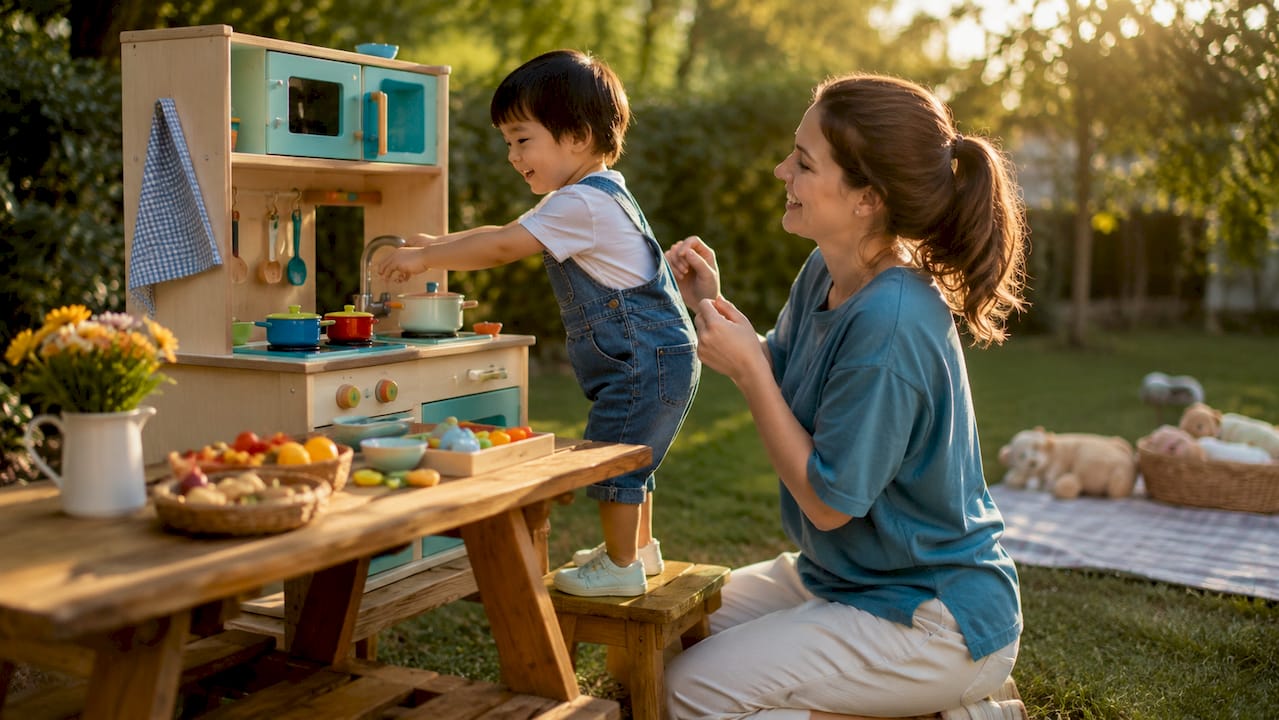
Children here are ready for toy kitchens, doll houses, simple puzzles, and block sets. The goal shifts to two-word and three-word combinations (“big block,” “more juice,” “baby sleep”). Activity prompt: narrate your own play moves (“I’m pouring soup”) and then pause — children at this stage often imitate immediately after a model.
3–5 years: syntax, sequencing, and narrative
Figure sets, dress-up props, simple board games, and story-based toys shine here. Fisher-Price and VTech both offer products at this stage, though open-ended figure sets and props tend to generate more child-initiated language than single-purpose electronic toys. Activity prompt: set up a small scene with figurines and ask “what happens next?” to elicit sequencing and early narrative.
| Stage | Best for (goal) | Skills targeted | Age range | Play style |
|---|---|---|---|---|
| Pre-verbal / early sounds | Joint attention, imitation | Vocalizations, eye contact, gestures | 0–12 mo | Open-ended, caregiver-led |
| Single words | Labeling, requesting | Nouns, animal sounds, early verbs | 12–24 mo | Open-ended, some cause-and-effect |
| Two-word combos | Combining words, pretend | Verbs, adjectives, turn-taking | 2–3 yrs | Open-ended pretend play |
| Early sentences | Syntax, sequencing, narrative | Prepositions, pronouns, story structure | 3–5 yrs | Open-ended + structured games |
Price guidance: budget options ($5–$15) include board books, bubbles, and simple puzzles; mid-range ($15–$40) covers wooden block sets, play food, and farm figures; premium ($40+) includes full pretend-play kitchens and multi-piece figure sets. Open-ended toys in the mid-range tend to offer the best language practice per dollar because they grow with the child across multiple stages.
Ten prompts that reliably get kids talking during play
Use these 10 prompts during play to reliably increase opportunities for language — each one maps to a specific communication target.
- Expectant pause: Hold up a toy, make eye contact, and wait 5–10 seconds. Targets: requesting, any vocalization.
- Incomplete sentence: “The cow goes in the…” (pause). Targets: fill-in vocabulary, early syntax.
- Parallel talk: Narrate what the child is doing — “You’re stacking the blocks!” Targets: verb and noun exposure.
- Self-talk: Narrate your own actions — “I’m pouring the juice.” Targets: modeling new vocabulary.
- Choice offer: “Do you want the cow or the pig?” Targets: single-word responses, decision-making language.
- Expansion: Child says “more.” You say “more juice!” Targets: two-word combinations.
- Recast: Child says “cow go.” You say “Yes, the cow is going!” Targets: grammar modeling without correction.
- Sabotage: Give the child a puzzle piece that doesn’t fit and wait. Targets: requesting help, problem-solving language.
- Narrative prompt: “What happens next?” with a figure set. Targets: sequencing, story structure.
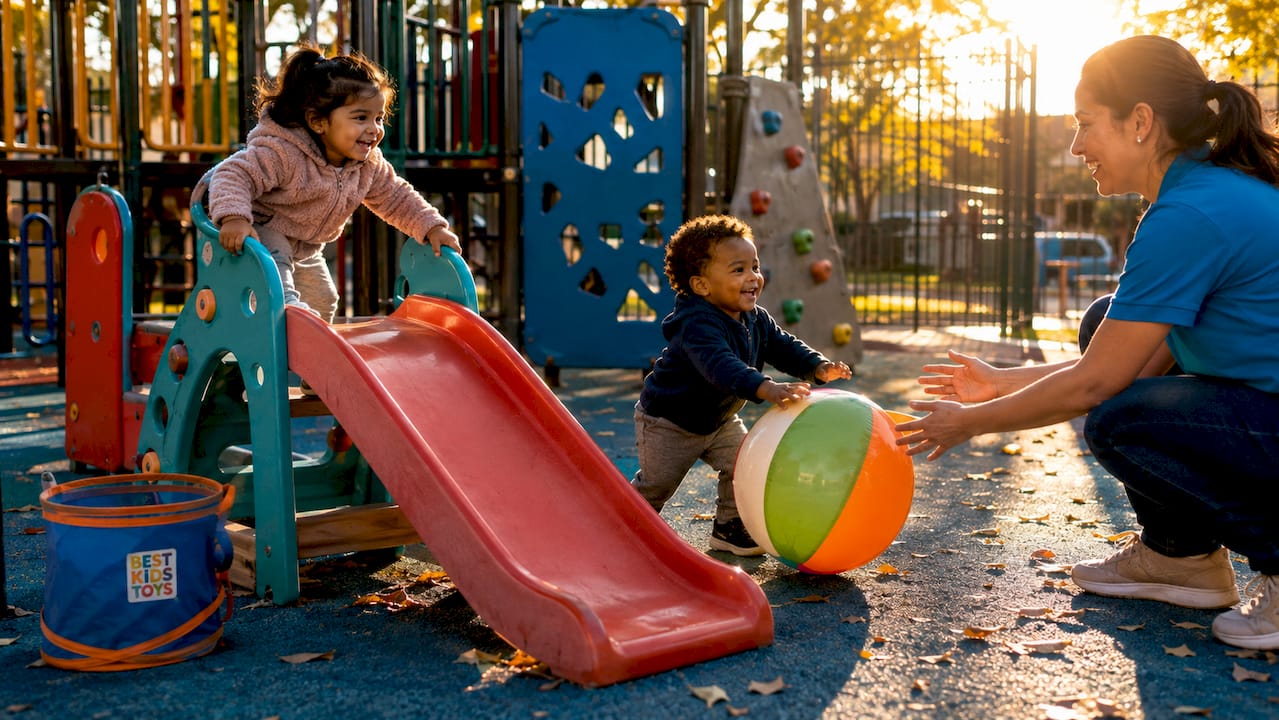
- Directional play: Roll a ball and say “roll it to me” or “put it in.” Targets: prepositions, action verbs.
Example scripts you can use word-for-word:
- “You push the car — say ‘go!’” (pause, wait for any attempt)
- “Put the cow in the barn — ‘in the barn!’” (model the phrase, then repeat together)
- “Uh oh, the block fell! What happened?” (open narrative invite)
Pro Tip: Create a small “mystery gap” on purpose — put one toy piece just out of reach or leave the lid on the play-food container. SLPs call this a communication temptation: it creates a genuine need for the child to request, which is far more powerful than asking them to repeat a word on demand.
Pairing these prompts with storytelling tips for children can extend the activity into narrative sequences, which builds longer utterances and sequencing skills naturally.
What should you check before buying a language toy?
Before any toy earns a place in your child’s play space, check safety and durability first — age labels, choking-risk guidance, and material quality are non-negotiable.
Safety checklist:
- Check the age label on the package; it reflects choking-hazard testing, not just developmental fit.
- Use the toilet-paper-roll test: any piece that fits inside a standard toilet paper roll is a choking risk for children under 3.
- Prefer solid wood or BPA-free, thick plastic over thin, brittle plastic that can splinter.
- Avoid toys with small magnets, button batteries, or long cords for children under 3.
- Look for ASTM F963 certification on the packaging — the U.S. standard for toy safety.
Value guidance: The highest-value language toys are open-ended (usable across multiple stages), target several language skills at once, and store easily. A wooden block set, for example, works from 12 months through age 5 and targets requesting, labeling, spatial vocabulary, and early syntax at different stages.
On technology: apps and interactive electronic toys can supplement language practice, but only with active caregiver involvement. SLPs generally recommend limiting passive screen-based “language toys” and using any tech tool as a conversation starter rather than a solo activity. A tablet app that names animals is far less effective than a wooden farm set where you and your child name animals together.
How were these picks chosen? The SLP-backed criteria
Every toy category recommended here was evaluated against a clear set of criteria drawn from ASHA guidance and SLP practitioner standards. The one-line test: does this toy create a reason for the child and caregiver to communicate?
- Minimal electronic distraction — ASHA’s holiday guidance notes that battery-operated toys frequently override a child’s vocalizations, reducing communicative practice.
Adapting for children with language delays: Start with simpler models of the same toy categories. For a child working on first words, a farm set with just three animals is less overwhelming than one with twenty pieces. Use the expectant pause and sabotage prompts above consistently. Teach Me To Talk organizes its entire toy list by developmental language range for exactly this reason — a child’s communication level, not their age, drives the choice.
For multilingual homes, the same toy categories work across languages; simply use the toy to model vocabulary in whichever language you’re targeting in that play session.
Key Takeaways
The most effective speech development toys are open-ended, caregiver-led, and matched to a child’s current communication stage — not their age on the calendar.
| Point | Details |
|---|---|
| Match toy to language stage | Choose by communication level, not chronological age; a farm set works from pre-verbal through two-word combos. |
| Open-ended beats electronic | Toys that “do nothing” force the child to vocalize, request, and label — the core of communicative practice. |
| Use the 10 prompts consistently | Expectant pauses, sabotage, and expansion recasts reliably increase language opportunities during any play session. |
| Safety check every purchase | Apply the toilet-paper-roll test for choking hazards and look for ASTM F963 certification on the packaging. |
| Thebestkidstoys for curated picks | Thebestkidstoys offers Montessori-inspired, open-ended toy categories — blocks, pretend play, and figure sets — vetted for language-stage fit and safety. |
Why open-ended toys are the heart of language learning
There’s a tendency in the toy market to equate “educational” with “electronic” — the more buttons, the more learning, the thinking goes. After spending time with the research behind speech-language pathology and Montessori-inspired play, that equation looks exactly backwards.
The toys that generate the most language aren’t the ones that talk. They’re the ones that make the child talk. A wooden block set sitting quietly on the floor creates a communication vacuum that a child and caregiver rush to fill with words, questions, and negotiation. A toy that sings, lights up, and narrates its own play fills that vacuum itself — and the child goes quiet.
What I find most compelling about the SLP-informed approach is how democratic it is. You don’t need expensive equipment. Empty boxes, pots, and junk mail consistently appear in ASHA guidance as effective language tools because they’re open-ended and familiar. The Montessori principle at work here is simple: give a child something real and interesting, step back just enough, and language follows naturally.
For families navigating limited budgets or multilingual homes, this is genuinely good news. The same wooden farm set works in English, Spanish, or any language you bring to it. The toy doesn’t set the language — you do.
Thebestkidstoys makes finding the right toy simple
Finding durable, Montessori-inspired toys that genuinely support communication growth shouldn’t require a research degree. Thebestkidstoys does the vetting for you, curating open-ended blocks, pretend-play sets, and figure collections that SLPs and Montessori educators recognize as the gold standard for early language practice.
Browse the infant development toy collection for stage-matched picks from birth through 12 months, or explore the full open-ended toy range for toddlers and preschoolers. Orders over $60 ship free, and the current 40% off sale makes it a great time to stock up on the block sets, play food, and figure sets your child’s speech practice actually needs. Pick one toy from your child’s interest area, try three of the prompts above this week, and watch the conversation begin.
Useful sources and further reading
- ASHA: Holiday Gifts That Help Build Speech and Language Skills in Young Children — ASHA members’ recommended toy categories and the rationale for open-ended, non-electronic choices.
- Associates in Pediatric Therapy: Toys That Promote Speech & Language Development — Practitioner-curated list favoring movement-rich, non-electronic toys with activity suggestions.
- Teach Me To Talk: Ultimate Toy List for Speech Therapy for Toddlers with Language Delays — Developmental-range toy list with activity prompts, organized by communication level rather than age.
- SpeechieTrish: Top 10 Recommended Toys for Speech and Language Development — Therapy-focused toy list with guidance on targeting nouns, verbs, prepositions, and pronouns.
- My Toddler Talks: Toys to Encourage Speech Development in Toddlers — Practical toy categories and play activities supporting vocabulary, sequencing, and social communication.