



Hand-Eye Coordination Toys for 7 Year Olds That Work
The best hand-eye coordination toys for 7 year olds, at a glance
Choosing the right hand-eye coordination toys for 7 year olds doesn’t have to feel like a guessing game. The most effective options combine visual tracking with precise physical movement, giving your child’s brain and hands something genuinely challenging to work through together. Here are the toy categories that consistently deliver real developmental results:
- Building blocks and construction sets: Aligning and connecting pieces trains spatial awareness and precision grip simultaneously.
- Puzzles: Fitting shapes into matching spaces builds visual discrimination and fine motor control.
- Lacing and threading beads: Guiding a lace through a small hole is one of the purest forms of fine motor skill practice available, strengthening the visual-motor connection foundational for writing.
- Throwing and catching games: Tracking a moving ball and timing a physical response develops gross motor hand-eye coordination through reaction speed and aim.
- Marble runs: Assembling tracks and watching marbles navigate them requires precise alignment and rewards careful hand placement.
- Magnetic fishing games: Hooking a moving target with a magnetic rod sharpens aim, patience, and wrist control.
- Peg boards: Placing pegs into small holes builds pincer grip strength and spatial planning.
- Ring toss: Aiming and releasing a ring onto a post demands timing and trajectory judgment.
- Bowling sets: Aiming a ball at a target from a distance combines gross motor power with directional precision.
- Shape sorters: Rotating and fitting shapes into the correct slot reinforces visual matching and controlled hand movement.
Each of these toy types asks your child to look, plan, and move with intention. That combination is exactly what builds lasting coordination skills.
Table of Contents
- Why hand-eye coordination matters so much at age 7
- What types of toys actually develop these skills?
- How to use these toys so they actually make a difference
- Choosing quality educational toys: insights from Thebestkidstoys
- Key Takeaways
- Thebestkidstoys brings the best of Montessori play to your home
Why hand-eye coordination matters so much at age 7
At seven, children are at a pivotal developmental window. Visual-motor integration — the brain’s ability to coordinate what the eyes see with what the hands do — is maturing rapidly, making this an ideal time to strengthen it through play.
This skill underpins far more than catching a ball. Consider everything a seven-year-old does in a single school day: forming letters, cutting along a line, using scissors, copying from a board. Every one of those tasks relies on the same neural pathway that a ring toss or marble run is quietly training.
Key reasons this age matters for coordination development:
- Handwriting readiness: Precise hand movements guided by visual feedback are the mechanical foundation of legible writing.
- Sports participation: Team sports and playground games become more complex at this age, requiring faster tracking and reaction.
- Tool use: Using scissors, rulers, and pencils with control depends on the same visual-motor circuits that toys engage.
- Cognitive confidence: Children who move with precision tend to approach new physical challenges with less hesitation, which carries over into learning.
- Bilateral coordination: Many coordination activities train both hands to work together, a skill linked to reading fluency and overall brain development.
Therapists highlight skill-based play as the key driver here. The goal isn’t to find a toy labeled “coordination toy” — it’s to find play that genuinely requires your child to manipulate objects with visual guidance.
What types of toys actually develop these skills?
Not all toys are created equal when it comes to motor development. Open-ended building toys consistently outperform rigidly “educational” ones for children ages 5 to 8, because they require real problem-solving rather than scripted interaction. Below is a practical breakdown of the most effective categories for seven-year-olds.
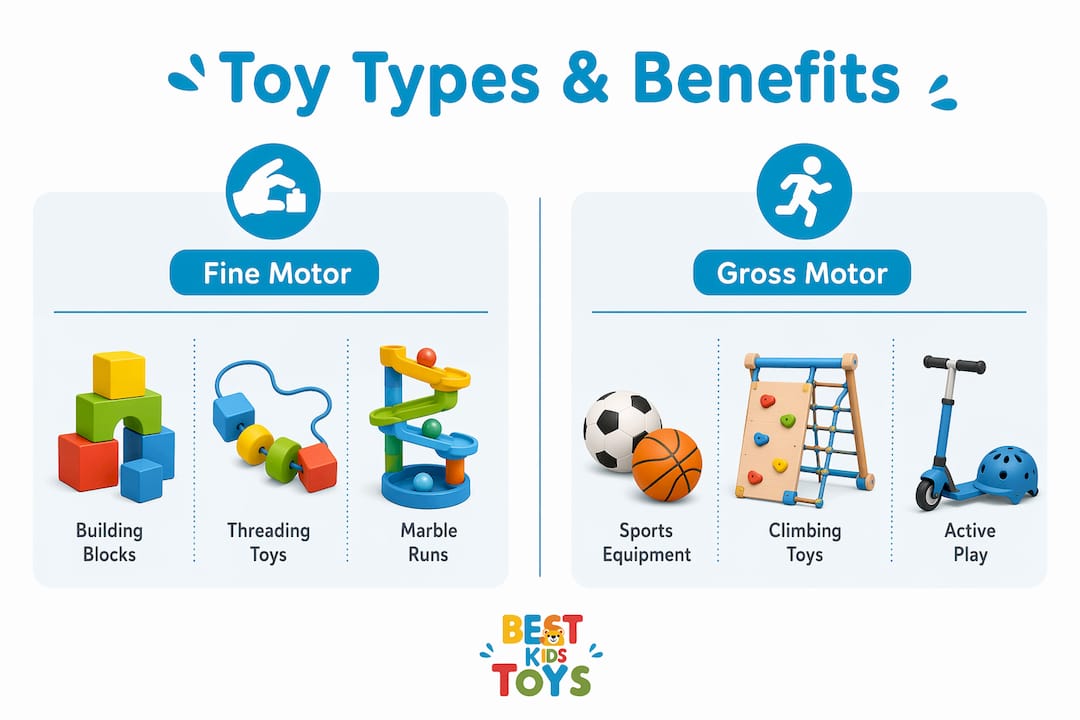
| Toy Type | Motor Focus | Fine vs. Gross | Key Developmental Benefit |
|---|---|---|---|
| Building blocks / construction sets | Grip, alignment, spatial planning | Fine | Precision, problem-solving, creativity |
| Throwing and catching games | Aim, timing, reaction | Gross | Visual tracking, bilateral coordination |
| Lacing and threading toys | Pincer grip, wrist control | Fine | Writing readiness, focus, patience |
| Marble runs | Alignment, sequencing | Fine/Gross | Spatial reasoning, cause-and-effect |
| Ring toss / bowling sets | Aim, release timing | Gross | Trajectory judgment, body control |
| Magnetic fishing games | Wrist control, aim | Fine | Patience, precision, sustained attention |
| Peg boards | Pincer grip, spatial planning | Fine | Grip strength, visual-motor accuracy |
Active sports equipment like T-ball sets and basketball hoops targets gross motor coordination by demanding that children track moving objects and time their physical responses. These are especially valuable for kids who learn best through movement.
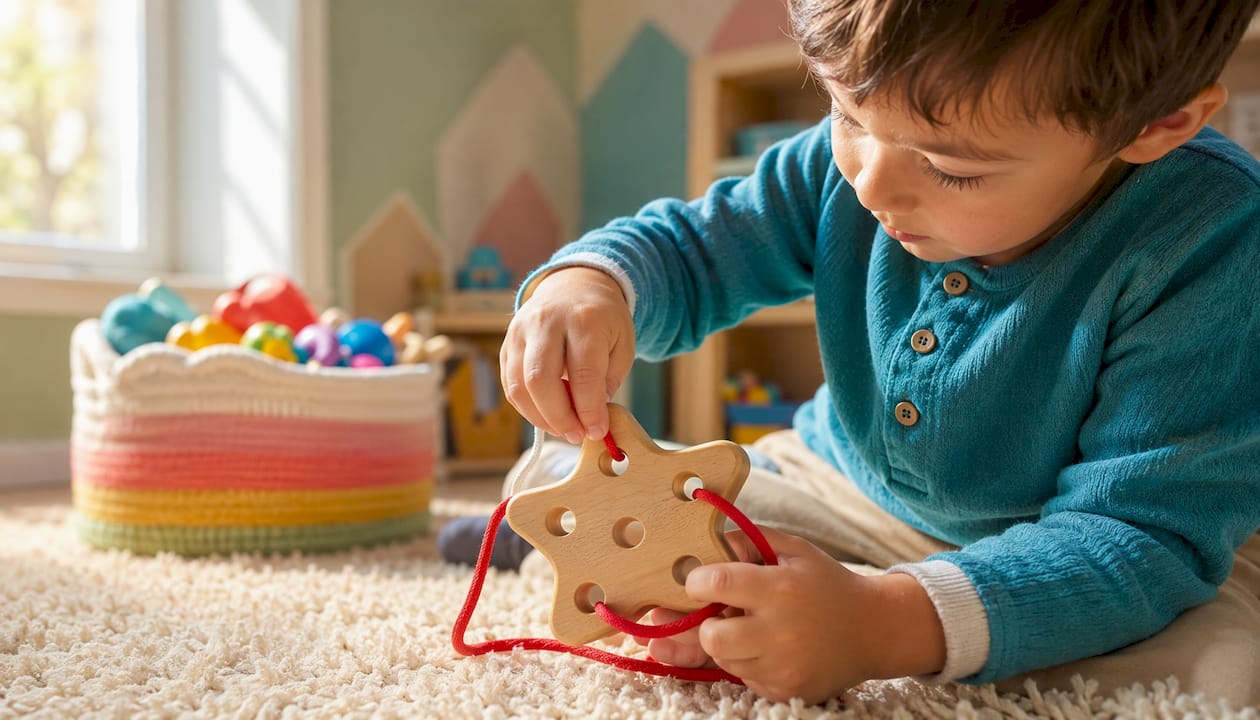
Threading and lacing toys sit at the other end of the spectrum. They require slow, deliberate visual guidance and build the kind of focused dexterity that translates directly to classroom tasks. For a seven-year-old who struggles with pencil grip or letter formation, a lacing bead set is one of the most targeted interventions you can offer through play.
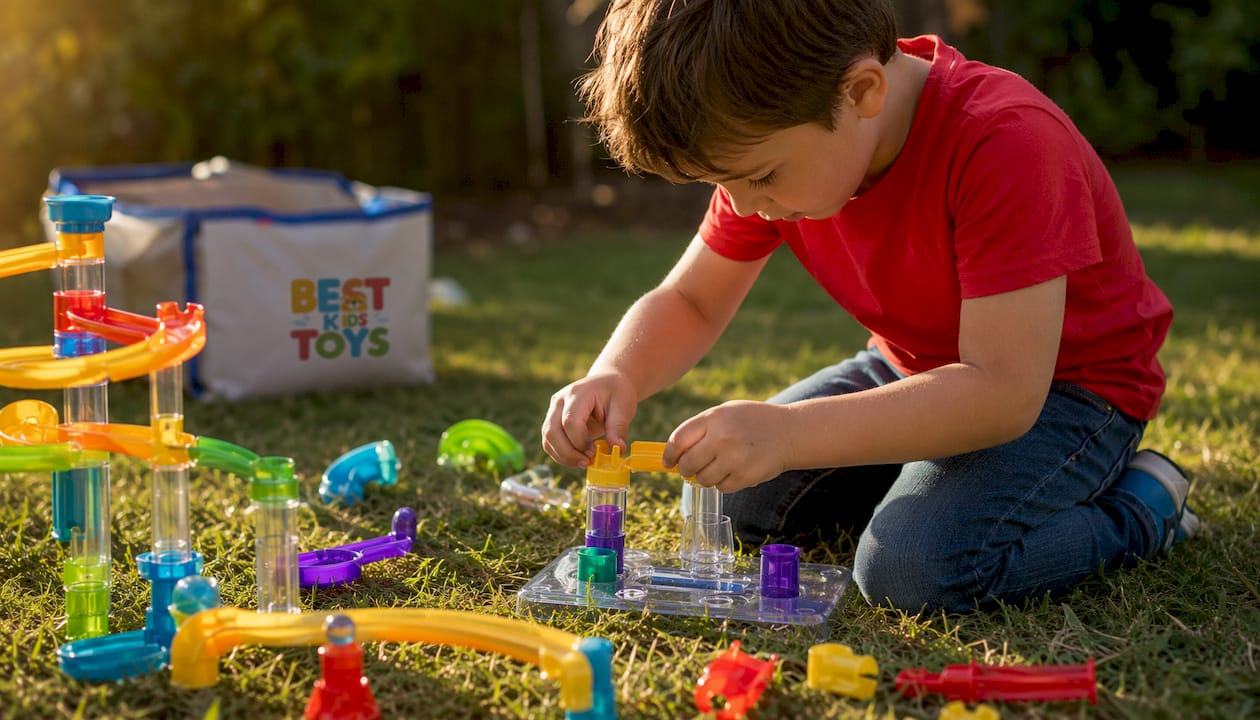
Marble runs occupy a satisfying middle ground. Assembling the track is a fine motor challenge; watching and adjusting the path is a spatial reasoning exercise. The gear-based versions of this concept, where children align interlocking gears to create moving systems, add an extra layer of visual-motor calibration that makes them particularly effective for this age group.
Pro Tip: Rotate toy types across the week rather than offering the same one daily. Alternating between a gross motor option like ring toss and a fine motor option like threading beads gives your child a fuller coordination workout and keeps play feeling fresh.
How to use these toys so they actually make a difference
Owning the right toy is only half the equation. How you integrate it into your child’s day shapes how much developmental benefit they actually get.
- Build consistency into the routine. Even 15 minutes of focused coordination play each day compounds meaningfully over weeks. Morning play before school or a post-homework wind-down session both work well.
- Increase difficulty gradually. Start with a larger target in ring toss, then move the throwing line back. Use fewer beads in a threading activity, then add more complex patterns. Consistent, structured playtime with progressive challenge maximizes skill acquisition.
- Mix active and fine motor play. A session that starts with a throwing game and ends with a puzzle gives the brain two different coordination challenges in one sitting, which is more effective than repeating the same activity.
- Use guided play, not directed play. Sit nearby, ask curious questions (“Where do you think that piece goes?”), and celebrate effort over outcome. Positive reinforcement during play keeps motivation high without creating performance pressure.
- Pair indoor and outdoor options. Outdoor active play with balls, targets, and movement-based games complements the precision work of indoor fine motor toys beautifully.
Pro Tip: Watch how your child adjusts their grip or repositions their body when a task gets tricky. That self-correction behavior is a clear sign that visual-motor calibration is happening. It’s one of the most reliable indicators that a toy is genuinely developing coordination rather than just keeping them busy.
Choosing quality educational toys: insights from Thebestkidstoys
The toy market is crowded, and the word “educational” on a box rarely means much. Many so-called educational toys are primarily marketing tools. The genuinely developmental ones share specific characteristics that are worth knowing before you buy.
Thebestkidstoys approaches toy selection through a Montessori-informed lens, reviewing each product for long-term skill-building value rather than novelty appeal. The criteria that matter most:
- Developmental appropriateness: A toy that’s too easy offers no challenge; one that’s too hard creates frustration. The sweet spot for a seven-year-old is a toy that requires effort but rewards persistence.
- Open-ended play value: Toys with no single “correct” way to play encourage experimentation and creativity. Open-ended building sets and games that allow experimenting without rigid rules deliver better developmental benefits than single-use toys.
- Durability and safety: Materials should withstand enthusiastic daily play. Look for non-toxic finishes, smooth edges, and pieces sized appropriately to avoid choking hazards.
- Fine and gross motor balance: The best collections include both precision-focused toys and movement-based options, so development happens across the full coordination spectrum.
- Screen-free engagement: Toys that demand physical interaction rather than passive watching build the neural pathways that screens simply cannot.
Choosing a toy isn’t about finding the one with the most impressive label. It’s about asking whether this toy will make my child look, think, and move with intention. When those three things happen together, real development follows.
The interactive play that Montessori-inspired toys encourage isn’t just more fun. It’s more effective. Children who engage with open-ended, hands-on materials build stronger problem-solving habits and more confident motor skills than those whose play is scripted by a toy’s single function.
For families exploring outdoor coordination challenges alongside indoor fine motor work, resources like climbing and active play guides can offer creative ideas for extending coordination development beyond the playroom.
Key Takeaways
The most effective hand-eye coordination toys for 7 year olds combine visual tracking with precise physical movement, building both fine and gross motor skills through consistent, progressively challenging play.
| Point | Details |
|---|---|
| Age 7 is a critical window | Visual-motor integration matures rapidly at this age, making targeted play especially impactful for school readiness. |
| Mix fine and gross motor toys | Alternating between lacing beads and throwing games gives children a fuller coordination workout than repeating one type. |
| Open-ended toys outperform labeled ones | Research finds open-ended building toys deliver stronger physical and cognitive growth for ages 5 to 8 than rigidly “educational” options. |
| Consistency matters more than duration | Even 15 minutes of daily structured coordination play compounds into meaningful skill gains over weeks. |
| Thebestkidstoys curates Montessori-inspired options | Each product is reviewed for developmental appropriateness, durability, and open-ended play value to support real skill-building. |
Thebestkidstoys brings the best of Montessori play to your home
If you’ve spent time comparing toy options online, you already know how quickly the choices pile up. Thebestkidstoys cuts through that by doing the curation work for you, selecting only Montessori-inspired toys that genuinely develop coordination, creativity, and independent thinking in children.
The Little Learners Montessori Busy Book is a standout example: it targets fine motor precision and visual-motor connection through hands-on activities designed specifically for developing learners, with no screens and no scripted play. Free shipping on orders over $60 makes stocking up on a few complementary toys easy on the budget. For a broader selection of skill-building options, the toys for kids 5 and up collection covers everything from open-ended building sets to precision games, all reviewed for safety and long-term developmental value. Browse the collection today and find the toys your seven-year-old will actually grow with.