


Halloween's Billion Dollar Turn: 5 Family Friendly Ways to Celebrate
Halloween lands every year on October 31, a night rooted in the ancient Celtic festival of Samhain that later blended with Christian observances into the holiday we recognize today. Modern celebrations center on trick-or-treating, costumes, and jack-o’-lanterns, though the traditions behind each one stretch back centuries and shift depending on where you live.
TL;DR:
- Trick-or-treating standardized across the U.S. in the 1930s and 1940s, fueled by post-World War II sugar consumption and candy industry support.
- Costumes originated as functional disguises tied to spirit warding and social inversion, shifting to licensed character outfits from the 1930s onward.
- Modern Halloween incorporates activities like apple bobbing, haunted attractions, and seasonal foods, all rooted in older harvest and spiritual traditions.
- The fear of tampered candy persists but is largely unfounded, with documented cases extremely rare and grounded in consumer anxiety rather than evidence.
- Halloween’s commercial impact exceeds its origins, with billions spent yearly on costumes, decorations, and themed entertainment across the United States.
Table of Contents
- The History Behind Halloween: From Samhain to Modern America
- How Trick-or-Treating, Costumes, and Jack-O’-Lanterns Took Shape
- Why Ghosts, Witches, and Black Cats Became Halloween Symbols
- Halloween Today: Parties, Haunted Houses, and Big Retail Spending
- Keeping Trick-or-Treating and Decorations Safe
- Simple Ways to Decorate and Host a Halloween Party on a Budget
- Day of the Dead, All Saints’ Day, and Other Fall Observances
- How Halloween Looks Different Around the World
- A Publisher’s Take on Halloween and Family Play
- Halloween Toys and Activities That Support Real Play
- Sources
The History Behind Halloween: From Samhain to Modern America
Halloween didn’t start as a single invention. It grew out of layers of tradition stacked on top of each other over roughly two thousand years, and each layer left a fingerprint you can still spot in tonight’s celebrations.
The earliest layer is Samhain, a Celtic festival marking the close of harvest season and the start of the dark half of the year. Ancient communities believed this seasonal turning point thinned the wall between the living and the dead, so people lit bonfires and wore disguises to ward off wandering spirits, according to a summary of Celtic festival practices from Brown University’s Joukowsky Institute. That single belief, that one night a year the boundary gets a little porous, is the seed everything else grew from.
Centuries later, the Christian church layered its own calendar on top of the Celtic one. November 1 became All Saints’ Day (also called All Hallows’ Day), and November 2 became All Souls’ Day, a time for honoring the dead through prayer and remembrance. The night before All Hallows’ Day was called All Hallows’ Eve. Say that phrase fast enough, often enough, for long enough, and it contracts into “Halloween,” a linguistic shortcut that stuck permanently, as detailed in Wikipedia’s overview of the holiday’s etymology.
Medieval customs filled in the gap between those two calendars. “Souling” had poor parishioners going door to door on All Souls’ Day asking for soul cakes in exchange for prayers for the dead. “Mumming” and “guising” involved performers or children dressing in costume and putting on a small show or reciting a verse for food or coins. Neither practice looked exactly like trick-or-treating, but you can see the shape of it forming: disguise plus door-to-door exchange plus a bit of performance for reward.
The holiday crossed the Atlantic with Irish and Scottish immigrants in the 19th century, but it didn’t become the child-centered event we know today right away. Early Halloween in American towns leaned heavily toward pranks and vandalism, with young men flipping outhouses and blocking roads. Civic leaders eventually pushed back, organizing town-wide parties, parades, and trick-or-treat routes specifically to redirect that mischief into something communities could enjoy together, a shift that HISTORY’s overview of Halloween’s traditions traces to the early 20th century. That deliberate civic effort worked. By the mid 1900s, Halloween had rebranded itself as a family holiday, and trick-or-treating as we know it became standard practice.
A few markers worth keeping straight:
- Samhain established the seasonal, spiritual framework: a harvest’s end and a night when spirits supposedly moved freely.
- All Hallows’ Eve gave the holiday its name and tied it to a Christian calendar of remembrance.
- Souling and mumming supplied the door-to-door, costume-for-treats mechanic.
- Early 20th-century civic campaigns transformed a night of pranks into an organized, family-friendly tradition.
What’s striking is how much of Halloween’s identity comes from problem-solving rather than pure celebration. Communities didn’t design trick-or-treating because it sounded fun in the abstract. They needed an alternative to property damage, and costumed candy collection turned out to be a good one.
How Trick-or-Treating, Costumes, and Jack-O’-Lanterns Took Shape
Trick-or-treating as a structured, neighborhood-wide activity is younger than most people assume. While its roots trace to souling and guising, the door-to-door candy exchange didn’t standardize across the United States until the 1930s and 1940s, gaining even more traction once sugar rationing ended after World War II. Once it caught on, it spread fast, partly because it gave kids a low-cost, low-supervision way to participate in a community event, and partly because candy companies were happy to help fuel the tradition.
Costumes tell a more layered story. Early disguises weren’t about looking cute or clever. They were functional: a way to blend in with the spirits believed to be wandering during that liminal night, or a way for the poor to move through a town anonymously while asking for food. Costumes also served as a form of social inversion. For one night, a farmhand could dress as a lord, or a child could dress as a monster, and nobody batted an eye. That inversion element is part of why Halloween costumes have always trended toward the fantastical and the taboo rather than the mundane.
Commercial costumes changed the game in the 1930s, when companies began mass-producing character outfits tied to comic strips and, later, movies and television. That shift moved costume-making from a home craft to a retail purchase, a pattern that only intensified as licensed characters from film and TV took over costume aisles.
Jack-o’-lanterns followed their own strange path. The original version wasn’t a pumpkin. Irish and Scottish folklore told of “Stingy Jack,” a trickster doomed to wander the earth with only a burning coal inside a hollowed turnip to light his way. Immigrants carried that turnip-carving tradition to North America, then discovered pumpkins: bigger, softer, and far easier to carve. The swap happened quickly once people realized how much less effort a pumpkin required.
Halloween’s activity list has grown well beyond candy and carving. Common additions include:
- Bobbing for apples, a party game with roots in older harvest festivals and courtship rituals.
- Costume contests, which formalize the social-inversion fun of dressing as someone or something else.
- Haunted hayrides and corn mazes, popular at farms and community events during the fall season.
- Seasonal foods like caramel apples, candy corn, roasted pumpkin seeds, and spiced cider, most of which trace back to harvest-time ingredients rather than Halloween specifically.
- Pumpkin carving parties, where families or friends turn the solo craft into a group activity.
Every one of these activities shares a common thread: they take an old agricultural or spiritual practice and repackage it as shared, sociable fun.
Why Ghosts, Witches, and Black Cats Became Halloween Symbols
Ghost stories cluster around Halloween for a reason that traces directly back to Samhain: a night believed to blur the line between the living and dead naturally produces imagery of spirits crossing over. That belief didn’t disappear when the calendar changed. It just got reframed as folklore and, eventually, as costume inspiration.
Witches carry a heavier history. Accusations of witchcraft in early modern Europe and colonial America often targeted women who lived alone, practiced folk medicine, or simply didn’t fit neatly into their communities. Over time, the witch became a stock Halloween character, softened from a symbol of real persecution into a costume archetype with a pointed hat and a broom. Black cats picked up their spooky reputation from the same era, when superstition linked them to witches and bad luck, an association that still shows up in shelters reporting slower adoption rates for black cats every October.
Urban legends add another layer, and the most persistent one is the fear of tainted Halloween candy. That fear has circulated for decades, fueled by a handful of high-profile scares. But reporting on the topic consistently finds little evidence of strangers randomly poisoning trick-or-treaters, a point National Geographic’s history of Halloween makes clear when tracing where the myth actually came from. The scare says more about anxiety around strangers and children than it does about any documented pattern of harm.
Symbols shift meaning depending on where and when you encounter them. A jack-o’-lantern in Ireland once warded off wandering spirits. In an American suburb, it’s more likely a front-porch decoration photographed for social media. The imagery survives; the intent behind it keeps changing.
Halloween Today: Parties, Haunted Houses, and Big Retail Spending
Halloween has grown into one of the more commercially significant holidays on the American calendar, and the numbers back that up. Retail surveys tracked by Statista’s annual Halloween expenditure data show Americans collectively spend billions of dollars each year on costumes, decorations, and candy. That spending pattern says something about how far the holiday has traveled from its origins as a quiet, spiritual harvest observance.
Halloween has grown from a one-night door-to-door tradition into a full seasonal industry, spanning haunted attractions, themed entertainment, and weeks of retail promotion. Haunted attractions in particular have expanded from small neighborhood setups into professional, ticketed experiences. Entire farms now build corn mazes and haunted trails as a primary autumn revenue stream, and standalone haunted houses run seasonal operations that rival small theme parks.
Film and television have also reshaped what Halloween looks like on the ground. A costume trend can shift overnight based on whatever character just dominated the box office or streaming charts, and decor aesthetics borrow heavily from horror movie tropes, from fog machines to animatronic props styled after classic monster movies.
Retail spending breaks down into a few recognizable categories worth understanding:
- Costumes remain the single biggest spending category, driven by both adult and children’s outfits.
- Decorations have grown from simple pumpkins to elaborate yard displays, some rivaling holiday light shows in scale.
- Candy stays a steady, high-volume purchase, with bulk buying common for households that expect large trick-or-treat turnout.
- Greeting cards and party supplies round out a smaller but consistent slice of the market.
Decor trends have split into two camps. One favors big, inflatable, store-bought pieces that go up and come down in a weekend. The other leans DIY, using thrifted items, repurposed household objects, and handmade touches, a budget-conscious approach that AARP’s guide to affordable Halloween decorations points out has stayed popular even as retail displays get more elaborate.
Keeping Trick-or-Treating and Decorations Safe
Good Halloween safety comes down to visibility, planning, and a little skepticism toward myths that outlive their evidence.
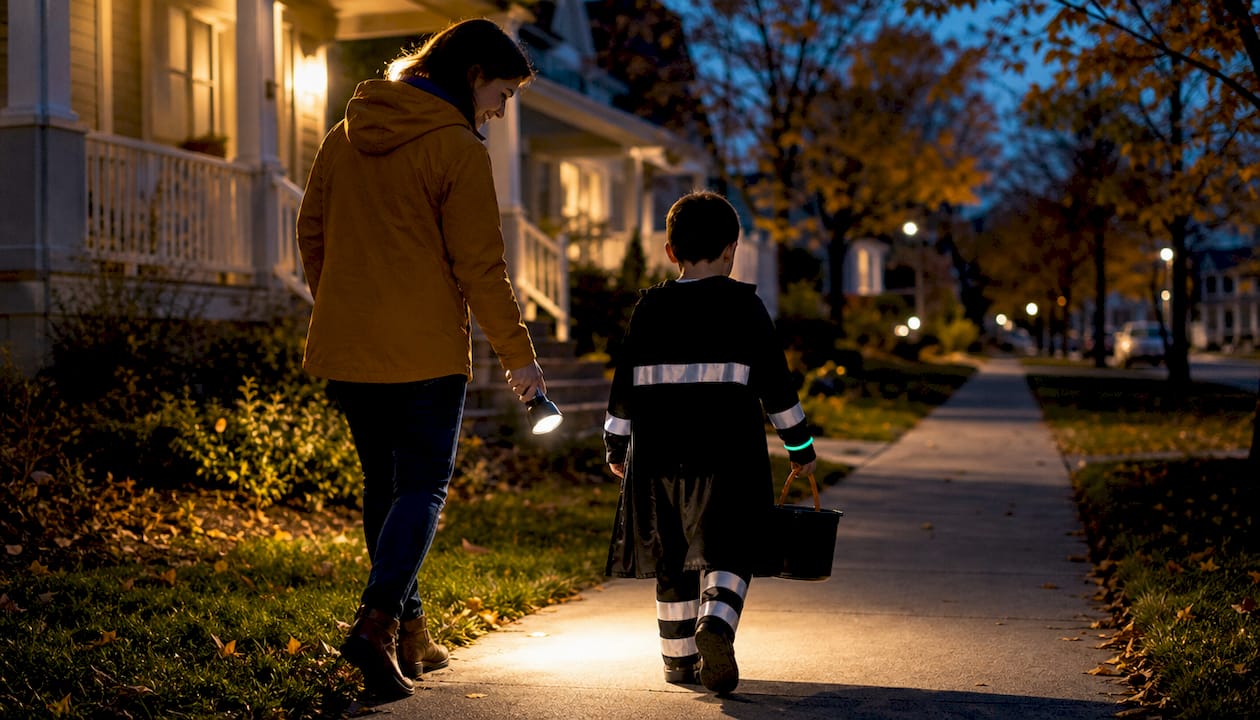
Visibility matters more than most families think about in advance. Dark costumes on a dark street are a real hazard, so adding reflective tape, a flashlight, or a glow stick to a costume makes a trick-or-treater far easier for drivers to spot. Planning a route in advance, sticking to well-lit streets, and keeping younger kids within arm’s reach cuts down on the two most common Halloween-night mishaps: getting lost and getting hurt crossing a street.
The tainted-candy fear deserves a clear-eyed response rather than blanket suspicion of every neighbor’s bowl. As covered above, documented cases of strangers deliberately poisoning candy are exceedingly rare, and most scares trace back to isolated incidents rather than any widespread pattern. A quick visual check of wrappers for tampering is a reasonable precaution. Treating every unfamiliar house as a threat is not.
Decorations and haunted houses carry their own risks, especially once candles, fog machines, and extra extension cords enter the picture. Standard home-safety guidance calls for avoiding open flames near costumes or paper decorations, keeping walkways clear of trip hazards like cords and props, distributing electrical loads across circuits instead of overloading one outlet, and marking exits clearly in any haunted house or maze setup, according to This Old House’s safety recommendations for DIY haunted houses.
One more courtesy worth building into any Halloween plan: allergy awareness. Offering a few non-food treats, like stickers or small toys, alongside candy gives kids with food allergies a way to participate fully instead of watching from the sidelines.
Simple Ways to Decorate and Host a Halloween Party on a Budget
Lighting does more for a Halloween display than almost anything else you can buy. Warm string lights inside a carved pumpkin, string lights inside a mason jar, or a strategically placed spotlight aimed up at a tree can transform a plain porch into something genuinely eerie, and design writers consistently point to lighting as the single highest-impact, lowest-cost decor choice available, an idea echoed in Chris Loves Julia’s guide to classic, spooky Halloween decor.
Pro Tip: Skip the giant inflatable skeleton and put that same budget into a dimmer switch or a few flickering LED candles instead. A room lit in warm amber light with shifting shadows reads as far more sophisticated than a yard full of plastic props, and it costs less.
Budget decorating rewards patience over impulse purchases. A few approaches worth trying:
- Raid thrift stores for old picture frames, vintage books, and glass jars, then group them together for a display that looks curated rather than store-bought.
- Save glass bottles year-round and turn them into apothecary-style decor with black paint and homemade labels.
- Use branches, dried leaves, and gourds from your own yard as a natural centerpiece instead of buying artificial foliage.
- Print free vintage Halloween images and frame them for an instant gallery wall.
Design writers who study seasonal decor tend to agree on one point: a handful of well-chosen, higher-quality pieces, like real candles, a couple of vintage books, or textured fabric, creates a more lasting and stylish display than a pile of cheap plastic items bought fresh every year.
Party formats for kids work best when they’re built around active, hands-on play rather than passive entertainment. A costume parade lets every child show off their outfit without the pressure of a formal contest. A simple scavenger hunt through the yard or house, with clues tied to Halloween trivia, keeps kids moving and thinking rather than staring at a screen. Pumpkin decorating with paint instead of carving knives gives younger children a safe way to join the tradition. Classic games like musical chairs or a simple relay race, dressed up with a Halloween theme, round out an afternoon without requiring elaborate setup.
If you want your decorating effort to stretch further than one night, lean into pieces that work for the whole autumn season rather than Halloween specifically. Pumpkins, gourds, dried corn stalks, and warm-toned string lights all read as “fall” rather than strictly “spooky,” which means your porch doesn’t have to go bare again on November 1.
Day of the Dead, All Saints’ Day, and Other Fall Observances
Halloween isn’t the only holiday built around the end of harvest and the memory of the dead, and it helps to know where it fits among its neighbors.
Día de los Muertos, or Day of the Dead, is a distinct Mexican observance held November 1 and 2 that centers on remembering and celebrating deceased loved ones through altars, marigolds, and family gatherings, rather than costumes or candy collection. Despite falling right after Halloween and sharing some visual overlap in skull imagery, the two holidays come from separate cultural traditions with different intentions: one is largely playful and communal, the other is reflective and ancestor-focused.
All Saints’ Day and All Souls’ Day, observed November 1 and 2 in the Christian calendar, remain active religious observances in many communities, marked by church services, visits to cemeteries, and prayers for the dead. These are the same observances that gave Halloween its name centuries ago, and in many parts of Europe they’re still treated as solemn occasions rather than festive ones.
Regional Celtic communities, particularly in parts of Ireland and Scotland, still hold events that consciously echo Samhain’s bonfire and harvest traditions, treating the night as a seasonal marker as much as a costume holiday. The common thread across all of these observances is the same one Samhain established thousands of years ago: late autumn as a time to acknowledge mortality, memory, and the turning of the year.
How Halloween Looks Different Around the World
American-style trick-or-treating has spread internationally, but plenty of countries keep their own distinct spin on the season. In the United Kingdom, Halloween coexists with Guy Fawkes Night on November 5, and older traditions like “punkie night” carving in some English villages predate the American pumpkin trend entirely. Ireland and Scotland, Halloween’s ancestral home, still hold onto older customs like bonfires and games such as apple bobbing, treated as heritage rather than imported novelty.
Germany largely skips trick-or-treating in favor of costume parties among adults, and some households put away sharp knives on Halloween night out of an older superstition about returning spirits. In Japan, Halloween has become a massive costume-and-street-party event, especially in Tokyo’s Shibuya district, with far less emphasis on children’s candy collection and far more on elaborate adult cosplay. Italy blends Halloween with local All Souls’ traditions, where families visit cemeteries around the same period, layering a newer, imported holiday on top of an older religious one.
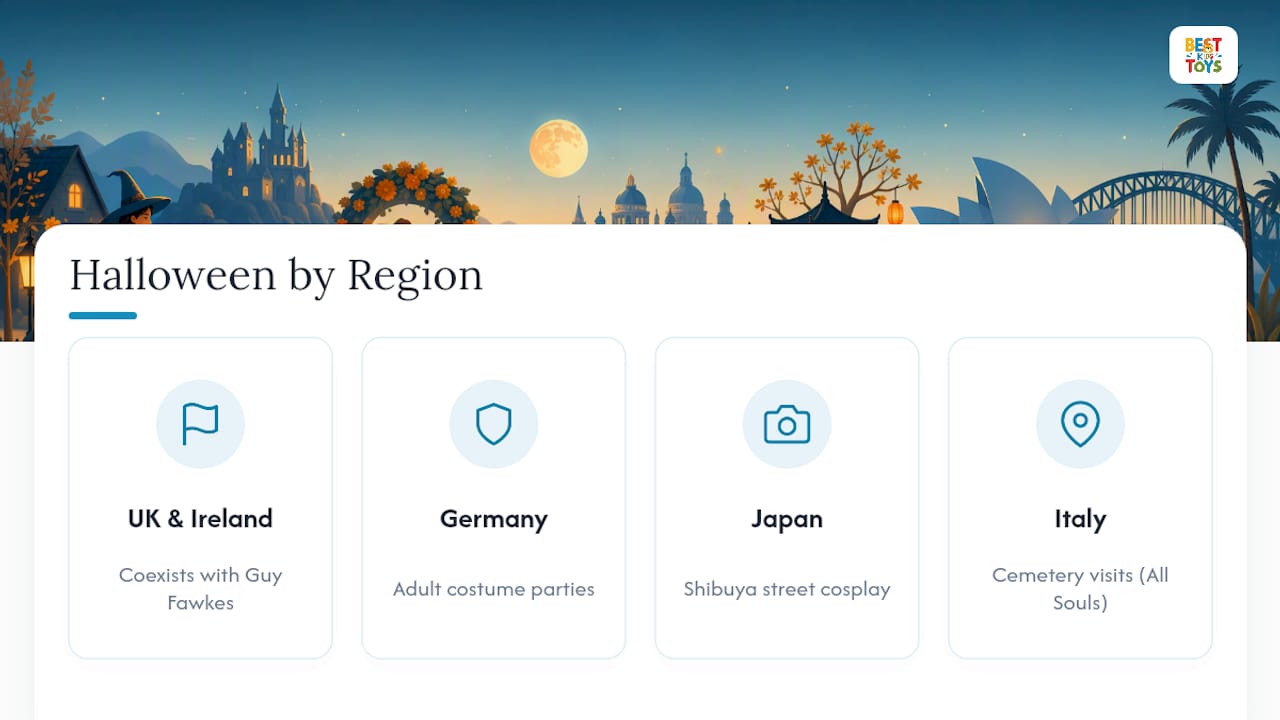
These variations make one thing clear: Halloween isn’t a fixed script. It’s a flexible cultural framework that different communities fill in with whatever local traditions already fit the season, whether that’s Celtic bonfires, adult costume parties, or a quiet cemetery visit.
A Publisher’s Take on Halloween and Family Play
Halloween gives families something increasingly rare: a whole night built around imaginative, physical, screen-free play. Costumes ask kids to become someone else for a few hours. Pumpkin carving and decorating hand them real tools and real creative decisions. Even a simple neighborhood walk with a flashlight and a candy bag is, at its core, an exercise in independence and problem-solving.
We think about Halloween the same way we think about toys: through the lens of what actually helps a child grow. Montessori-inspired play values hands-on exploration and independent decision-making, and Halloween, stripped of the sugar and spectacle, is full of those same opportunities. A costume built from open-ended dress-up pieces does more for a child’s imagination than one pulled straight off a store shelf.
— Danica Hodge
Halloween Toys and Activities That Support Real Play
If you’re looking to round out your family’s Halloween season with pieces that outlast the holiday, a few categories are worth a look. Open-ended dress-up sets let kids build their own costume concept instead of stepping into a single licensed character, which keeps the creative decisions in their hands rather than a costume designer’s. Activity kits centered on sorting, building, or pretend play give kids something to do at a Halloween party beyond staring at a screen while waiting for candy sorting time. Sturdy, well-made trick-or-treat bags and baskets hold up for years instead of ripping halfway through the block.

This catalog is built around screen-free, developmentally sound play, which makes Halloween an easy season to lean into rather than a one-off costume scramble. Every toy is reviewed for safety and durability first, so a dress-up piece bought for October 31 can just as easily become a favorite for pretend play in March. Browse the 10 Best Halloween Toys for Kids in 2026 for costume-friendly picks, or check out Montessori toys that double as costume pieces if you’d rather build an outfit from open-ended play items than buy a single-use character suit. For a broader look at Montessori life-skills toys that support the same independent, hands-on play Halloween encourages, that collection is a solid place to start shopping today.
Sources
- Halloween: Origins, Movies & Traditions — HISTORY
- Halloween — Wikipedia
- Joukowsky Institute / Brown University summary of Samhain and Celtic festivals
- Annual Halloween expenditure in the United States — Statista