



The Best Gender Neutral Toys for Inclusive, Educational Play
Gender neutral toys are the right call. They let children follow curiosity instead of a color-coded label, and the developmental payoff is real: stronger problem-solving, broader creativity, and the confidence to try anything. Whether you’re shopping for a newborn, a curious five-year-old, or a gift recipient you’ve never met, the categories below give you a fast, clear path to the best picks.
Best toy types to consider right now:
- Open-ended building sets (wooden blocks, magnetic tiles, loose parts)
- STEM kits (beginner science, coding puzzles, math manipulatives)
- Sensory toys (tactile boards, water play, sand and kinetic sets)
- Pretend-play sets (kitchen, tool bench, doctor kit, farm animals)
- Dolls and figures that invite role play and storytelling
- Outdoor and movement toys (balance boards, sand tools, nature exploration kits)
Browse Thebestkidstoys’ open-ended Montessori collection to see curated picks across every age band.
Key Takeaways
Gender neutral toys support stronger developmental outcomes because they let children choose play based on genuine interest rather than gender labels.
| Point | Details |
|---|---|
| Choose open-ended designs | Toys with multiple uses outlast single-outcome, gender-coded options and grow with the child. |
| Verify U.S. safety standards | Look for CPSC compliance, ASTM F963, and CPSIA certification on every product before buying. |
| Match toy to developmental stage | Age-appropriate challenge matters as much as gender neutrality; use age bands as your primary filter. |
| Read packaging critically | Green-flag descriptions focus on what the child does; red flags emphasize appearance or gender identity. |
| Shop Thebestkidstoys | The curated collection offers Montessori-inspired, safety-checked picks organized by age and play type. |
Table of Contents
- Why parents choose gender neutral toys for child development
- Best types of gender neutral toys by age group
- How to choose a genuinely gender neutral toy: checklist and red flags
- Thebestkidstoys’ curated gender neutral picks
- Safety, materials, and certifications to check when buying toys in the U.S.
- How to encourage inclusive, non-gendered play at home
- What “gender neutral toys” actually means
- Common misconceptions about gender neutral toys
- How major toy brands and market trends are shaping gender neutral options
- How to read packaging and marketing to spot truly inclusive toys
- The case for open-ended play over gendered toys
- Thebestkidstoys has the gender neutral collection you’re looking for
- Sources
Why parents choose gender neutral toys for child development
The core argument is simple: when a toy isn’t labeled “for girls” or “for boys,” children choose it based on genuine interest. That choice-driven play is where the developmental magic happens. Research and expert reporting confirm that gender-inclusive toys encourage problem-solving through trial and error and build persistence by letting children direct their own play.
Specific benefits parents see include:
- Problem-solving and critical thinking from open-ended construction and STEM challenges
- Spatial reasoning developed through building, stacking, and assembling
- Persistence and a growth mindset when children work through multi-step play without a single “right” answer
- Social confidence from pretend play that isn’t scripted by gender roles
- Early STEAM exposure through science kits, art materials, and coding toys accessible to every child
These benefits align directly with Montessori principles. Montessori-inspired play prioritizes child-led exploration, open-ended materials, and intrinsic motivation — all of which thrive when gender labels are removed from the equation.
Best types of gender neutral toys by age group
Matching a toy to a child’s developmental stage matters as much as choosing an inclusive one. The table below maps age bands to the right toy categories and the skills each one builds.
| Age Band | Recommended Toy Types | Primary Skills | Safety Note |
|---|---|---|---|
| 0–2 years | Soft stacking rings, fabric sensory books, wooden rattles, shape sorters | Fine motor, cause-and-effect, sensory processing | Avoid small parts; all pieces must be larger than 1.75 inches |
| 3–5 years | Wooden building blocks, pretend-play sets, simple puzzles, sensory kits | Language, imaginative play, spatial reasoning | Check for non-toxic finishes; no sharp edges |
| 5–8 years | Magnetic tiles, beginner STEM kits, creative arts sets, open-ended building | Executive function, early STEAM, collaboration | Age-appropriate complexity; verify CPSC compliance |
| 9+ years | Advanced STEM kits, coding puzzles, strategy board games, craft kits | Logical reasoning, persistence, abstract thinking | Standard safety labels apply; no choking concern |
For infants and toddlers, developmental baby toys that grow with the child are the smartest investment. A wooden shape sorter at 12 months becomes a color-sorting game at 18 months and a stacking challenge at 24 months.
Toy types worth knowing by age:
- 0–2: Soft sensory books, wooden rattles, fabric stacking rings, high-contrast mobiles
- 3–5: Unit blocks, farm animal sets, doctor kits, simple bead mazes, water play tools
- 5–8: Magnetic building tiles, beginner robotics, watercolor sets, nature exploration kits
- 9+: Electronics kits, strategy games, weaving looms, advanced coding puzzles
Food52’s curated list of 34 gender-neutral toys is a useful cross-reference for spotting which categories consistently appear across age groups.
How to choose a genuinely gender neutral toy: checklist and red flags
Start with these five criteria before adding anything to your cart:
- Materials: Prefer sustainably sourced wood, BPA-free plastics, and non-toxic paints or stains. Avoid toys with strong chemical smells or unlisted finishes.
- Developmental play value: Does the toy invite multiple uses, or does it have one fixed outcome? Open-ended beats single-outcome every time.
- Packaging language: Is the description about skills and play, or about appearance and gender? “Builds spatial reasoning” is a green flag; “perfect for little princesses” is not.
- Age-appropriate challenge: The toy should stretch the child slightly without frustrating them. Look for age ranges backed by developmental rationale, not just size safety.
- Sustainability and durability: A toy that lasts three years costs less per hour of play than one that breaks in three weeks.
Shopper questions to ask any product page:
- Is this categorized by gender or by age and skill?
- Does the description focus on what the child does with the toy, or on how it looks?
- Are the materials and safety certifications listed clearly?
Marketing red flags that signal a gendered toy in disguise:
- Color-only differentiation (pink version vs. blue version of the same toy)
- Placement in “for girls” or “for boys” store sections with no age-based alternative
- Descriptions that emphasize appearance, nurturing stereotypes, or action-hero themes exclusively
- Accessories marketed separately by gender (e.g., “girl add-on pack”)
Design reporting from DesignWanted shows that the most progressive brands sidestep these traps by using neutral palettes, multifunctional parts, and open-ended use cases — design cues you can spot on any product page.
Pro Tip: Prefer toys described as “open-ended” or “Montessori-inspired” over those with a single play mode. A toy that can be a rocket ship, a bridge, or a city block on different afternoons will hold a child’s attention far longer than one with a scripted outcome.
Thebestkidstoys’ curated gender neutral picks
The picks below are selected for open-ended play, Montessori-inspired design, and developmental clarity. Every item works for any child, regardless of gender.
- Montessori Busy Book (ages 1–3): Builds fine motor skills, color recognition, and early cognitive sorting through hands-on page activities. Durable, portable, and screen-free. Shop the Busy Book.
- Sensory exploration kits (ages 1–5): Tactile boards, water play tools, and kinetic sand sets support sensory development and emotional regulation. Shop sensory toys.
- Beginner STEM kits (ages 5–8): Science experiment sets and coding puzzles introduce logical thinking and early STEAM concepts. See the 5+ educational collection.
- Pretend-play sets (ages 3–5): Kitchen sets, tool benches, and animal figures let children write their own stories. Shop ages 3–4 and ages 4–5 collections.
Sustainably made wooden toys, like those using rubberwood and non-toxic finishes, are a strong default for any age band. They’re durable, safe, and visually neutral.
Safety, materials, and certifications to check when buying toys in the U.S.
U.S. toy safety is governed by three overlapping standards. Check for all three before purchasing:
- CPSC (Consumer Product Safety Commission): The federal agency that sets and enforces toy safety rules in the U.S. Products sold here must comply with CPSC regulations.
- ASTM F963: The voluntary standard most reputable toy makers follow, covering mechanical hazards, flammability, and chemical limits. Look for “ASTM F963 compliant” on the packaging.
- CPSIA (Consumer Product Safety Improvement Act): Federal law requiring third-party testing for lead, phthalates, and other chemicals in children’s products. A General Conformity Certificate (GCC) or Children’s Product Certificate (CPC) confirms compliance.
Materials to prefer:
- Sustainably sourced solid wood (rubberwood, beech, maple)
- Non-toxic, water-based paints and stains
- BPA-free and phthalate-free plastics
- Natural or organic fabric for soft toys
Materials to avoid:
- Unlisted or unspecified plastic compounds
- Strong chemical odors (a sign of off-gassing)
- Toys with no listed finish or paint type
Action steps before you buy:
- Search the product listing for “CPSC,” “ASTM F963,” or “CPSIA” compliance language
- Check for a small-parts warning if the child is under 3 (pieces must be larger than 1.75 inches)
- Confirm the age recommendation matches the child’s developmental stage, not just their size
- For wooden toys, verify the finish type is listed as non-toxic
Thebestkidstoys reviews every product for safety compliance before adding it to the collection. The sensory toys page lists materials and certifications for each item.
How to encourage inclusive, non-gendered play at home
The most effective move is simple: normalize choice and model diverse play yourself. Children follow what they see, so when adults pick up the building blocks or the baby doll without commentary, the message lands without a lecture.
Quick strategies for your home play space:
- Rotate toys every few weeks so children encounter different categories without pressure
- Mix building, nurturing, sensory, and pretend-play items in the same accessible space
- Avoid labeling shelves or bins by gender (“girl toys” vs. “boy toys”) — organize by type or color instead
- Let children lead the play scenario without redirecting toward “appropriate” themes
Play prompts that open up imagination:
- “What could you build with these pieces today?”
- “Who lives in this house you made? What do they need?”
- “Can you design an experiment with these materials?”
- “What’s the fastest way to sort these by color? What about by size?”
When children ask about gender and toys, keep the answer simple and age-appropriate: “Toys are for everyone. You get to choose what sounds fun.” That single sentence, repeated consistently, does more than any curated toy shelf.
Diversifying the home toy collection — mixing building, nurturing, sensory, and pretend-play items — is more effective than removing toys children already love. The goal is addition, not subtraction.
What “gender neutral toys” actually means
The term “gender neutral toys” refers to playthings designed and marketed without gender-specific cues: no pink-only or blue-only color schemes, no “for boys” or “for girls” labeling, and no play scenarios that assume a child’s gender identity or future role. The more precise industry framing is “gender-inclusive” or “open-ended” toys, which signals that the design invites any child to engage on their own terms.
Parents choose them for two overlapping reasons. The first is developmental: research consistently links open-ended, interest-driven play to stronger cognitive outcomes. The second is social: toys that don’t prescribe roles give children room to build identity through genuine curiosity rather than marketing.
Common misconceptions about gender neutral toys
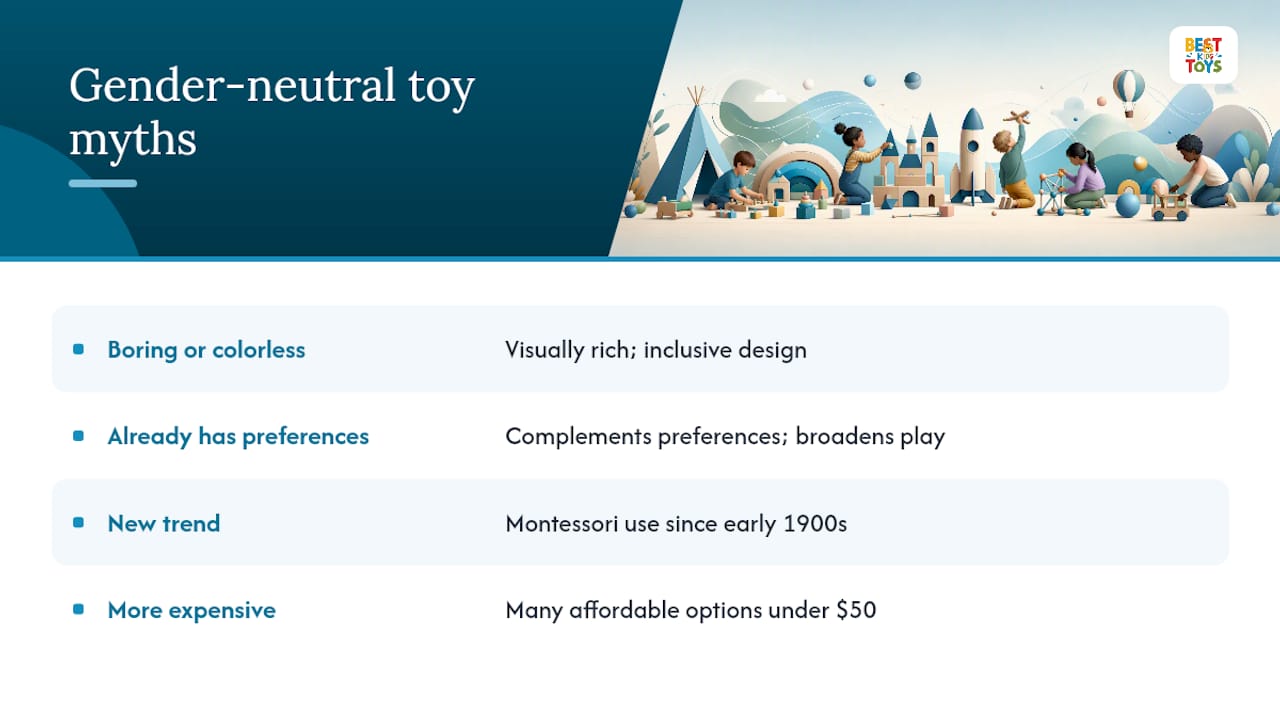
“Gender neutral means boring or colorless.” Not true. The most celebrated inclusive playthings, from wooden building sets to sensory kits, are visually rich and deeply engaging. Neutral doesn’t mean beige; it means the design doesn’t exclude.
“My child already has preferences, so this doesn’t apply.” Preferences are healthy. The goal isn’t to override them but to make sure the full range of play is available. A child who loves dolls can also love building sets; one doesn’t cancel the other.
“This is a new trend with no track record.” Wooden blocks, shape sorters, and pretend-play sets have been staples of early childhood education for decades. Montessori classrooms have used gender-neutral, open-ended materials since the early 1900s. The framing is newer; the toys are not.
“Gender neutral toys are more expensive.” Many of the best options, including unit blocks, simple puzzles, and basic art supplies, are among the most affordable in any toy category. Gift-roundup posts consistently show strong options available under $50.
How major toy brands and market trends are shaping gender neutral options
The market is shifting, and the direction is clear. Design-focused reporting shows brands and designers actively moving away from binary pink/blue marketing toward open-ended, neutral-aesthetic products that emphasize age and skill over gender. Some retailers have dropped separate “boys” and “girls” aisles entirely, replacing them with age-based or play-type sections.
Brands like MOLUK have built their entire product philosophy around open-ended, movement-based toys intentionally designed to be gender-neutral from the ground up. That design-first approach, rather than a retroactive “gender neutral” label, is the standard worth looking for.
The pressure is coming from parents, educators, and child development researchers simultaneously. Retailers who ignore it are losing shelf space to brands that have already made the shift.
How to read packaging and marketing to spot truly inclusive toys
Packaging tells you almost everything you need to know in under 30 seconds. Here’s what to look for:
Green flags on packaging:
- Age range prominently displayed (not gender)
- Descriptions focused on what the child builds, creates, or discovers
- Images showing children of different genders and backgrounds playing with the toy
- Materials and safety certifications listed clearly
Red flags on packaging:
- “For girls” or “for boys” printed anywhere on the box
- Images showing only one gender using the toy
- Descriptions that emphasize appearance (“beautiful,” “handsome”) over function
- A pink or blue version of the same toy sold separately with no functional difference
The most reliable shortcut: if the packaging describes what the child does rather than who the child is, the toy is almost certainly designed with inclusivity in mind.
The case for open-ended play over gendered toys
The strongest argument for gender-inclusive toys isn’t ideological. It’s practical. Open-ended toys last longer, get used more creatively, and adapt to a child’s growing abilities in ways that single-outcome, gender-coded toys simply can’t. A set of wooden blocks is a castle at age three, a bridge at age four, and a math manipulative at age five. A toy marketed exclusively to one gender tends to have a narrower play window and a shorter shelf life.
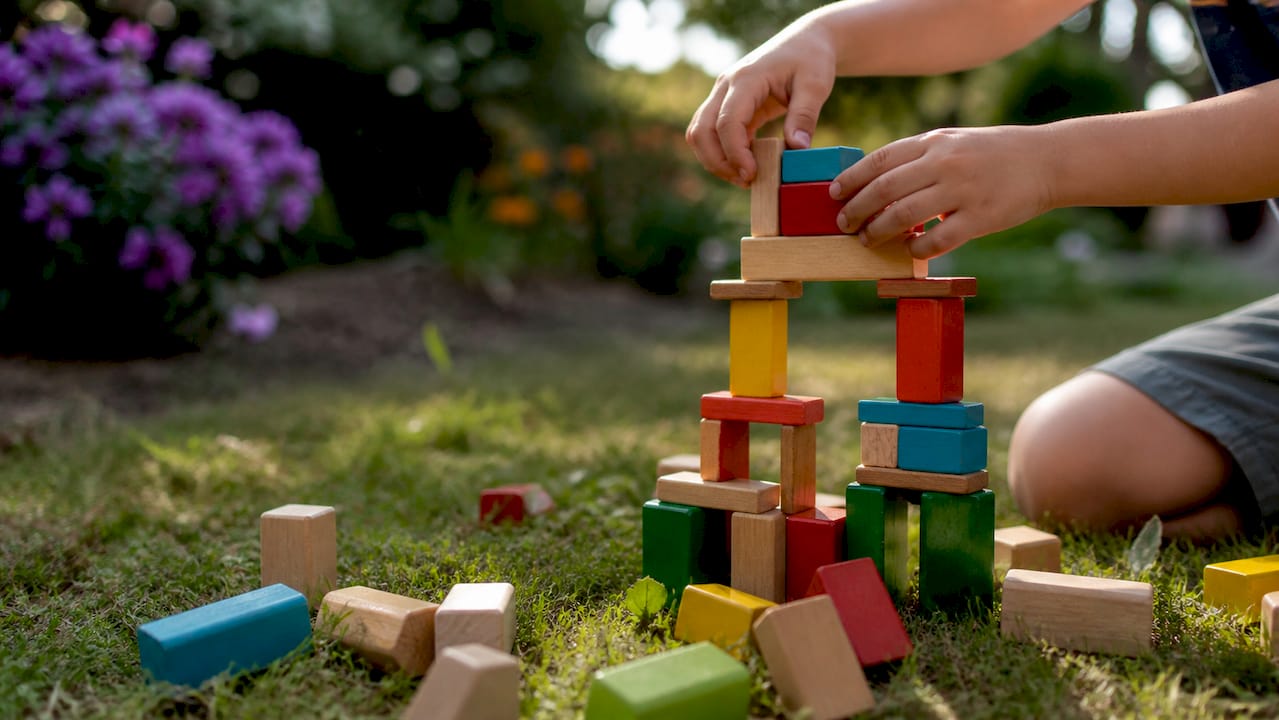
The brands and educators who have understood this longest, from Montessori practitioners to progressive toy designers, have always organized their offerings by developmental stage rather than gender. That framing is now becoming the mainstream standard, and for good reason.
Thebestkidstoys has the gender neutral collection you’re looking for
Thebestkidstoys curates every product with developmental outcomes first and gender labels nowhere. The collection spans Montessori-inspired wooden toys, sensory kits, open-ended building sets, and beginner STEM options, all safety-checked and organized by age so you can find the right fit in minutes.
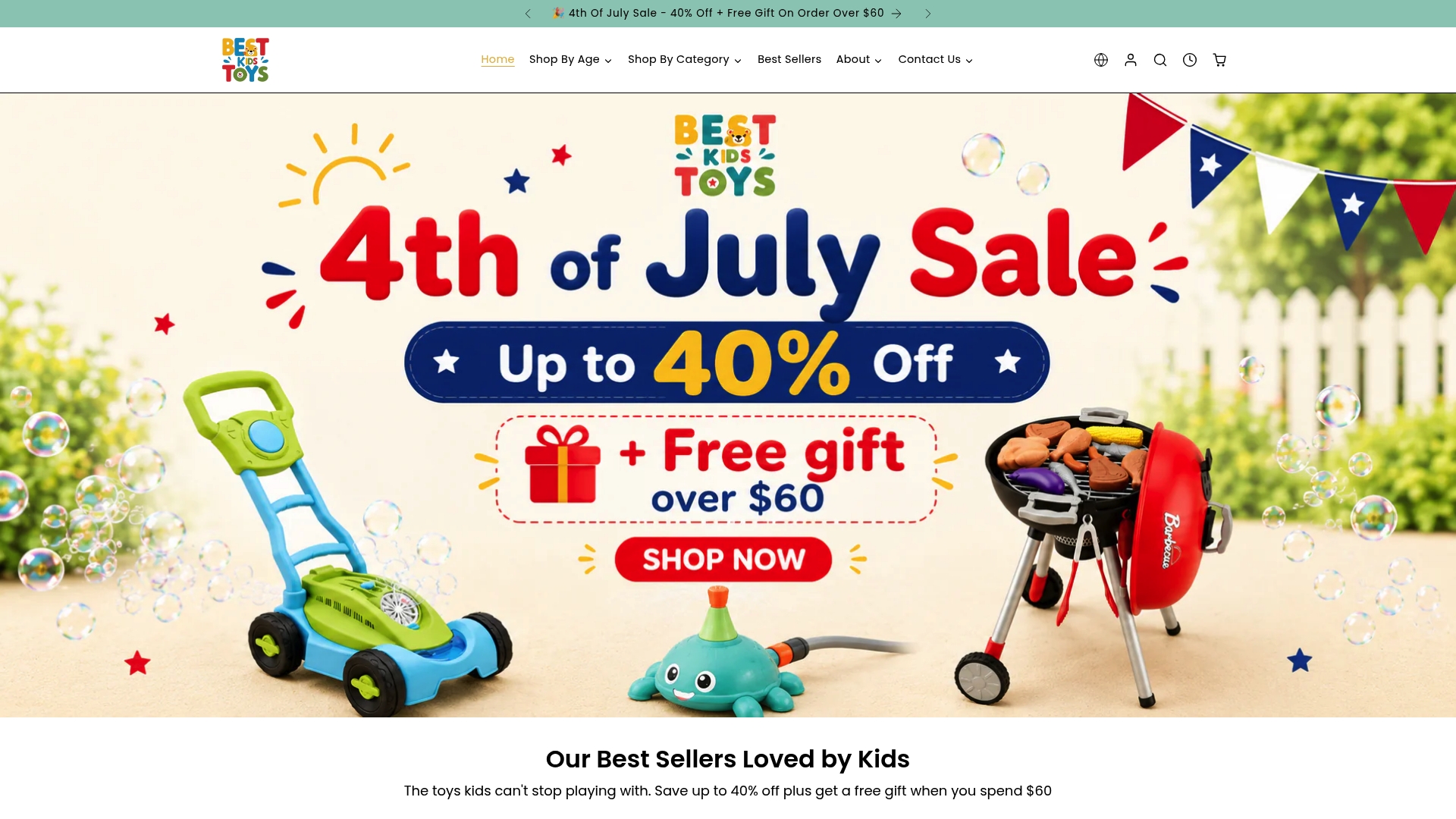
Right now, the site is running up to 40% off select items, with free shipping on orders over $60. Whether you’re buying for a toddler or a ten-year-old, the full curated collection gives you a shortlist of genuinely inclusive, educational picks without the guesswork of sorting through a big-box toy aisle. Browse by age, by play type, or by developmental skill, and find something every child will reach for again and again.
Sources
- Ways kids benefit from gender-neutral toys and activities | Parents
- Gender neutral toys: 6 progressive brands : DesignWanted
- 34 Gender-Neutral Toys for Kids of All Ages | Food52
- MOLUK | Open-Ended Toys That Move and Inspire - Since 2001
- Tender Leaf Toys - Space Voyager Set - 7 Piece Solid Wood Space Vehicle Set with Moving Parts - Boost Imagination and Learn Through Play, Gender-Neutral for Pre-School Boys and Girls - Age 3 + | Amazon
- Gender Neutral Gift Ideas Under $50 — Style with Hannah London
Recommended
- Toys for Girls: Creative Toys for Girls That Encourage Imagination – Best Kids Toys
- Educational Toys For Grandkids – Best Kids Toys
- Exploring the Best Easter Toys for 2026 An Insight into Montessori Options – Best Kids Toys
- Educational Toys: How Educational Toys Turn Playtime Into Lifelong Lea – Best Kids Toys