



Best Busy Boards for Toddlers: Top Picks and Buying Guide
The Montessori Bear Busy Board from Thebestkidstoys is the top pick for Montessori-aligned skill practice at home, and the Little Learners Montessori Busy Book is the best soft option for travel and younger toddlers who still mouth objects. Together, they cover the two most common parent needs: durable home skill-building and safe, portable quiet play.
Here’s a quick shortlist to get you started:
- Montessori Bear Busy Board (Thebestkidstoys): Best for home Montessori play, fine-motor skill isolation, and toddlers past the mouthing stage.
- Little Learners Montessori Busy Book (Thebestkidstoys): Best for travel, tactile-sensitive toddlers, and children who still mouth objects. Washable fabric pages.
- 9-in-1 Busy Cube (Thebestkidstoys): Best for small homes and multi-child households that need rotating tasks in a compact form.
- Foam buckle/zipper travel board: Best for infants and young toddlers who mouth toys. Lightweight, soft, low small-parts risk.
- Felt quiet book: Best for sensory-sensitive children and quiet settings like church or bedtime. Gentle textures, washable.
- Wooden Montessori panel: Best for older toddlers (typically 3+) ready for real metal latches, gears, and laces.
Safety note: The U.S. Consumer Product Safety Commission (CPSC) advises supervising children under 3 with any toy containing small parts or real-world hardware. Match the board’s material to your child’s mouthing behavior first, then to age. A 2-year-old who still mouths objects needs foam or felt, not a wooden board with metal latches, regardless of the box label.
Table of Contents
- How do the best busy boards compare at a glance?
- Top picks: what each board does and who should buy it
- How to choose the right busy board for your toddler
- What materials and safety checks matter before you buy
- Are busy boards Montessori-aligned, and how do you choose one that is?
- Which type of busy board fits your situation?
- What do busy boards cost, and where can you buy them in the U.S.?
- Key Takeaways
- Why skill isolation matters more than activity count
- Thebestkidstoys’ Montessori busy boards, ready for your toddler
- Sources and further reading
How do the best busy boards compare at a glance?
| Product | Best for | Materials | Primary skills | Portability | Durability | Safety notes | Price band | Montessori alignment |
|---|---|---|---|---|---|---|---|---|
| Montessori Bear Busy Board | Home Montessori play, toddlers 2+ past mouthing | Wood | Latches, zipping, fine motor | Low | High | Supervise under 3; no small loose parts | $$ | High |
| Little Learners Montessori Busy Book | Travel, tactile-sensitive, mouthing-stage toddlers | Fabric/felt | Zipping, buttoning, tactile | High | Medium | Washable; low small-parts risk | $ | High |
| 9-in-1 Busy Cube | Small homes, multi-child, rotating tasks | Wood/plastic | Multi-skill rotation | Medium | High | Supervise under 3 | $$ | Medium–High |
| Foam buckle/zipper travel board | Infants, mouthing toddlers, car travel | Foam | Buckling, zipping | Very high | Low–Medium | Mouthing-safe; minimal small parts | $ | Low–Medium |
| Felt quiet book | Sensory-sensitive toddlers, quiet settings | Felt/fabric | Tactile, fine motor, page tasks | High | Medium | Washable; gentle textures | $ | Medium |
| Wooden sensory/skill-builder panel | Older toddlers 3+, long-term skill building | Wood | Latches, gears, laces, clock | Low | Very high | Real hardware; supervise under 3 | $$$–$$$$ | High |
| Simple latch & shape sorter board | Montessori starters, early skill isolation | Wood/plastic | Latches, shape sorting | Medium | Medium | Check for sharp edges | $ | High |
| Customizable busy board | Multi-age households, adaptable play | Wood/mixed | Varies by configuration | Medium | High | Inspect swappable parts regularly | $$–$$$ | High |
| DIY picture flip door busy board | Budget-conscious caregivers, custom play | Mixed/DIY | Opening/closing, recognition | Medium | Low–Medium | Inspect fastenings; use non-toxic materials | $ | Medium |
Top picks: what each board does and who should buy it
Montessori Bear Busy Board (Thebestkidstoys)
This is Thebestkidstoys’ flagship wooden busy board, built around the Montessori principle of skill isolation. Each activity on the board targets one specific dressing task, such as a zipper, a button, or a latch, rather than piling on a dozen unrelated elements. That focused design helps toddlers build real concentration alongside real dressing skills. Best for children who are past the mouthing stage and ready for focused, independent practice at home.
Pros: Durable wood construction; Montessori-aligned skill isolation; curated by Thebestkidstoys for quality. Caution: Not for children who still mouth objects; supervise under 3 with any metal hardware.
Little Learners Montessori Busy Book (Thebestkidstoys)
Soft, washable fabric pages make this the go-to for travel and for toddlers who are still in the mouthing phase. It folds flat into a bag and produces almost no noise, which makes it a parent favorite for restaurants, waiting rooms, and long car rides. The tactile variety across pages keeps sensory-sensitive children engaged without overwhelming them.
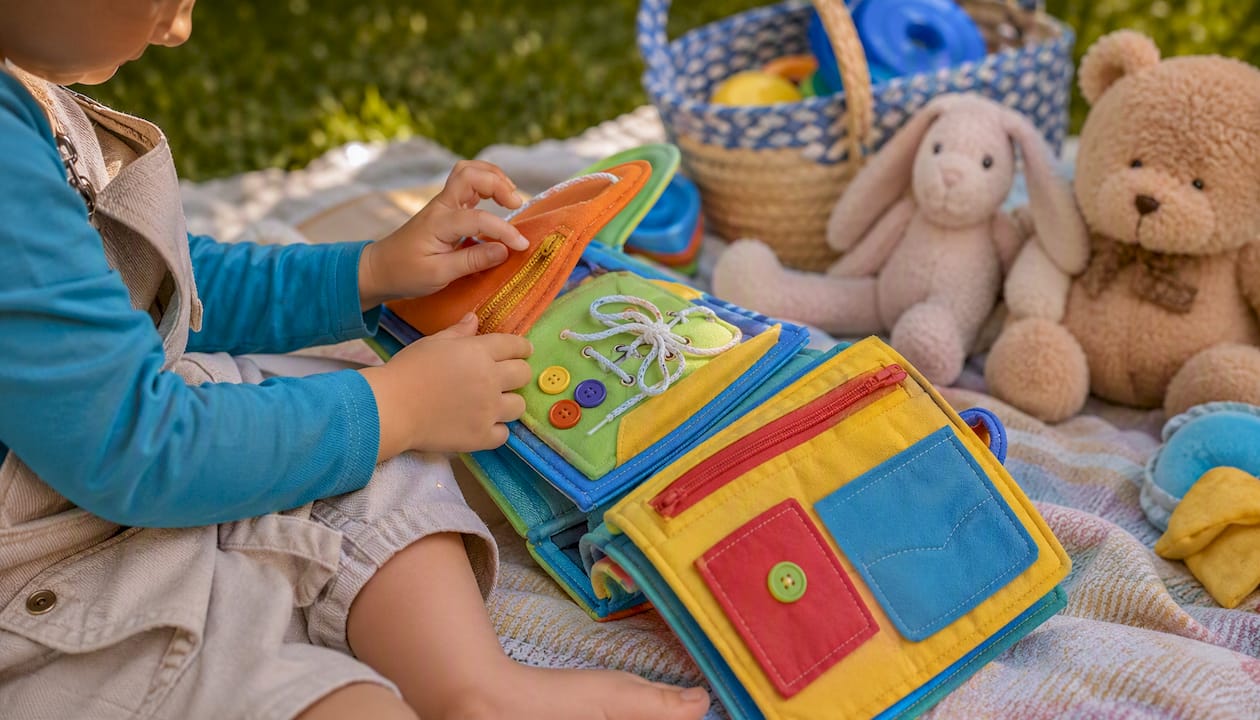
Pros: Washable; compact; mouthing-safer than wooden boards; quiet. Caution: Fabric wears faster than wood with very rough play.
9-in-1 Busy Cube (Thebestkidstoys)
Six faces, nine activity stations, and no loose panels to lose. The cube format is a clever solution for small apartments or daycare settings where floor space is limited. Toddlers rotate the cube themselves, which adds a physical challenge on top of each skill station. Check the 9-in-1 Busy Cube product page for the full activity list.
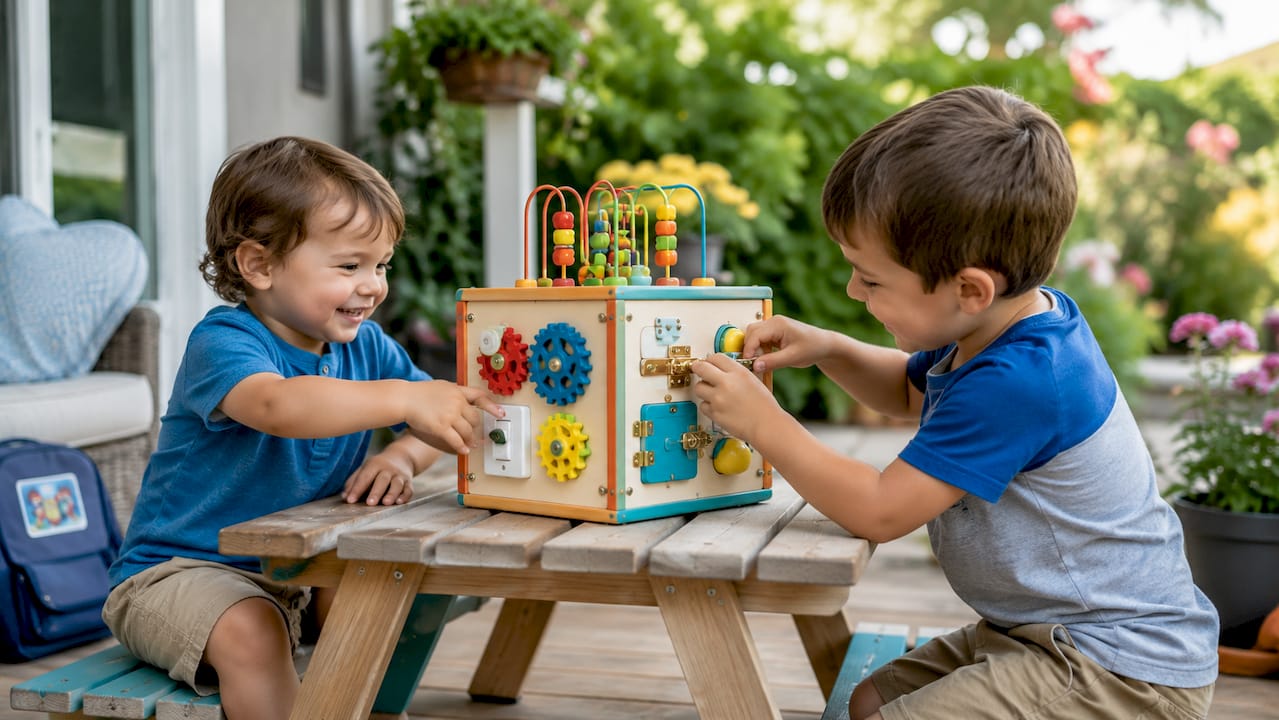
Pros: Space-saving; self-contained; suits multi-child households. Caution: Multiple activities on one toy is less strictly Montessori; best for children who have already practiced individual skills.
Foam buckle/zipper travel board
All-foam buckle boards offer a rare combination of mouthing safety and real dressing-practice motion, making them appropriate for younger toddlers who still put objects in their mouths. The soft construction means no pinching edges, and the light weight makes them easy to clip to a stroller or tuck into a diaper bag. Skill range is narrower than wooden boards, but that is the point at this stage.
Pros: Mouthing-safe; lightweight; great for car travel. Caution: Less durable; fewer skills than wooden boards.
Felt quiet book
For children with sensory sensitivities, felt and fabric quiet books are often a better starting point than heavy wooden panels because textures are gentler and sound is quieter. Sewn-on pieces stay attached better than glued ones, so check the construction before buying. These work beautifully as a screen-free activity for bedtime wind-down or church.
Pros: Quiet; washable; gentle on sensory-sensitive children. Caution: Sewn pieces can loosen over time; inspect regularly.
Wooden sensory/skill-builder panel
Full wooden panels with real metal latches, hinges, gears, and laces are the most educationally rich option, but they come with the highest supervision requirement. Some midrange wooden Montessori boards combine multiple life-skill stations and recommend adult supervision for children under 3 because of small parts and real-world hardware. Many handcrafted versions use birch plywood and include working switches or lights for cause-and-effect feedback. Best for children 3 and up who are ready for a genuine challenge.
Simple latch & shape sorter board
A minimalist starter board that focuses on one or two tasks. Low visual clutter means a toddler’s attention goes straight to the skill, which is exactly what Montessori-style practice calls for. A good first wooden board for children just past the mouthing stage.
Customizable busy board
Parents who want a board that grows with their child will appreciate the modular design. Swap in harder latches as skills improve, or remove elements that are too easy. The best long-term value for multi-age households, though the swappable parts need regular inspection for loose fasteners.
DIY picture flip door busy board
A low-cost project that isolates one skill: opening and closing lids. Tuck family photos underneath each door for a recognition game that adds a personal, joyful layer. Use non-toxic paint and check every fastening before handing it to a toddler.
How to choose the right busy board for your toddler
Before you buy, ask yourself four questions:
- Does my child still mouth toys? If yes, foam or fabric only.
- Which skills do I want to practice? Zipping and buckling suit younger toddlers; latches, gears, and laces suit children 3+.
- Where will we use it? Car and travel need lightweight, compact boards. Home skill-building can handle heavier wooden panels.
- Do I need washable materials? Fabric and felt wash easily; wood does not.
Decision flow
- Assess mouthing behavior and developmental stage. Mouthing = foam or felt. Past mouthing = wood is an option.
- Pick a material type based on where the board will live (home vs. travel) and how rough your child plays.
- Check safety and certifications. Look for ASTM F963 or EN71 labeling on the product page. CPSC guidance recommends supervising children under 3 with any toy containing small parts or real hardware.
- Consider portability and price. Foam and felt boards are lighter and cheaper. Wooden boards cost more but last longer.
Red flags to avoid
- Loose small parts that detach easily
- Unsecured battery compartments (a CPSC safety concern)
- Sharp metal edges with no protective coating
- Missing or vague age guidance on the packaging
- No mention of non-toxic finishes or safety testing
For gifting: Choose a foam or felt board unless you know the child’s exact developmental stage. Wooden boards with real hardware are a better gift for children you know are past the mouthing stage.
For multi-child households: Look for split or removable panels, or a customizable board where you can set different difficulty levels for different ages.
What materials and safety checks matter before you buy
Material trade-offs at a glance
| Material | Weight | Mouthing safety | Longevity | Washability |
|---|---|---|---|---|
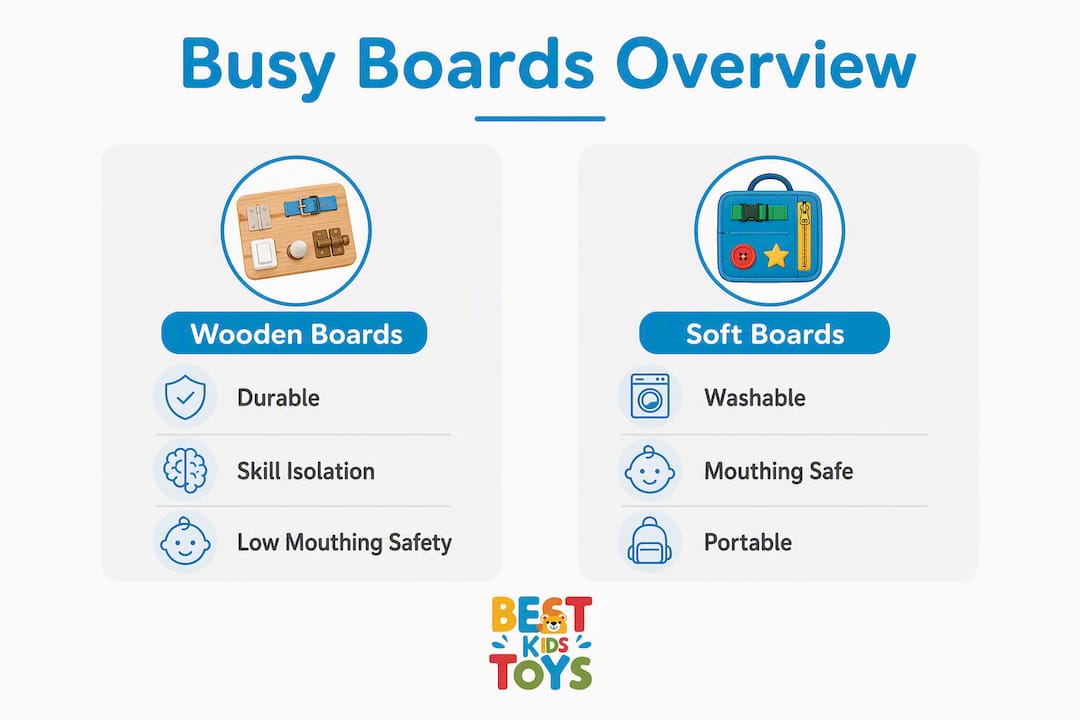
| Wood | Heavy | Low (hard edges) | Very high | Low |
| Foam | Very light | High (soft) | Medium | Medium |
| Felt/fabric | Light | Medium–High | Medium | High |
| Plastic | Light–Medium | Medium | Low–Medium | High |
Wood is the most durable and educationally rich material, but it is the least forgiving for younger toddlers. Foam is the safest for mouthing but wears out faster. Felt sits in the middle: gentle, washable, and quiet, with a lifespan that depends heavily on construction quality.
Safety checklist before every purchase
- Small parts: can any piece detach and become a choking hazard?
- Battery compartments: are they secured with a screw?
- Metal hardware: are edges smooth and coated?
- Finish: does the product page state non-toxic paint or stain?
- Age guidance: does it match your child’s stage, not just their birthday?
- Certifications: look for ASTM F963 or EN71 on the product listing. Some Montessori-branded vendors document safety standards on product pages, including material specs and age guidance.
Pro Tip: If you want to use a wooden board with a toddler who is close to but not fully past the mouthing stage, cover any exposed metal edges with foam tape and replace small padlocks with larger, foam-friendly alternatives. Inspect the board every few weeks for loose screws or splinters.
Real hardware such as metal padlocks and small keys increases educational value but also raises pinching and small-part risks. The CPSC recommends adult supervision for children under 3 with any toy that includes real-world hardware.
Are busy boards Montessori-aligned, and how do you choose one that is?
Busy boards are often Montessori-inspired, but not strictly Montessori. A true Montessori material isolates one skill at a time and uses natural materials sized for a child’s hands. Most commercial busy boards pack many activities onto one surface, which can work against concentration.
A Montessori teacher’s roundup cautions that some busy boards are overstimulating and recommends simpler boards that isolate one or two skills for better focus. That insight shapes how Thebestkidstoys curates its picks.
The Montessori principle that matters most for busy boards: when a child can focus on one task without visual noise pulling their attention elsewhere, they build deeper concentration and transfer that skill to real life faster. A board with twelve activities competing for attention teaches switching, not mastery. Choose boards that let your child finish one thing before moving to the next.
Montessori-friendly checklist
- Isolated tasks: one or two activities per board or per session
- Natural materials: wood, felt, or cotton over bright plastic
- Realistic hardware: real zippers, real buckles, real latches
- Child-sized components: pieces a toddler’s fingers can actually grip
- Open-ended use: no single “correct” outcome that triggers a light or sound
Making a non-Montessori board more Montessori-friendly
Cover unused sections with a cloth during play so your child focuses on one area at a time. Rotate which section is exposed each session. This simple adjustment turns a busy, multi-activity board into a focused skill station without buying anything new. Play-based learning works best when the environment supports concentration, and a little intentional setup goes a long way.
Which type of busy board fits your situation?
Travel and in-car boards
Foam buckle boards and fabric quiet books are the clear winners here. They are light enough to clip to a car seat, produce no noise that distracts drivers, and carry no sharp edges. For longer road trips, a travel-friendly activity that keeps little hands busy without requiring adult help is worth its weight in gold. The Little Learners Montessori Busy Book fits this role perfectly.
Quiet settings (restaurants, waiting rooms, church)
Felt quiet books shine here. No rattling hardware, no battery-powered sounds, and pages that flip quietly. Look for books with sewn rather than glued pieces for durability.
Home skill-building station
A wooden Montessori panel or the Montessori Bear Busy Board is the right call. Set it up at a low table or prop it against a wall at toddler height. Rotate which activities you highlight each week to keep engagement fresh.
Classroom or daycare shared use
Customizable boards with removable panels work well because teachers can adjust difficulty for different children. Washable materials are a practical must in shared settings.
DIY option
A picture flip door board takes about an hour to build. Cut small wooden doors into a painted board, hinge each one, and place a family photo underneath. Use non-toxic paint, sand all edges smooth, and check every hinge screw before play. This isolates one skill (opening and closing) and adds a personal recognition game that toddlers love.
What do busy boards cost, and where can you buy them in the U.S.?
Price breaks down cleanly by material and complexity:
- $10–$30: Foam buckle boards, simple felt quiet books, basic travel boards. Great entry point for younger toddlers or gifting when you’re unsure of the child’s stage.
- $30–$80: Midrange felt books, simple wooden latch boards, and fabric activity books with more pages and tasks.
- $80–$250+: Full wooden Montessori panels, customizable boards with real hardware, and premium handcrafted options. These last years and often become a household fixture.
Thebestkidstoys product pages are the best first stop. The site currently offers up to 40% off select items and free shipping on orders over $60, which makes the midrange and premium wooden boards more accessible. Check the product page for current pricing and availability.
When shopping elsewhere, run this quick retailer checklist:
- Does the listing include ASTM F963 or EN71 safety information?
- Is there a clear return policy if the board arrives damaged?
- Are customer reviews specific about durability after several months of use?
- Does the shipping policy protect fragile wooden items?
Local Montessori toy shops and specialty children’s retailers are worth visiting in person for wooden boards, since you can check edge smoothness and hardware security before buying.
Key Takeaways
The single most important buying rule: match the board’s material to your child’s mouthing behavior first, then to age and skill stage.
| Point | Details |
|---|---|
| Match material to mouthing stage | Foam or felt for mouthing toddlers; wood only when mouthing has stopped. |
| Montessori alignment means fewer activities | Boards that isolate one or two skills build deeper concentration than busy, multi-activity panels. |
| Safety checks are non-negotiable | Look for ASTM F963 or EN71 labeling; supervise children under 3 with any real hardware per CPSC guidance. |
| Price reflects material and longevity | Foam boards run $10–$30; wooden Montessori panels run $80–$250+; choose based on how long you need the board to last. |
| Thebestkidstoys picks lead the shortlist | The Montessori Bear Busy Board and Little Learners Montessori Busy Book cover the two most common parent needs: home skill-building and safe travel play. |
Why skill isolation matters more than activity count
Most parents shopping for a sensory busy board instinctively reach for the one with the most features. More latches, more gears, more colors. It feels like better value. But the boards that actually move the needle on fine-motor development are the ones that let a toddler repeat one action until it clicks, not the ones that scatter attention across many competing tasks.
This is the gap between what looks impressive on a product page and what works in a playroom. A board crammed with activities can entertain a child for twenty minutes. A board that isolates buckling or zipping can build a skill that transfers to getting dressed independently, which is the whole point.
The Montessori Bear Busy Board earns its place at the top of this list not because it has the most features, but because it has the right ones, arranged so a toddler can focus. The Little Learners Montessori Busy Book earns its place because it takes that same principle into a format that works anywhere. Neither board tries to do everything. That restraint is what makes them worth recommending.
Thebestkidstoys’ Montessori busy boards, ready for your toddler
Thebestkidstoys curates every busy board on the site against three criteria: Montessori alignment, construction quality, and age-appropriate safety. The two picks that consistently rise to the top are the Montessori Bear Busy Board for home skill-building and the Little Learners Montessori Busy Book for travel and younger toddlers.
Both are available now with up to 40% off select items and free shipping on orders over $60. The Montessori Bear Busy Board targets fine-motor and dressing skills with isolated, real-hardware tasks on a durable wooden surface. The Little Learners Montessori Busy Book offers washable fabric pages that fold flat into any bag. Visit the Thebestkidstoys product pages to check current pricing, read parent reviews, and confirm the right fit for your child’s stage before you order.
Sources and further reading
- U.S. Consumer Product Safety Commission (CPSC) — authoritative guidance on small parts, battery compartment safety, and supervision recommendations for children’s toys.
- The Montessori Twin Mama: Best Busy Boards for Toddlers and Babies — a Montessori teacher’s roundup covering overstimulation concerns and skill-isolation principles.
- Spectrum Unlocked: Best Busy Boards for Autistic Kids — detailed category-level guidance on foam vs. wooden boards and mouthing safety.
- Mivoody Montessori Wooden Busy Board — example product page showing life-skill station design and supervision guidance for children under 3.
- Baf Space Natural Wooden Busy Board — example of birch plywood construction with working switches and cause-and-effect features.
- Kukoo Montessori All-in-One Wooden Busy Board — example of a product page that documents ASTM/EN71 safety testing and age guidance.
- Thebestkidstoys: Montessori Bear Busy Board — publisher product page; check for current pricing and safety details.
- Thebestkidstoys: Little Learners Montessori Busy Book — publisher product page for the recommended soft/travel option.
- Toddler Learning Toys: How Play-Based Learning Boosts Early Cognitive Growth — internal article on the developmental rationale behind skill-based toys.
This article provides general product and safety information, not professional medical or developmental advice. Confirm age guidance and safety certifications on each product page, and consult a pediatric occupational therapist if you have specific developmental concerns.