



Best Bath Toy Set for Montessori Independent Play
Choose a sealed or open-clean Montessori-style bath toy set that includes pouring cups, stacking pieces, and a mesh storage bag. That combination directly supports fine motor development and cause-and-effect reasoning while staying genuinely low-maintenance. Thebestkidstoys curates exactly this kind of set, reviewed against CPSC safety standards and Montessori developmental principles, so you can skip the guesswork and get straight to the good stuff: bath time that actually builds skills.
Table of Contents
- Why do Montessori bath toys support your child’s development?
- What should you look for in a Montessori-friendly bath toy set?
- Which safety labels should you check before buying?
- How do you clean and store bath toys to prevent mold?
- Montessori bath play activities that build independence
- Why Thebestkidstoys’ Montessori bath toy set stands out
- Where to buy and what to expect to pay
- Key Takeaways
- The part most parents overlook about bath toy selection
- Ready to make bath time count?
- Useful sources and further reading
Why do Montessori bath toys support your child’s development?
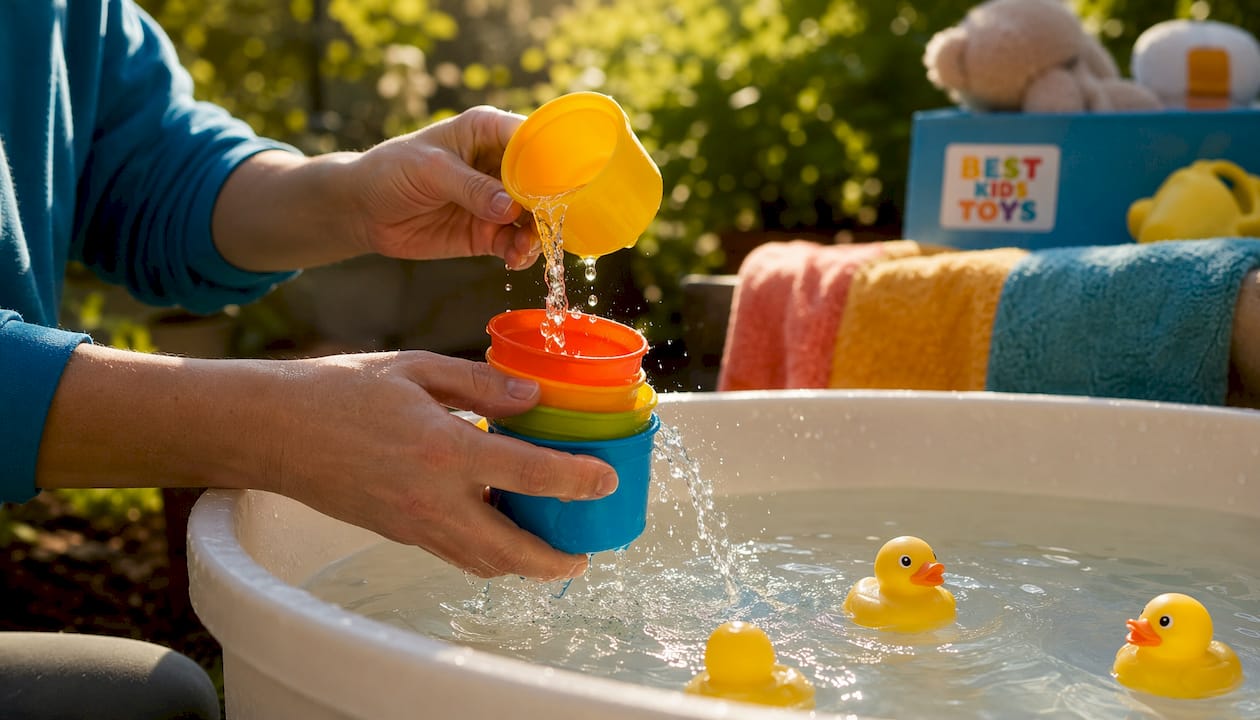
Montessori-style features do something passive floating toys simply cannot: they put your child in charge of the outcome. Pouring water from cup to cup builds grip strength and hand-eye coordination. Stacking and nesting pieces train spatial reasoning as children figure out which size fits where. Water gears and suction tracks let toddlers experiment with cause-and-effect in real time, which is early STEM reasoning in its most tactile form.
Here is how specific activities map to developmental milestones:
- 6–12 months: Reaching and grasping textured, hand-sized toys builds sensory awareness and early grip control.
- 12–24 months: Pouring and stacking cups develop pincer grasp, wrist rotation, and basic sequencing.
- 2–3 years: Operating water wheels and gear sets introduces cause-and-effect logic and early problem-solving.
- 3+ years: Animal figures and imaginative water scenes spark language development and creative storytelling.
Fine motor activities like pouring and stacking are among the most effective ways to strengthen early hand control, and bath time is one of the few daily routines where children are naturally motivated to repeat them. That repetition is exactly what Montessori learning depends on.
What should you look for in a Montessori-friendly bath toy set?
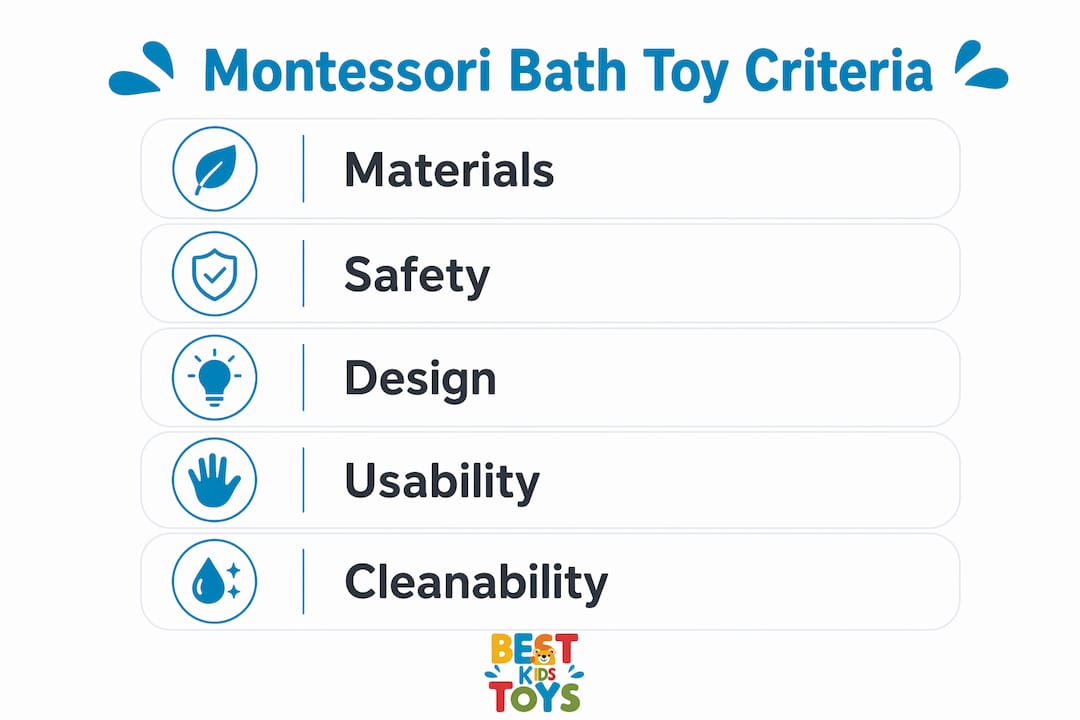
The six criteria below give you a fast, reliable framework for evaluating any set before you buy.
| Criterion | Why it matters | What to check on the product page |
|---|---|---|
| Materials and safety labels | Prevents chemical exposure | “BPA-free,” “phthalate-free,” food-grade dyes |
| Sealed or open-clean design | Reduces mold risk | No internal cavities; or pieces that unscrew for drying |
| Easy cleaning | Saves time and extends toy life | Dishwasher-safe (top rack) or mild-soap washable |
| Size and age safety | Prevents choking hazards | Age recommendation ≥ 6 months; no small detachable parts for under-3s |
| Multifunctional play | Maximizes developmental value | Includes pouring cups, stacking pieces, or gear/wheel elements |
| Storage solution | Keeps toys dry between baths | Mesh bag with suction cups included |
A common trade-off worth knowing: multi-part gear sets deliver richer STEM play, but they require a more committed cleaning routine. Stacking cups and nesting boats are the lower-maintenance alternative that still teaches pouring and spatial skills effectively.
Pro Tip: To verify sealed construction from a product photo, look for a smooth, unbroken seam around the toy’s base. If the listing shows a hole, a plug, or a squeezable body, water will get inside. Descriptions that say “open for rinsing” or “unscrew to dry” are the next-best option.
Which safety labels should you check before buying?
Start with three non-negotiables: CPSIA compliance, ASTM toy safety references, and explicit “BPA-free / phthalate-free” language. Here is what each one means in practice:
- CPSIA compliance: The Consumer Product Safety Improvement Act sets lead and phthalate limits for children’s products sold in the United States. A compliant product will state this on the packaging or listing.
- ASTM F963: The standard toy safety specification covering mechanical hazards, small parts, and material requirements. Look for it on the box or in the product description.
- CPSC recall check: Before buying any set, run the product name through the CPSC recall database to confirm it has no open safety notices.
- BPA-free / phthalate-free: These phrases confirm the plastic does not contain hormone-disrupting chemicals. They should appear explicitly, not just implied.
Red flags to avoid: small detachable parts on sets labeled for under-3s, vague “non-toxic” claims with no specific standard cited, and non-food-grade dyes that bleed color in warm water.
Mold warning: Wirecutter testing found that hollow toys with small holes are a frequent source of hidden mold. Squeezing water out after bath time is rarely enough to prevent bacterial buildup inside the cavity. Sealed designs or toys that fully open for drying are the only reliable long-term solution.
How do you clean and store bath toys to prevent mold?
Open-design or fully sealed toys reduce mold risk more effectively than any cleaning routine alone. That said, a consistent care habit keeps even the best-designed set safe and long-lasting.
After every bath, rinse toys under clean water and shake out any pooled water. For a weekly clean, wash with warm water and mild soap or run dishwasher-safe pieces on the top rack. Once a month, a brief vinegar soak helps prevent mildew on pieces that contact standing water regularly. The step most parents skip: full air-drying before storage. Storing damp toys in a closed bin is what turns a minor moisture issue into a mold problem.
| Toy type | Recommended cleaning method | Storage tip |
|---|---|---|
| Sealed (no holes) | Mild soap + rinse; top-rack dishwasher if labeled safe | Mesh bag hung to air-dry |
| Open-design (unscrew/open) | Open fully, rinse interior, air-dry completely | Store open or in mesh bag |
| Hollow squirters (holes) | Replace; cleaning is rarely sufficient long-term | Not recommended for ongoing use |
Hang the mesh bag on a suction hook above the tub after every bath. That single habit, combined with good toy storage practices, does more to prevent mold than any cleaning product. Discard any toy that shows persistent slime, a musty smell, or visible black spots inside, because those are signs bacterial growth is already established.
Montessori bath play activities that build independence
Short, repeatable activities are the heart of Montessori bath time. You set up the invitation; your child leads the play.
Pouring practice is the simplest starting point. Place two or three cups of different sizes in the tub and let your child transfer water back and forth. This trains grip strength, wrist control, and early volume concepts. For babies under 18 months, start with one large cup and one small one.
Stacking and nesting works beautifully with graduated cups. Children figure out the size sequence independently, which builds spatial reasoning and patience. Older toddlers can try stacking while the cups are partially filled, adding a balance challenge.
Water wheel experiments let children discover that their actions have predictable effects: pour water here, the wheel spins there. That loop of action and result is cause-and-effect learning at its most satisfying. STEM-inspired gear sets extend this by letting children connect pieces and redirect water flow.
Sorting by color or animal type suits children 2 and up. Place a few floating figures in the tub and invite your child to sort them into cups by color or type. This builds early classification skills and vocabulary.
Imaginative water scenes with animal figures encourage storytelling and language development. A simple prompt card near the tub (“Who lives in the ocean? Who lives on land?”) is enough to spark independent play without adult direction.
Why Thebestkidstoys’ Montessori bath toy set stands out
Thebestkidstoys’ Montessori-style bath toy set is built around the exact checklist above. Here is how it maps:
- Materials: BPA-free, phthalate-free construction with food-safe dyes, meeting CPSIA requirements.
- Design: Open-clean or sealed components with no hidden cavities, so mold has nowhere to hide.
- Play value: Includes pouring cups, stacking pieces, and interactive water elements that cover the 6-month to 3-year developmental range.
- Storage: A mesh bag with suction hooks is included, so the drying routine is built into the set from day one.
- Age range: Suitable from 6 months through early preschool, matching the developmental milestones covered earlier.
Thebestkidstoys reviews every product for safety compliance and long-term play value before it joins the collection. Current promotions include discounts on select sets and free shipping on orders above a certain amount, making it easy to pick up a full set without stretching the budget.
Where to buy and what to expect to pay
The Thebestkidstoys online store is the most direct place to buy a curated Montessori-style water play set, with the added benefit of the brand’s safety-review process already done for you. Major online retailers carry comparable sets for price comparison, and specialty Montessori toy shops are worth browsing if you want a narrower, philosophy-focused selection.
Price-wise, entry-level stacking cup sets typically run at lower cost levels. Mid-range sets with gears, animal figures, and a mesh bag are moderately priced. Premium multi-piece STEM sets with suction tracks tend to be the most expensive. The price difference usually reflects the number of pieces, the complexity of interactive elements, and whether a storage solution is included.
Quick buying tips: check product photos for smooth, unbroken seams or visible unscrew points; read the cleaning notes in the product description; confirm a mesh bag or suction storage hook is included; and verify the age recommendation matches your child’s current developmental stage.
Key Takeaways
A Montessori-style bath toy set with sealed or open-clean design, pouring and stacking elements, and a mesh storage bag gives your child the best combination of developmental value and low-maintenance care.
| Point | Details |
|---|---|
| Choose sealed or open-clean designs | Hollow toys with holes trap water and grow mold; sealed or unscrewable pieces are safer long-term. |
| Check three safety labels | Look for CPSIA compliance, ASTM F963 reference, and explicit BPA-free/phthalate-free language before buying. |
| Hang the mesh bag after every bath | Air-drying in a hung mesh bag is the single most effective habit for preventing mold between uses. |
| Start with pouring and stacking tonight | Two cups of different sizes in the tub is all you need to begin Montessori-style independent play. |
| Thebestkidstoys curates the shortlist | Their Montessori bath sets meet the full buying checklist and are reviewed for safety and developmental value. |
The part most parents overlook about bath toy selection
There is a tendency to evaluate bath toys the same way you evaluate any toy: does my child like it? That question matters, but it misses the more important one: does this toy give my child something to figure out on their own?
The Montessori principle that gets lost in most bath toy marketing is repetition with variation. A child who pours water from a large cup to a small one, then back again, then tries it with a medium cup, is not just playing. They are running a self-directed experiment, refining their grip, and building an intuitive sense of volume. That process only works if the toy is simple enough to be operated independently and open-ended enough to invite variation.
Most sets fail on the second count. They include too many prescribed functions and not enough open-ended pieces. The best bath toy sets are the ones that disappear into the background and let the child’s curiosity do the work. That is why the checklist in this article weights open-ended play elements (pouring cups, stacking pieces, water wheels) over novelty features. Novelty fades in a week. Open-ended play grows with the child.
Ready to make bath time count?
Thebestkidstoys takes the stress out of finding a bath toy set that actually delivers on its developmental promises. Every set in the collection has been reviewed for safety compliance, Montessori alignment, and real play value, so you are not sorting through hundreds of options hoping for the best.
Right now, select sets are up to 40% off, and orders over $60 ship free. If your little one is between 0 and 12 months, the infant development toy collection is a great place to start. Browse the full Montessori bath selection at Thebestkidstoys and find the set that fits your child’s stage today.
Useful sources and further reading
- Wirecutter: The Best Bath Toys — Independent testing with a strong focus on mold risk and maintenance; the most thorough evaluation of sealed vs. hollow designs available.
- BabyGearLab: The Best Bath Toy — Hands-on testing of STEM-inspired and classic sets; useful for comparing gear-based toys and stacking cups side by side.
- WebMD: How to Clean Bathtub Toys — Practical, medically reviewed guidance on dishwasher safety, vinegar soaks, and air-dry storage routines.
- Jool Baby: Bathtime Adventure Gift Set — Product page illustrating how mesh bags with suction cups are integrated into a complete bath set.
- Itzy Ritzy: Best Bath Toys for Maximum Learning — Overview of developmental benefits tied to specific bath toy components, including stacking cups and floating figures.
- CPSC Recalls Database — The primary source for checking whether a specific toy has an open safety notice before purchasing.