



Abacus 1 to 10: A Step-by-Step Lesson for Kids
On a standard beginner abacus, you show numbers 1–10 in the ones column by raising lower beads (1–4), lowering the single top bead for 5, combining the top bead plus lower beads for 6–9, and then carrying to the tens column to make 10. That’s the whole system, and once a child feels it in their fingers, the numbers click in a way no worksheet can replicate.
Here’s how to get started right now:
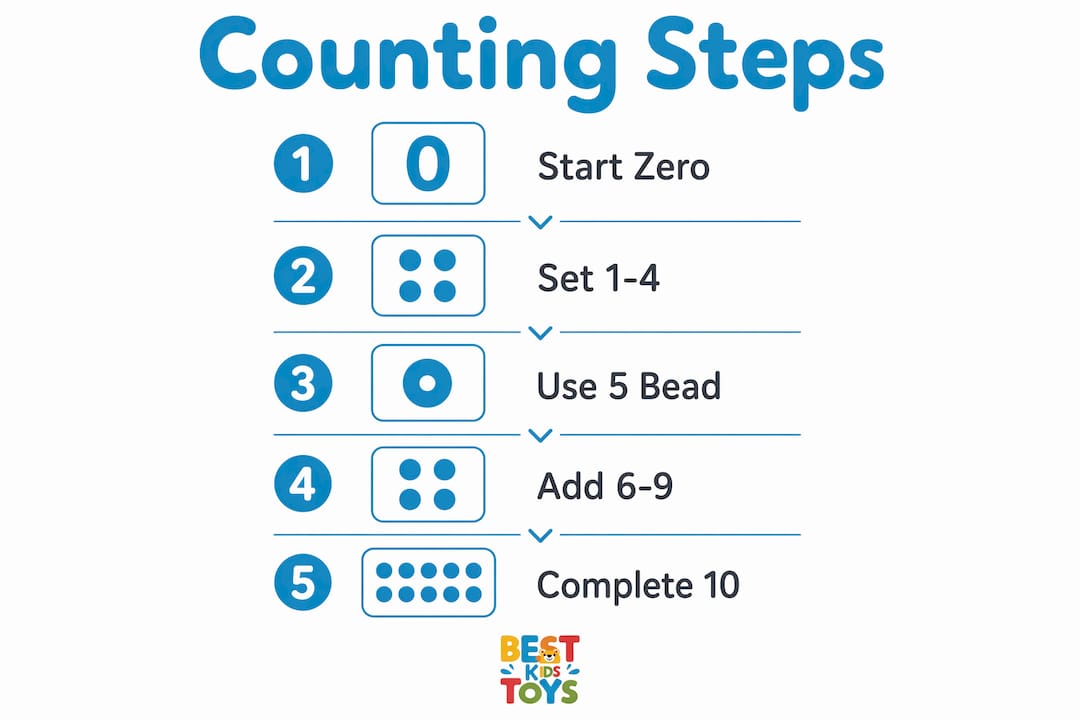
- Zero first. Push all lower beads away from the center beam, and push the top bead away from the beam too. The abacus is now at zero and ready to go.
- Count 1–4. Push one lower bead up toward the beam for 1, two for 2, and so on up to 4.
- Make 5. Push the top bead down toward the beam and push all four lower beads back down. That single top bead equals 5.
- Count 6–9. Keep the top bead down (5) and push lower beads up again: one lower bead for 6, two for 7, three for 8, four for 9.
- Make 10. Clear the ones column back to zero, then push one lower bead up in the tens column (the column just to the left).
ONES COLUMN — three snapshots:

  Zero        Five        Seven
  [ o ]       [ • ]       [ • ]   ← top bead (= 5)
  -----       -----       -----
  [ o ]       [ o ]       [ • ]   ← lower beads
  [ o ]       [ o ]       [ • ]     (• = touching beam)
  [ o ]       [ o ]       [ o ]
  [ o ]       [ o ]       [ o ]
Pro Tip: Let your child move every bead themselves. Thumbs and index fingers on the beads, not just watching you do it. That tactile contact is what builds the memory.
Table of Contents
- What do the beads and columns actually mean?
- How to set every number from 1 through 10 on the abacus
- A 5-minute daily lesson plan and three quick practice games
- Common mistakes, how long it takes, and what abacus to buy
- Abacus vs. structured programs: which works better for beginners?
- How to reinforce number recognition and count beyond 10
- Key Takeaways
- Why tactile counting matters more than most people realize
- The Best Kids Toys Montessori abacus is a great place to start
What do the beads and columns actually mean?
The most common beginner abacus follows a Soroban-style layout: one bead above the center beam and four beads below it in each column. The top bead is often called the “heaven” bead and equals 5. Each of the four lower “earth” beads equals 1. So the maximum value in any single column is 9 (5 + 4).
Columns represent place value, reading right to left. The rightmost column is the ones place (values 1–9). The column immediately to its left is the tens place. That’s why making 10 means the ones column goes back to zero and one bead moves in the tens column.
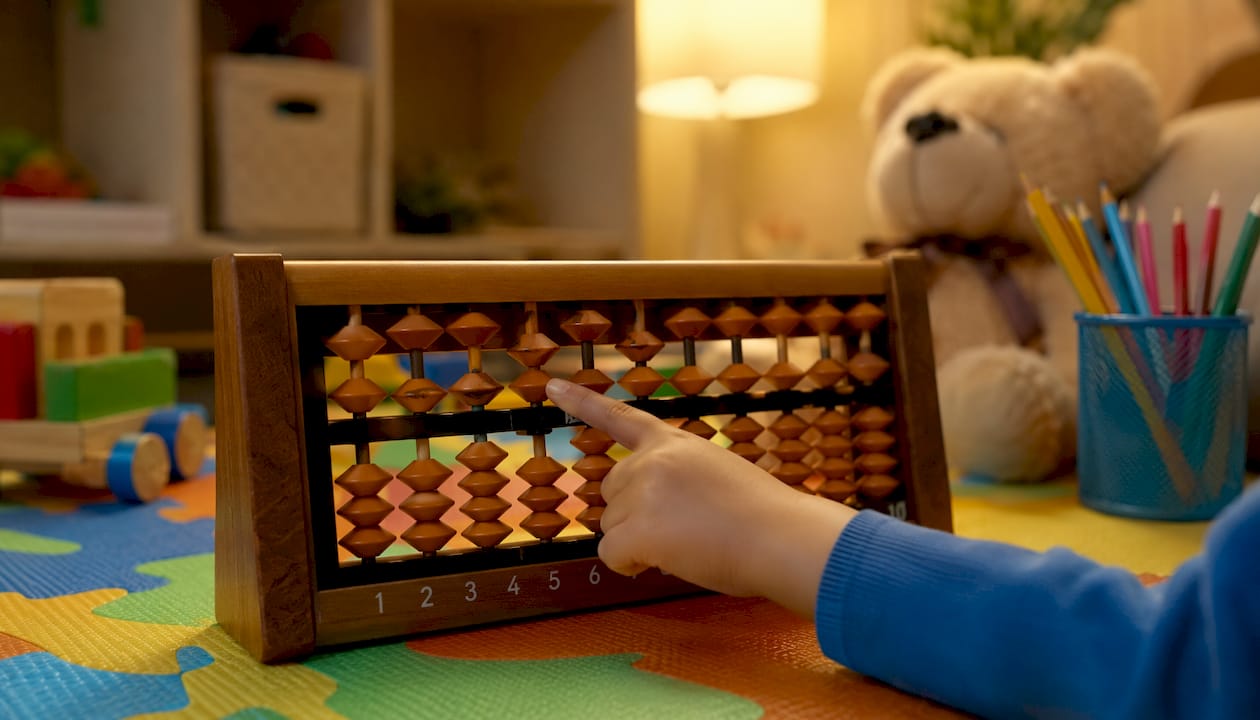
Orienting to zero before every session is a small habit that prevents big confusion. If leftover beads from a previous session are still touching the beam, the child starts counting from a mystery number. A quick “let’s clear the board” reset takes five seconds and sets the stage for a clean, confident lesson.
Pro Tip: Try saying this to your child: “The top bead is the big one — it’s worth five all by itself. The bottom beads are the little ones — each one is worth just one.” Simple, memorable, and true.
How to set every number from 1 through 10 on the abacus
Numbers 1–4 use lower beads, 5 uses the top bead, 6–9 combine the top bead with lower beads, and 10 requires a carry. Walk through each one with your child, letting them move the beads at every step.
- 1 — Push one lower bead up to the beam. Say: “One little bead, one big number.”
- 2 — Push two lower beads up. “Two beads, two fingers — count them together.”
- 3 — Three lower beads up. Tap each bead as you count aloud.
- 4 — All four lower beads up. “That’s as high as the bottom beads go!”
- 5 — Push all four lower beads back down, then push the top bead down to the beam. “One big bead does the work of five little ones.”
- 6 — Top bead stays down (5), push one lower bead up. “Five plus one more equals six.”
- 7 — Top bead down, two lower beads up. “Five plus two — can you count them?”
- 8 — Top bead down, three lower beads up. “Getting close to nine!”
- 9 — Top bead down, all four lower beads up. “The ones column is completely full.”
- 10 — Clear the ones column to zero (top bead up, all lower beads down), then push one lower bead up in the tens column. Do this together: right hand clears the ones column while the left hand moves the tens bead. Say: “We filled up the ones column, so we carry one over to the tens.”
That left-hand/right-hand coordination for 10 is a genuine motor-skill moment. It’s also the first time a child physically feels what place value means, which is far more powerful than seeing it on paper.
A 5-minute daily lesson plan and three quick practice games
A short, consistent daily session beats a long weekly one every time. Here’s a micro-lesson you can run in about five minutes.
The 5-minute micro-lesson:
- Orient to zero (30–60 seconds). Start every session the same way. Child clears the abacus, you confirm it’s at zero together.
- Demo 1–5 (about 90 seconds). You set each number, child names it. Then swap: child sets it, you name it.
- Demo 6–9 as “5 plus ones” (about 60 seconds). Emphasize the pattern out loud: “Top bead plus how many more?”
- Practice the carry to 10 (30 seconds). Do it together, narrating each hand’s job.
- Quick check (30 seconds). Call out any number from 1–10 at random. Child sets it. Celebrate every correct answer.
Three low-prep games to keep it fresh:
Find It on the Abacus. Grab a small bowl of cereal or coins. Count out a handful together, then have the child set that number on the abacus. Counting real objects and then representing them on the abacus links the bead to a real quantity, which deepens understanding.
Beat the Clock. Set a gentle timer for 30 seconds. Call out numbers 1–10 in random order and see how many the child can set correctly before the timer goes off. Keep the energy light and playful — the goal is speed of recognition, not pressure.
Teacher Says. The child becomes the teacher. They set a number on the abacus and you have to guess it. Kids love being in charge, and explaining their own reasoning out loud is one of the strongest ways to lock in a concept.
Pro Tip: Encourage your child to use their fingers to physically push each bead rather than nudging the whole row. That deliberate, finger-by-finger movement builds stronger number memory than a quick swipe.
Pair these sessions with a kids activity planning guide to build a weekly rhythm that keeps learning playful and low-stress.
Common mistakes, how long it takes, and what abacus to buy
The mistakes parents see most often
- Skipping the zero reset. Leftover beads from a previous session silently corrupt the count. Fix: make “clear the board” a ritual, not an afterthought.
- Confusing top and bottom beads. Children sometimes push the top bead up to mean 5 instead of down. Reinforce the direction: top bead comes down to the beam to be active.
- Frustration at the carry to 10. This is the hardest moment in early abacus learning. Slow down, narrate both hands separately, and frame it as a milestone. Educators describe the carry-to-tens as the “aha” moment when place value truly clicks — patience here pays off enormously.
Realistic learning timeline
With 5–10 minutes of daily practice, most children ages 4–6 can recognize and set numbers 1–5 within the first week or two. Confident, independent setting of 1–10 (including the carry) typically takes 3–6 weeks. Ages 4–5 are a natural starting point for abacus identification and counting to 10, with expanded operations coming at ages 5–6.
Which abacus to buy: age, type, and price
| Abacus Type | Best For | Typical Price Range |
|---|---|---|
| Wooden Montessori abacus (10 beads per row) | Ages 2–5, early counting | Low ($10–$) |
| Child-sized Soroban (1 top / 4 bottom beads) | Ages 4–7, place value intro | Medium ($20–$) |
| Cranmer abacus (solid backing, tactile markers) | Visually impaired learners, all ages | Medium–High ($30–$60+) |
Safety matters as much as bead configuration. Look for smooth, rounded edges, beads that are firmly attached to the rod (no small detachable parts), and a sturdy frame that won’t tip during enthusiastic bead-pushing. A fine motor learning toy alongside the abacus can also help younger children build the finger dexterity they need to move beads with precision.
Abacus vs. structured programs: which works better for beginners?
The abacus and structured programs like Kumon serve genuinely different goals, and the best choice depends on what you want your child to get out of math practice right now.
The abacus builds conceptual grounding and visualization; a child who can physically set 7 as “top bead plus two” understands place value in their hands, not just their head. Structured programs like Kumon focus on paced repetition and worksheet-based speed practice, which is valuable once the concepts are solid.
For ages 3–7, abacus-first is the stronger starting point. The tactile, self-directed nature of bead counting aligns naturally with how young children learn. Once a child can set 1–10 confidently and understands the carry, adding a structured program for speed and extended practice makes a lot of sense. The simplest combination: a short daily abacus session (5 minutes) plus optional worksheet practice two or three times a week, keeping total math time under 15 minutes for young learners.
How to reinforce number recognition and count beyond 10
Once your child can set 1–10 with confidence, the abacus opens up naturally to bigger numbers. The key is showing that the same pattern repeats: ones column fills up, carry to tens, tens column fills up, carry to hundreds.
Start by counting familiar objects together — coins, snack pieces, or small toys — and representing each total on the abacus. This links bead movement to real quantities and keeps the learning grounded in something tangible. A Montessori counting game alongside the abacus gives children another tactile way to practice one-to-one correspondence while keeping the session playful.
For numbers 11–19, show how the tens column holds one bead (worth 10) while the ones column counts up again from 1. Eleven is one tens bead plus one ones bead. Twelve is one tens bead plus two ones beads. Letting the child discover this pattern themselves, rather than being told, is where the real learning happens. You can also explore a children’s activity checklist for low-prep ideas that pair naturally with abacus counting sessions.
Pair abacus counting with other number-concept toys to reinforce recognition from multiple angles. The more ways a child encounters a number, the more securely it settles in.
Key Takeaways
Teaching abacus numbers 1 to 10 works best when you start from zero every session, use the “5 plus ones” pattern for 6–9, and treat the carry to 10 as a milestone worth celebrating.
| Point | Details |
|---|---|
| Setting 1–4 | Push one to four lower beads up toward the center beam in the ones column. |
| Making 5 | Push all lower beads down and bring the single top bead down to the beam. |
| Setting 6–9 | Keep the top bead down (5) and add one to four lower beads for the remaining ones. |
| Making 10 (carry) | Clear the ones column to zero, then push one lower bead up in the tens column. |
| Daily habit | Five minutes of practice daily helps build confident 1–10 recognition typically within several weeks. |
| Recommended abacus | Thebestkidstoys’s Montessori abacus is a safety-reviewed, screen-free option for ages 2–7. |
Why tactile counting matters more than most people realize
There’s a tendency in early math education to rush toward flashcards and apps because they feel efficient. But for children under 7, efficiency isn’t the goal — embodiment is. When a child pushes a bead and feels it click into place, their brain registers that number differently than when they see it on a screen. The movement is the learning.
What I find most compelling about the abacus is that it makes place value physical. The carry to 10 isn’t an abstract rule; it’s something a child does with both hands at once. That kinesthetic experience tends to stick in a way that worksheets simply don’t replicate. Montessori education has understood this for over a century: hands-on materials aren’t a supplement to learning, they are the learning at this age.
The practical takeaway for parents: don’t worry about speed or perfection in the early weeks. A child who happily picks up the abacus and moves beads around for five minutes a day is building something real. Keep sessions short, keep them joyful, and let curiosity lead. The numbers will follow.
The Best Kids Toys Montessori abacus is a great place to start
You’ve got the lesson plan, the bead positions, and the games. Now you need a well-made abacus your child will actually want to pick up. Thebestkidstoys carries a Montessori-style activity set that’s been reviewed for safety, built for small hands, and designed to make screen-free counting genuinely fun.

Every product at Thebestkidstoys is selected with child development principles in mind: smooth edges, sturdy construction, no small detachable parts, and a design that invites independent exploration. Free shipping is available on orders over $60, and current promotions make it easy to build a full Montessori counting kit without stretching the budget. Head to Thebestkidstoys to browse the full selection and find the right abacus for your child’s age and learning stage.
Recommended
- 9-in-1 Busy Cube for Toddlers – Montessori Sensory Activity Toy for Ag – Best Kids Toys
- The Ultimate Checklist for Montessori Easter Toys for Curious Minds – Best Kids Toys
- FingerCount Learning Box – Montessori Math & Counting Game – Best Kids Toys
- Numberblocks Toys: How Numberblocks Toys Make Math Fun Through Play – Best Kids Toys